Categories
Manga Reviews REVIEWS Uncategorized

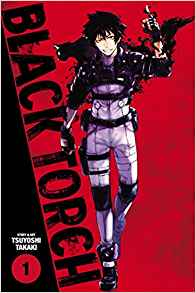
Black Torch, Vol 1

Black Torch, Vol 1 by Tsuyoshi Takaki

I was surveying my stacks of manga and decided that I needed to make more of an effort to get into the Halloween spirit. I figured that Black Torch was an ideal candidate since it features supernatural beings and a black cat, who is also a supernatural being. Spooky!

Jiro is the plucky protagonist of this manga, who has some unique abilities. He has the ability to talk to animals and is descended from a long line of ninjas. He also has absolutely no tolerance for animal cruelty, as the opening scene in the manga shows him driving of a gang that was bugging a stray cat and raven. Jiro’s Grandfather seems to mainly enjoy yelling at his grandson about ninja traditions. Jiro finds out about a cat in distress and goes to rescue it. He finds Rago, a demon (or mononoke) trapped in the form of a black cat. Jiro learns that Rago was caught up in a demonic struggle, and doesn’t remember all the details of his past. Jiro is determined to help Rago, even though the demon attempts to leave Jiro, he is relentless in his desire to help. This is one of the more endearing aspects of Black Torch, even though Jiro ends up getting trapped in a deadly mononoke battle. Rago and Jiro end up being fused together, as Rago goes to help his reckless ninja friend. There are elements that are somewhat predictable in most shonen manga, like a supernatural protection agency and the hints that Rago and Jiro will soon join a team fighting evil.
Black Torch 1

The art in Black Torch has a slightly scratchy quality that I enjoyed. Rago’s surprised cat faces were hilarious, and when his mystical powers manifest in the form of swirling black tendrils surrounding his cat form, the effect is suitably dramatic and mystical. The action scenes are dynamic. While Black Torch doesn’t stray far from the typical shonen manga formula, Jiro’s devotion to animals, the odd couple relationship between him and Rago, and Rago’s hilarious cat expressions go pretty far in making it an enjoyable supernatural action manga.
Categories
Manga Reviews REVIEWS

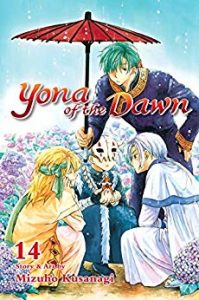
Yona of the Dawn, Vol. 14

Yona of the Dawn Volume 14 by Mizuho Kusanagi

I always put down each volume of Yona of the Dawn feeling like Kusanagi has just served up a master class in plot and character development, but I felt that way even more in this volume, which shows Yona traveling to visit the Water Tribe and confronting some very serious issues along the way. As soon as they arrive on Water Tribe land, Jaeha takes the opportunity to invite Hak along to visit the Red Light District, because the women of the Water Tribe are legendary for their beauty. Yona’s cloaked reactions as this conversation unfolds underscores how much she cares. Hak turns Jaeha down, and Jaeha heads out to explore the city solo, sensing that something is very wrong with the town. He meets up with a couple ladies, who burn some suspicious incense and offer him some of the special local rice wine. Jaeha goes along with everything, as he suspects that someone is watching both him and the girls.

Yona of the Dawn 14

Yona and her crew rescue Jaeha and go out to investigate, learning that the Kai empire is flooding the town with a drug called Nadai. Yona is determined to stay and fight the drug traffickers, even though Jaeha urges her to leave. The leadership and confidence Yona has developed over the course of 14 volumes has me confident that she’ll leave the Water Tribe lands in a better state than when she arrived. Yona’s group also attracts the attention of some local dignitaries, Ladi Riri and her two companions Ayura and Tetra. Riri first thinks that Yona is suspicious, but eventually realizes that the groups have similar goals. Seeing Riri’s assessment of Yona shifting as she learns more about her just serves to underscore Yona’s strength. There’s time for a little bit of situational comedy as Riri is horrified that Yona routinely sleeps outside, surrounded by men.

After some army battles in the last volume, there’s a return to close action sequences featuring Yona’s determination as well as the unique abilities of her protectors. This volume ends on a cliffhanger, but I’m very curious to see how Yona and her companions change and grow after being challenged by the situation in the Water Tribe kingdom. I’m also happy to see Yona getting some more female friends as she continues her travels.

Categories
Manga Reviews REVIEWS

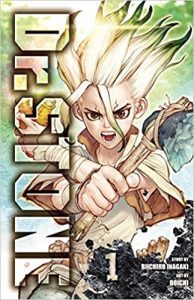
Dr. Stone, Vol. 1

Dr. Stone Volume 1 by Riichiro Inagaki and Boichi

Dr. Stone is a shonen series that is entertaining due to the combination of post-apocalyptic setting and mad scientist hero. The first chapter opens with overly enthusiastic high schooler Taiju vowing to confess his love to the girl he’s had a crush on for the past five years. His cynical scientist friend Senku wishes him well in a backhanded fashion. Just as Taiju is about to launch into his confession a mysterious light appears in the sky and all the people in the world get turned into stone, frozen in place for several thousand years.

When Taiju wakes up again, he comes to in an overgrown area littered with stone fragments of people. He wanders around and sees one of his most powerful classmates, Tsukasa, also frozen in place. Senku pops up and tells Taiju that he overslept terribly, because he’s been awake and on his own for the past year and a half. Senku is determined to restart civilization, but he needs additional help, and Taiju is going to serve as the muscle in his scientific endeavors. Senku has a habit of making grand pronouncements about the rate of his ability to reconstruct stone-age scientific discoveries by yelling “Get Excited!”

There’s certainly a lot of yelling, naked men wearing leaves, and hazardous attacks from both animals and other survivors in Dr. Stone, but I enjoyed the emphasis on adventures driven by ancient science. The dynamic between the two protagonists, with one of them being super smart and the one mainly having enthusiasm on his side also set up plenty of amusing side scenes in between all the fighting and scrabbling for survival. I tend to not always be that enthusiastic about non-sports shonen manga, but I was definitely intrigued by the first volume of this series.

Dr Stone

Categories
Manga Reviews REVIEWS

Ao Haru Ride, Volume 1

I remember when Io Sakisaka’s series Strobe Edge was announced initially there was plenty of excitement, but also many many people wondering, “What about Ao Haru Ride?” So I was excited when I heard that this series was being added to the Shojo Beat lineup, even though I wasn’t terribly familiar with it. The story opens with a bit of a prequel as Futaba spends her time in the junior high hallways attempting to escape any attention from boys, because she thinks they are loud and obnoxious. The only exception to her “No Boys Allowed” rule is Kou Tanaka, who is short, quiet, and gentle. After a couple random close encounters they agree to go on a date, but Tanaka overhears Futaba proclaiming her hatred of all men when she gets teased. Futaba waits alone for her date, and then Tanaka moves over the summer, so she’s never able to find out what has happened to him.

Fast forward into the present time and Futaba still wonders about Tanaka as she attends high school, where’s she’s determined to reinvent herself after being ostracized in junior high. She tries to play down her good looks and attractiveness, because she doesn’t want her new “friends” to think that she’s attempting to look cute for boys. There’s a classmate named Mabuchi who dimly reminds Futuba of Tanaka, but she tells herself that he’s too tall to be her long-lost friend. While Futaba continues to go through her tomboyish charade to fit in with the mean girls, she takes notice of a couple different girls in her class who are all alone, who actually seems interesting. While Futaba tells herself that she’s better off with her girl group, I think she’s unconsciously drawn to people who would be much better friends, given the chance.

Tanaka/Mabuchi is very intriguing in this first volume. He smirks at Futuba a bit, and when she starts to realize who he might be, reveals himself to her by leading her back to a shrine where they waited out a rainstorm when they were younger. He seems like a snarkier, more cynical version of his younger self, even though it seems like he can’t help himself from occasionally being kind. His kind actions are immediately balanced out by his habit of bluntly commenting on Futaba’s life, for example by telling her that she has “fake friends”. Sakikasa has a winning way with facial expressions, but one of the things I loved in this first volume was the sense of place, seeing Futuba and Tanaka having charged encounters in the shrine many years apart evoked the themes of both future and nostalgia that Ao Haru Ride is touching upon.

Unusually for a shoujo manga, this first volume covers the first year of high school, but it shows Futuba making some important decisions about who she wants to be as a person, helped along by Tanaka’s blunt prodding. Ao Haru Ride reminded me most of series like We Were There and the Sand Chronicles, just in terms of having the potential to develop into a very sensitive and emotional love story as the characters work through various complex issues. I feel like it has been some time since we’ve seen a series with such a strong emotional core story, and Ao Haru Ride seems like it has exactly that type of potential.

Categories
Manga Reviews REVIEWS

Skip Beat!, Vol. 41

Skip Beat!, Volume 41 by Yoshiki Nakamura

There’s something about picking up a new volume in a long-running shoujo series that is the manga equivalent of comfort food to me. It is great to settle in to a story arc, even if the situations are similar to what has happened before, seeing how the characters have grown and evolved as they encounter new challenges still makes it rewarding for the reader.

Kyoko has a big audition in this volume, and even though this has happened so many times before in Skip Beat!, this was very satisfying to read simply to see the way she’s grown into her comfort zone as an actor. Also, Skip Beat! excels at serving up sweet sweet revenge as Kyoko proves people who underestimate her wrong with her unique skill set. In this case, Kyoko is competing for the role of the ninja Momiji against the spoiled niece of the director. Kyoko is able to bring something unique to the role due to her recent training in stage fighting, combined with her skills and instincts as an actor. One of the many things that makes Skip Beat! so special after 41 volumes is Nakamura’s gifts at drawing the process of acting. Kyoko’s body language and intensity utterly change when she’s inhabiting a role, and seeing her dynamic approach to her character’s demanding physical scenes makes it clear that the executives are crazy if they cast anyone else.

Kyoko is at her best when proving herself, and her agency isn’t afraid to pile on a little extra difficulties by manipulating the situation behind the scenes, in an attempt to improve the casting possibilities for all the actors who get started as “talent” on variety shows instead of the pure acting track. Rory’s oversight and machinations doesn’t just stop at Kyoko’s career. This volume is largely Ren free, but we get a hint at what might be happening in the next few volumes as Ren returns and Rory tips him off to a situation that might actually inspire jealousy in Ren! As always I’m having it hard to manage my anticipation until the next volume.