Categories
Manga Reviews REVIEWS

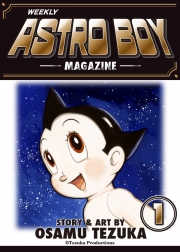
Weekly Astro Boy Magazine Vol. 1

Weekly Astro Boy Magazine Vol. 1

I was intrigued when Emanga.com announced that they would be releasing an Astro Boy magazine. I’m feeling a bit nostalgic for manga magazines at this point, with the demise of print anthologies. I’ve read some Tezuka, but I’m definitely not familiar with all of his works. The magazine format for Tezuka works very well, because his art and storytelling style varies so much with the titles presented in the magazine, it is interesting to compare and contrast the differences between his different titles in this format.

I haven’t read much Astro Boy before, but the storyline for inclusion in the first issue of this manga magazine is a strong one, as it is “The Greatest Robot on Earth,” where the robot Pluto created to battle all the other great robots that exist, until he is hailed as the supreme robot. This storyline is what Naoki Urasawa used for his manga series Pluto. Astro Boy tangles with Pluto for a little bit, but his creator calls him off. Astro Boy responds to the existence of the new robot by requesting an upgrade of his own power. Astro Boy really displays the virtue of simplicity. The robot designs are so distinct, and the action in Astro Boy is so clear and easy to follow, it makes me think that some of the detail and opaque action in modern manga has really missed the mark.

Phoenix is the next title featured in this magazine, and this is a real treat because I believe some of the print volumes released by Viz are now out of print. The story comes from the fourth volume of Phoenix, called Karma. It is easy to see why Phoenix is often called Tezuka’s masterwork. This chapter featured the story of a boy who was injured just after being born, becoming a monster due to the harsh treatment from his fellow villagers. He encounters a sculptor in the woods and damages one of his arms. The sculptor finds refuge in a temple and begins to reach a different stage of consciousness as he attempts to take up art again. Reading Phoenix itself is a bit of a philosophical experience, as the characters encounter each other in this fable-like story, with stylized depictions of nature inter cut with both action and personal reflection.

The rest of the book is rounded out by shorter chapters for Dororo and Black Jack. It was a bit difficult for me to get a handle on Dororo just due to the small page count. Black Jack, I automatically read with feelings of affection, because the two-fisted surgeon is one of my favorite Tezuka characters. Overall, I really enjoyed the opportunity to read different Tezuka works back to back. It is a bit different than diving into a full volume of manga, but it really gives the reader an appreciation for the variations in art and theme that is expressed in Tezuka’s manga. This is definitely worth checking out if you don’t have an extensive Astro Boy collection and especially if you want an accessible way of reading Phoenix.

Electronic access provided by the publisher

Categories
Manga Reviews REVIEWS

Knights of Sidonia, Vol. 2

Knights of Sidonia, Volume 2 by Tsutomu Nihei

As I was reading the second volume of Knights of Sidonia, it occurred to me that Nihei ably manages a narrative balancing act of giving the reader just a little bit more information in each volume, but not so much that everything feels completely filled in. My curiosity about the history of Sidonia was fulfilled with a bit of backstory about why the massive ship seems to be moving through space alone, isolated except for occasional attacks by the Guana. I’m still intrigued to learn more about Nagate Tanikaze and why he happens to be so good (in a somewhat bumbling way) at piloting the Tsugumori. He also seems to be continually singled out by those in command.

I enjoy the general sense of scale expressed with the illustrations of interior of the giant spaceship – it does really seem massive. The human cost that occurs when it has to maneuver itself suddenly makes it clear that even safely inside a spaceship death can come at any instant. Reading this manga, I get the sense that Nihei plans out all the details of his worlds very meticulously. One negative thing is that generally the characters in this manga suffer a bit from samefaceitius, making it sometimes difficult to sort out who is who absent any extreme differences in hairstyle. However, this is a minor quibble next to the general awesomeness of seeing the Guarde units fly through space in their ringed locked arm formation.

This is not a happy manga about giant space robots fighting aliens. The evolutionary capabilities of the Guana give some scenes a horror comic vibe, and bad things certainly happen to good people. But there’s enough humor in the strained interpersonal interactions of the people aboard the Sidonia that when finishing up a volume of this manga, I’m not feeling oppressed by tragedy but very interested to see what happens next.

Also, for those of you reading this manga solely for talking bear appearances, there is some talking bear in this volume!

Categories
Manga Reviews REVIEWS

Sunny, Vol. 1 by Taiyo Matsumoto

It makes me feel good that there are still new series coming out from Viz in the Viz Signature imprint. Sunny by Taiyo Matsumoto is also an addition to the trend of nicely packaged manga hardcovers. With a slightly larger trim size (the same as the other IKKI titles) and color pages before most chapters, this is a volume that will delight manga collectors looking for something nicer than the average paperback. I’ve only read Blue Spring by Matsumoto before, I really need to get around to reading Tekkon Kinkreet.

Sunny is written in one of my favorite fiction formats – a collection of interrelated short stores with shifting main characters that are all tied together. The Sunny of the title of the book refers to a broken down old Nissan Sunny car that sits in the back of a group home for abandoned children. The Sunny is a secret hideout, place to stash porn and other illicit materials, and a means of escape for a group of kids that doesn’t have much security or fun in their daily lives. The volume opens with a brief glimpse of foster home chaos, quickly inter cut with a scene showing the imagination of Haruo, who sits in the car imagining that he’s bleeding out in the desert like a tragic movie tough guy. Haruo’s reverie is abruptly interrupted by Junsuke, an overly hyper snotty-nosed kid who eagerly announces that there’s a new arrival in the house. The readers of Sunny and the new kid Sei both get an abrupt introduction to the children’s home as Sei goes through the house and sits in the Sunny with Haruo and Junsuke. When Sei says that his mom is going to pick him up before summer Haruo says, “No way you’re goin home. You got dumped.”

Sunny captures Haruo’s frustration and anger about his own situation, combined with his helplessness about being able to change anything. Junsuke struggles with his instinct to grab anything shiny, even stealing from his classmates at times. While Haruo is a central viewpoint character, Sunny fluidly moves among different points of view, showing Megumu’s concern for a dead cat and the real-world concerns of older kid Kenji. While there’s a lot of hopelessness in the lives of the kids who live at the home, they also stick up for each other and come together when one of them goes missing.

Matsumoto has a scratchy pen and ink style in his drawings, which incorporate cartoonish elements like circles for rosy cheeks. Washes of ink in varying intensity and hand-drawn textures instead of screentones give Sunny a hand-crafted feel that stands out among more corporate glossy manga. Matsumoto’s detailed backgrounds firmly establish the neighborhood the kids live in, as well as the run-down environment of their house. Overall, Sunny is exactly what I’d expect from the Viz Signature line – a nuanced work that is set apart from more commercial manga due to its artistic and literary value .

Categories
Manga Reviews REVIEWS

Demon Love Spell, Vol. 3

Demon Love Spell Volume 3 by Mayu Shinjo

It is nice being able to read a Mayu Shinjo series that I can wholeheartedly enjoy. There are so many overly serious paranormal romance stories out there, it is still refreshing to visit Demon Love Spell for a bit of a comedic spin on the genre. Bumbling shrine maiden Miko and overly alpha male incubus Kagura are just goofy enough to be funny but not ridiculous, and their relationship has enough character-based humor that it is easy to root for them as a couple.

This volume opens with the overly theatrical banishing of a demon by Sou Yamabuki, a former pupil of Miko’s father. Kagura in chibi-form gets jealous that Miko is crushing on Yamabuki on TV, but she assures him that she thinks he’s the coolest. At school the next day Miko gets a bunch of attention from other guys and excitedly assumes that she’s now popular with boys. Miko and Kagura go on an actual date with some great moments where Miko blackmails Kagura into ignominious activities like eating hamburgers by threatening to shrink him again. The ending of the date is interrupted by Sou, who promptly banishes the source of Miko’s new found charms – a weak succubus demon. With Sou, Shinjo explores the old standby “sudden fiance” as he decides that he needs to marry Miko in order to take her away from Kaguya. Sou also reveals that while Miko’s ability to apply her power might not be the best yet, she’s actually extremely gifted. Sou’s desires seem to center more on gaining demon fighting power than truly caring for Miko. Kaguya decides upon an extremely unorthodox method to fend off his rival, but it does show how much he actually cares for the priestess. The next main story in the volume focuses on the sudden appearance of a handsome snow demon who spends some time protecting Miko when Kaguya storms off in a huff.

I still sort of wish that some of Shinjo’s other, earlier series would be translated over here. Sensual Phrase has most other English-translated shoujo beat for unadulterated melodrama. But Demon Love Spell is a nice substitute. It has the humor of Ai Ore without going too far out into left field, and the relationship between Miko and Kaguya is nicely balanced due to the power imbalance inherit in him spending a good portion of each day as mini-figure clipped to her handbag. This was a satisfying volume of this series, and I’m looking forward to seeing what happens with Miko’s newly revealed power in future volumes.

Categories
Manga Reviews Reread Reviews REVIEWS

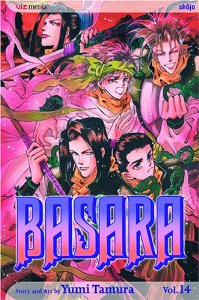
Basara, Vols 13-16

Whenever I pick up and read a few volumes of Basara, I’m always struck by how much story and emotion Yumi Tamura is able to pack into a few pages. I’d started rereading Basara last year, but got distracted by having too many volumes of shiny new manga. The Manga Moveable Feast seemed like a great excuse to dig up these volumes again. These volumes cover Sarasa’s journey as she escapes from prison and wages war on the desert city of Suo, only to encounter the Red King. The battle doesn’t go the way either of them planned.

Sarasa is able to escape Abashiri prison with her comrades, but she doesn’t have time to settle back and appreciate freedom again. It is time to head south and take up the struggle to determine the fate of Japan. Ageha leaves Sarasa, saying that he can’t become a crutch to make things easier for her. She has to execute her plans on her own, based on her convictions. Shuri heads to his precious desert city of Suo, but things have changed there for the worse as the administrator there Momonoi attempts to remake it in the image of Kyoto by displacing the poor and blowing up buildings. Asagi prevents a reunion between Sarasa and Shuri in a southern market, because he thinks if they each find out the truth about each other now, it would be “too dull.” Sarasa and Shuri both head to Suo with drastically different purposes.

The struggle in Suo is portrayed in mental as well as physical terms. Sarasa meets up with Hozumi, Momonoi’s son who his a non-violent artist. His girlfriend Renko runs an underground newspaper in the city. Sarasa starts unsettling the city by plastering notices that “Tatara was here” on the walls, and even flying the message from a kite. Sarasa starts to reflect a bit about what it means to be both a strong and feminine woman after spending some time with Renko. Hozumi stages his own form of protest by painting elaborate pictures on the walls of buildings slated for destruction, so people hesitate to blow them apart.

When Shuri sees the wreckage of Suo, he’s angry at what it has become. Momonoi brutalizes both Hozumi and Renko. Sarasa and Shuri both go after Momonoi for different reasons. Sarasa is nervous about being in close proximity to the Red King, the man who destroyed her village. Shuri sees that he’s not welcomed as a savior in his treasured city, and begins to reflect that his previous philosophy about a good leader inspiring fear was mistaken. Sarasa’s reinforcements come, but her plan to use Momonoi’s own explosives to cut off the palace kills the water supply for the city. The Red King’s army executes a tricky sneak attack, and the star-crossed lovers seem like they are headed towards mutual destruction. Sarasa is devastated when she realizes that she’s bring more destruction to the people of Suo. A horrible sandstorm prevents the battle from progressing further, but rather than regroup with her comrades, Sarasa runs off and finds Shuri in the chaos.

It is a little unbelievable that Sarasa and Shuri have managed to keep their identities from each other for so long, especially considering the way they both tend to show up and meet each other right around the time that Tatara and the Red King have a skirmish. It is clear now that part of reason is that they honestly don’t care, and they are both blinded by love for each other so much that they aren’t going to stop and ask inconvenient questions when they could just enjoy each other’s company. This idyll is very short, and the Red King and Tatara’s army clash the next day and Shuri and Sarasa finally get a glimpse of each other from across the battlefield.

What follows is one of the most emotionally devastating scenes in the series, as Sarasa and Shuri react to this newfound knowledge in different ways. Sarasa slips into a fugue state, forcing out commands to kill the Red King, while Shuri mechanically tries to kill himself at the suggestion of his followers because his group is so clearly outnumbered by the rebel forces. Both armies flee the battle as King Ukon’s army approaches and Ageha takes Sarasa away in an attempt to bring back Tatara. Ageha thinks “Was he…that good? Why not just take me instead?” Ageha concludes that Sarasa isn’t his “woman worth dying for” and decides to leave. Sarasa ends up finding shelter with a local priest and his family, but her destiny isn’t going to let her sit back and do nothing.

Sarasa strikes up an odd friendship with Kikune, one of the White King’s spies. Sarasa and Kikune end up befriending Lady Purple, the Black King’s estranged wife. Lady Purple ends up being another type of mentor to Sarasa, but Sarasa’s emotional healing really begins when she’s reunited with her mother. In a very nurturing way, Sarasa’s mother asks her some pointed questions about the reasons why she was fighting and what she wants the future of Japan to be.

There’s some funny yet poignant exchanges happening as Asagi has rescued Shuri, who is undergoing his own emotional rehabilitation. Asagi is all but twirling his non-existent evil mustache in an attempt to get Shuri to have some sort of emotional reaction to him, but Shuri calmly accepts the prospect of being sold into slavery by his half-brother.

Overall, these volumes server as a great emotional climax to the first half of the series. The central mystery about what would happen if Sarasa and Shuri would find out about each other has been answered, and now they have to pick up the pieces of their lives yet again. While Ageha might have given up on Sarasa, it is clear that her destiny as Tatara will not allow her to just retire into the countryside and life out the rest of her life peacefully. Shuri has his own set of trials ahead, and it will be interesting to see how both of these powerful leaders manage to build a new Japan with such strong and well-connected enemies lining up against them. One of the strengths of Basara is the way Tamura will intersperse shorter, more personal adventures into the larger struggle with the extended cast. Having Sarasa and Shuri both on their own a little bit, without their customary support systems allows them to grow more as individuals, making the battles much more human. I’m glad I set aside the time to get back with my Basara rereading program, and I’ll likely finish up rereading the rest of the series outside of this week’s manga moveable feast.