Categories
Reread Reviews REVIEWS

Dawn of the Arcana Vols 11 and 12

Dawn of the Arcana Vol 11 by Rei Toma

Dawn of the Arcana is a series that I think is best experienced in mini bursts of 2 or 3 volumes, simply due to the deliberate pace of the storytelling in the manga, as well as the fact that it sometimes takes a half volume or so for my brain to kick in with my memories about what happened in the previous volume due to all the relationships developing and the shifting nature of the geopolitical situations happening in Toma’s world. Usually I’m far too impatient to let the volumes pile up like this though!

After 10 volumes, the new status quo for red haired socially outcast with alarming powers of precognition Princess Nakaba and formerly arrogant but really a nice guy who has a social conscience inspired by the power of love Prince Caesar is to be separated. Nakaba has returned to Senan, determined to do some ruling in her own right, and Caesar is back in his home country of Belquat, dealing with his evil family. This volume shows the emotional impact of Nakaba’s power, the Arcana of Time, as she is determined to save the outcast child of a village that is in the direct path of an avalanche. This becomes a story that further explores the position of the humanoid animal hybrid race called ajin, as Lala the child with bunny ears is actually the product of a human/ajin encounter, leading to her abandonment. Lala has one human friend, and Nakaba’s ever present ajin protector Loki is there to save the day as always.

Loki always seems to have a new revelation every few volumes, either about his emotions or background, and a secret is revealed in this volume that shows that he and Nakaba have even more in common than I previously thought. While there’s the more conventional romantic storyline with Caesar and Nakaba, I actually find Nakaba’s relationship with Loki much more interesting, as they trade off protector duties in unexpected ways. Nakaba decides to take power in her home country, and her choices are largely driven by wanting to prevent Loki from going too far for her.

Dawn of the Arcana Vol 12 by Rei Toma

Everything keeps zipping along, as now that Nakaba and Caesar are in power in their respective countries, they have a chance to finally see each other again, when Caesar is ordered to invade Senan. Nakaba’s been looking in on Caesar and remarks that he’s going to start a revolution, so she’s “Here to lend a hand.” Nakaba’s power also provides Toma with a great way of providing more backstory about her characters. Nakaba looks back at Caesar’s father when he was young, even though Loki warns her that it might be difficult for her to see because she’s “too kind”. Nakaba sees King Guran’s first meeting with his unconventional first queen, the commoner Sara. The unhappy ending of this romance provides a reason for why King Guran might have ended up so twisted and bitter, but it doesn’t prevent a confrontation that is sure to cause even more fallout to happen in the volumes ahead.

One of the things that I really like about the art in this series is that it is so clear and easy to read. Toma might not have the most intricate backgrounds or innovative approach to paneling, but I’m never left puzzled about action scenes or finding that I have to go back and reread a page to make sure I understand the sequencing. The wordless exchanges between Nakaba and Caesar and the sidelong glances between Loki and Caesar do more to express the tensions between the characters than several pages of dialog. Overall, these were two very solid volumes in a fantasy series that is always surprising me with unexpected depths. I’m looking forward to the next few volumes to see what will become of Nakaba, Caesar, and Loki (well, really mostly Loki).

Categories
Manga Reviews REVIEWS

Harlequin Manga: The Tycoon’s Pregnant Mistress and Her Sheikh Boss

The Tycoon’s Pregnant Mistress by Maya Banks and Nanao Hidaka

tycoon

The Tycoon’s Pregnant Mistress manages to hit some sort of Harlequin manga trifecta, because the pregnant mistress in question gets cast off, kidnapped, and develops amnesia in the first 30 pages! The woman with the eventful life is Marley, and her boss is a slightly dimwitted Greek tycoon named Chrysander. Marley finds out that she’s pregnant and attempts to have a meaningful talk about their relationship with Chrysander, only to be shut down and promptly kicked out when Chrysander discovers top secret business documents in Marley’s handbag only minutes after his extremely suspicious secretary pays him a visit at their home. While he might be successful in business, Chrysander has very little insight into human nature, as he kicks Marley out onto the street, where she is immediately scooped up by kidnappers, appearing four months later in an advanced stage of pregnancy!

Chrysander is very suspicious of his pregnant former mistress who has amnesia, but he is determined to Do the Right Thing and decides that he’s going to take care of her and her child. Marley attempts to get her memories back, all the while being slightly bewildered by the continued presence of Chrysander’s skanky secretary and his distant nature. The art for this title is about average for a Harlequin manga, it is attractive despite some slightly odd proportions, and while it doesn’t have the lush 80s retro vibe that I tend to love the most in these manga adaptations, everyone’s hair is glossy and there is a profusion of brooding greek tycoons.

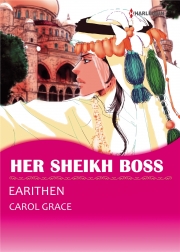
Her Sheikh Boss by Carol Culver and Earithen

hsb

The story for this manga is fairly predictable, but I really enjoyed the art for this title, which had a loose sophisticated style that reminded me a bit of Walkin’ Butterfly. Claudia is a highly efficient secretary working in the United States for Samir, the prince of a country in the Middle East. She’s indispensible for his business, and he decides to take her along when he goes home to his country. Samir tends to view Claudia as an efficient piece of furniture, and when Claudia goes on her trip she is profoundly dismayed to find out that her boss his traveling back to his family in order to get engaged!

Claudia has developed a secret crush on her boss, and she struggles with her feelings as his family regards her with suspicion. As Claudia visits Samir’s country he begins to see her as a woman for the first time, as she throws herself into new experiences with enthusiasm. His fiancee seems very unenthusiastic, perhaps due to the handsome male servant that follows her about wherever she goes. The art captures Claudia’s transformations and shifts in moods easily and there’s plenty of billowing hair and the occasional camel. While the illustrations aren’t necessarily very detailed, there’s more variation with the paneling and I found myself just as entertained by the art as the story. The complications that keep Samir and Claudia are resolved nicely, and overall I found myself pleasantly entertained.

Categories
Manga Reviews REVIEWS

Fushigi Yugi Genbu Kaiden, Vol 12


Fushigi Yugi Genbu Kaiden, Vol 12 by Yuu Watase

I’m sure it sounds odd, but I was actually a bit nervous about picking up the final volume of this series that I’ve been enjoying so much, simply because I’ve been a bit frightened of the ending. I knew that plenty of deaths would be occurring. This is no big secret, since the heroine Takiko has been dying of tuberculosis throughout the series, and the presence of a couple ghostly Genbu Celestial Warriors in the first Fushigi Yuugi series gave enough hints towards inevitable tragedy that a certain air of melancholy has hung over this manga, giving it an additional theme that has offset all the fantasy adventure I’d expect from a Yuu Watase series.

When I put this volume down, I realized I was wrong to be nervous, because the ending was the best one possible given the set of circumstances the characters found themselves in. The final confrontation with the Qu-Dong army has arrived, and even though Takiko has married the Uruki, now Emperor of Bei-Jia, all the efforts of her Celestial Warriors aren’t going to fend off the eternal winter that is going to threaten all the people of Bei-Jia. The Celestial Warriors fight gallantly, but Takiko is determined to see her destiny as a priestess fulfilled, even if she ends up being consumed by the god that she summons. There are plenty of quiet moments between the characters mixed in with the battles, and each Celestial Warrior gets a bit of a sendoff. Tomite teases Takiko one last time. Hatsui is courageous in battle. Inami deflects volleys of arrows with her hair, arranged in a giant web. Naname undergoes an unexpected and meaningful last transformation.

Throughout everything that happens in this final volume, the connection between Takiko and Uruki remains strong and supportive. As a heroine, Takiko’s quiet and unwavering determination really sets her apart, and I thought that this series exhibited more maturity in storytelling than the first Fushigi Yugi series. This is one of my favorite Yuu Watase series, and that’s saying a lot since I’ve read and enjoyed most of her manga. I’ve read all the volumes of this series as soon as I’ve been able to get my hands on them, and the only thing that has marred the reading experience is the long wait between volumes! I really want to set aside some time and read the whole series again in a shorter span of time, to see what I think about it without having to wait months and years between volumes. Overall though, I don’t hesitate to recommend Fushigi Yugi Genbu Kaiden to anyone who enjoys fantasy and adventure shoujo.

Categories
Manga Reviews REVIEWS

Attack on Titan, Vol 1


Attack on Titan Vol 1 by Hajime Isayama

At this point, given the ubiquity of Attack on Titan on manga best seller lists, reviewing it is a bit like reviewing the air, but I decided to finally get around to reading this series when Mangablog alerted me to the crazy deal for the kindle edition of the first volume that was running recently. Sometimes I have no trouble reading manga on my Kindle Paperwhite, but I had more difficulty figuring out what was going on with the art with the reduced size, and quickly switched over to reading this manga on my iPad instead.

I’ve been reading a bunch of post-apocalyptic fiction recently, just because there are so many YA dystopian novels out there, and I’m also in the middle of reading Justin Cronin’s The Twelve. Attack on Titan is an interesting twist on the dystopian genre as many years into the future humanity has retreated into walled cities in order to protect themselves from the Titian, giant zombie-like humanoid creatures who enjoy eating human flesh. Eren is in many ways a fairly typical brash and opinionated shonen hero, whose close companion is a quieter and seemingly more pragmatic girl named Mikasa. Eren is worried about the complacency his town seems to be developing, as Titans haven’t attacked it for a long time.

Sure enough, a devastating attack on the town follows, as a Titan bigger than anyone has seen before easily breaches the wall, causing panic and confusion in the town where few humans are equipped to deal with a direct attack. Years later, Eren and Mikasa are ready to take their work assignments in the town, and they have to choose the safer duty of directly protecting the townspeople or joining up with the riskier survey corps. Eren wants to avenge his family, and Mikasa is quietly determined to follow him in order to protect him.

By far the weakest element of Attack on Titan is the art. The characters are drawn stiffly and not in proportion. For much of the time Eren and his comrades are yelling at each other, with facial expressions that don’t have very much variation. At the same time, the more detailed renderings of the Titans are plenty creepy, with their musculature visible on their bodies due to lack of skin, wide jaws, and shark-like rows of teeth. In contrast to the art, the worldbuilding in Attack on Titan is excellent, and it is clear that Isayama has spent plenty of time plotting out the events in his future history, thinking through the weapon systems and defenses the humans have constructed, and setting up the relationships between the characters in an interesting way. The first volume ended on a cliffhanger that was both shocking and weirdly refreshing from a manga plotting perspective, making me wonder a bit if Attack on Titan is going to be serving up a bit of metacommentary about manga plot cliches. Even though the art was fairly awkward, I was still able to follow along with the action sequences, and the Titans were genuinely unsettling, with their grimacing silence and habits of eating people in one gulp. I’m a little leery of taking on such a long series, but I can certainly see why Attack on Titan is so popular.

Categories
Manga Reviews REVIEWS

Alice in the Country of Joker: Circus and Liar’s Game Vol 2

I enjoyed the first Alice in the Country of Hearts series much more than I expected to. I’ve since tried out some of the sequels here and there, and I think this series is one that I’ve enjoyed the most, just because the storyline seems to echo back to the first series in both theme and tone. While most of the other Alice series that I’ve read tend to focus more on what I think of as the core cast of characters, Alice in the Country of Joker introduces the Circus as a new place and the mysterious Joker accompanies the Circus. It is April season, which is a different and unsettling time for the inhabitants of Wonderland.

The second volume of the series continues with many of the things I enjoyed about the first. There are flashbacks to Alice’s previous life that hint at the psychological issues that might cause her to take refuge in Wonderland. Alice is reminded of her sister as she spends time with the obsessive white rabbit, Peter White. Blood Dupre continues his flirting campaign, but the influence of the Circus and the barrier that Nightmare placed in Alice’s mind are in conflict. There seems to be a cyclical conflict between the Circus and the rest of Wonderland, and Alice is trapped in the middle of it. The unsettling tone and hints of suspense were more of what I tend to look for in one of these many Alice stories. So far, this is the main spinoff series I would make a point of recommending to fans of the first Alice in the Country of Hearts. I still miss the art from Soumei Hoshino in the original series. There isn’t anything really wrong with the illustrations of the adapter here, but Hoshino’s art was more delicate and surreal, adding another dimension to the Wonderland portrayed in these stories.