Categories
Manga Reviews REVIEWS

Ao Haru Ride, Vol. 2

Ao Haru Ride Volume 2 by Io Sakisaka

When reading the second volume of this series, I found myself thinking about how the characters in Ao Haru Ride are different from some of the unusually self-aware protagonists that occasionally appear in shoujo manga. Teens with involved thoughts about the condition of being teenagers are fairly common, but Ao Haru Ride is concerned with issues of time and memory, and how memory can be a constructed choice in a way that feels refreshing to me as a reader.

As Futuba enters her second year of high school, she still struggling to find her niche. Her attempt to ingratiate herself with a small gang of judgemental girls didn’t work out well for her, and she wants to develop real friendships. She makes a point of being friendly to Makita in an attempt to head off a resurgence of rumors and finds herself a topic of gossip. Joining her and Makita in the new class are the enigmatic girl Murao, the boisterous Aya, and Kou. Futuba decided to throw herself into class leadership after hearing about a school-sponsored leadership retreat, and she’s joined by her new classmates.

Ao Haru Ride

Kou isn’t too happy when he realizes that he’s signed up for a trip that his older brother Tanaka is overseeing as a teacher, but he and Futuba reach a sort of understanding about their previous middle school crushes, as he warns her that he’s different now, and she starts appreciating Kou in the present without expecting him to match up with her memories. Futuba is also extremely conscious of making new memories on the trip, as the not-quite-friends-yet group goes through the typical outdoor activities to encourage class bonding. She makes sure that everyone gets together to watch the sunrise, knowing it is the type of memory they will treasure later.Ao Haru Ride’s are unusually insightful and self-reflective, which makes this a shoujo romance manga with so much emotional depth. Kou points out to Futuba that things come easier for him because he just doesn’t care about anything, and the fact that she’s struggling to make things better means that she’s a better person than he is. Futuba in turn notices all the times that Kou’s innate kindness shows through his acerbic exterior.

This series is inching up the list of my all time shoujo favorites after the fourth volume. There’s the potential for more drama to develop as the new group of friends starts to come together, but with Kou and Futaba being such uniquely thoughtful protagonists, I’m looking forward to seeing how they deal with all the issues of high school life. Ao Haru Ride is such a special series, I’m glad to have the chance to read it.
Categories
Manga Reviews REVIEWS

Ran and the Gray World, Vol. 1

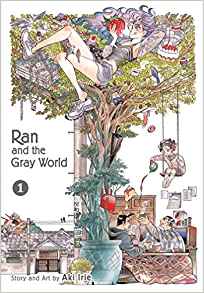
Ran and the Gray World Volume 1 by Aki Irie

Ran and the Gray World blends slice of live pacing with beautiful illustrations in this story about a girl with magical tennis shoes that transform her into a grown-up. Ran is being forced to do her chores in her cluttered home, and her older brother Rin strategically hides her shoes in a light fixture in order to get her to clean up. Ran’s homelife is just as haphazard as her room, since her mother is a powerful sorceress who has to live away from her family to deal with magical business.

Shizuka appears accompanied by a flock of birds and a profusion of flower petals, conjuring up sweets that threaten to engulf the whole neighborhood. Irie’s illustrations are wonderful at showing how things get off-kilter and out of control with such a powerful sorceress paying a visit, as Shizuka and her daughter lean up against a giant strawberry while eggs hatch into giant chickens and doughnuts threaten the roofing of the family’s near neighbors. Shizuka seems utterly unaware of the effect of her sudden appearance and disappearance on her family, and doesn’t seem to care that she’s annoying her son as she dazzles her daughter with magic.

Ran and the Gray World

Ran continues to throw on her tennis shoes and run away, with her most extended adventure involving dropping out of the sky onto the penthouse garden of playboy, who is intrigued by Ran. They remodel her guest room and have an additional random encounter at a local festival.

One aspect of the book that made me uneasy was seeing how Ran was getting placed in situations with adult men who are reacting to her as a young woman. While nothing much happens due to her magical powers, naiveté, and the vigilant actions of her older brother Jin, this is certainly something that I’d like to see minimized in further volumes. The first volume did such a great job setting up a unique magical world, though, I’m hoping that the series doesn’t turn into another Bunny Drop. Uneasiness aside, Ran and the Gray World seems like a must for low key fantasy fans. The magical world Irie creates with her illustrations is lovely, and it is shown off well by the larger volume size and deluxe treatment of the Viz Signature Edition.

Categories
Manga Reviews REVIEWS

Shortcake Cake, Vol. 2

Shortcake Cake Volume 2 by suu Morishita

The first volume of this series efficiently introduced the boarding house where most of the characters live, showed Ten to be a cheerfully blunt heroine, and hinted at an intriguing love triangle. The second volume provides more depth about the relationships between the characters along with some dramatic confrontations and too many flowers. As the volume opens, Riku is dealing with his feelings of rejection after Ten offhandedly asked if he liked her, and then turned him down, assuming that he was just being his normal overly flirtatious self. Chiaki quietly observes their interactions. Just when things are starting to calm down again, Rei shows up when Ten and Chiaki are walking home from school to issue the command “Be my Girlfriend!” Considering that his name for Ten is “Ugly”, she resists his allure easily, pointing out to him that he’s clearly never been in love. Rei is actually Riku’s younger brother, so his pursuit of Ten is more of a cry of attention than anything else.

shortcake cake 2

One of the things I enjoy about this series are the distinct character designs, but I have to say Rei’s almost feral facial expressions and perennial tired look make him appealing, even if he does have the emotional maturity of a baby squirrel. I enjoyed seeing how quickly Chiaki and Riku moved to help Ten out, even though she shows that she’s perfectly capable of defending herself. Shortcake Cake feels refreshing to read, mostly because many of the characters are in tune with their emotions and what they want. Leaving things unsaid or not knowing one’s own feelings are familiar shoujo conventions, and even if that will be happening a little bit in this series, Ten seems capable of handling it.

Categories
Manga Reviews REVIEWS

Water Dragon’s Bride, Vol. 7

Water Dragon’s Bride, Volume 7 by Rei Toma

I suspected that when the Water Dragon God sent Asahi home, she wouldn’t stay there long, and that was definitely the case. She struggles to feel at home back in her own world, with a younger brother that she’s meeting for the first time, and her parents, especially her mother who desperately missed her. This brief story line shows how The Water Dragon’s Bride is a story of a family tragedy, in addition to exploring how human rules fight for power and resources. Asahi misses her old life, but back in the realm of the Water Dragon God, the young king is struggling with drought and the idea that he’s lost the favor of the heavens since Asahi’s disappearance. Subaru even attempts to intervene with the Water Dragon God in Asahi’s absence. When the Water Dragon God does intervene, in his cold and calculated way, Subaru reflects that Asahi was incredibly powerful to make a god change.

Water Dragon's Bride 7

Asahi’s disarming way of talking with both the Water Dragon God and Subaru show that she doesn’t regret her choice to leave her family behind, and the way the Water Dragon God is actually able to articulate his emotions and even show a sliver of a smile shows how far he’s become from a god who would dispassionately watch a human starve. While so far the elemental gods that we’ve seen seem content to observe and occasionally make some cutting observations to the Water Dragon God, now that Asahi has returned the next storyline for this series looks like it will be even darker than before. When will hte suffering end????

I’m delighted to keep reading this manga, but there was such a great artistic leap for Toma between Dawn of the Arcana and Water Dragon’s Bride (which makes sense given when they were released in Japan), I’m also extremely curious to see other series of hers.

Categories
Manga Reviews REVIEWS

Idol Dreams, Vol. 5

Idol Dreams Volume 5 by Arina Tanemura

Idol Dreams is a fun, if a bit uneven, soapy series about a repressed office lady reliving her youth in the best way by occasionally taking magic pills that turn her into a teenage aspiring teen idol singer! People fall in and out of love and deal with show business shenanigans, but will Chikage’s teenage adventures translate into any newfound maturity in the real world? Indications in this fifth volume are promising!

Chikage is much more assertive and resourceful in her teen idol persona as Akari. She’s trying to gain more recognition through a sing-off battle and manages to dodge a series of mean girl attacks and come out on the other side victorious even though she’s just a slightly better known aspiring idol singer. One of the things I’ve been wondering about is when Chikage’s old classmate and magical teen pill supplier Tokita was going to get a bit more focus, because so far he seems to be mainly pining in silence. My patience was rewarded with this volume, as it focuses on him. The real world is much more complex than teen idolland, as Chikage learns that Hanami who one of her workplace mean girls is also Tokita’s girlfriend, and she’s been cheating on him. Chikage is able to stick up for Tokita in a way that she’s never managed for herself, but she doesn’t realize what her own feelings are for Tokita until it is far too late. There is more time spent on the characters’ backstory in this volume, especially Tokita, which was a nice change of pace. I’m a bit worried that Chikage is going to bury herself in her teen persona in the next volume to distract herself from her pain as an adult.

It is all breezy fun although I’m slightly terrified about what might happen with Akari and Hibiki. I think that the series would also seem a bit less disjointed if I was reading it all with less time in between volumes, where the quick pace of people falling in and out of love might be less noticeable in a larger chunk of story. Still, I’m always up for an Arina Tanemura manga, and I’m hoping that Chikage becomes a more self-assured woman by the end of the series, and I’m glad that she’s showing some signs of assertiveness, even though she still needs more self-awareness to match.