Categories
Manga Reviews

The Secret Notes of Lady Kanako

The Secret Notes of Lady Kanako by Ririko Tsujita Volume 1

This manga mash-up of Harriet the Spy and Mean Girls ends up being a great read due to a uniquely acerbic heroine and the unexpected friendships that she finds. It is obvious that The Secret Notes of Lady Kanako was originally intended to be a stand-alone short story that was expanded later on because the first chapter has a very self-contained conclusion. Kanako holds herself apart from her classmates because she’s entertained by the idea of being the perfect outside observer. Her notebook is full of detailed notes about the behavior and secrets of the kids that surround her even though they don’t really know she exists. The focus of her current research are the boys and girl that are the most popular students in the school. Haru is the most handsome boy in school, but his beauty is combined with a somewhat sadistic personality. The prettiest girl in school is Momoka, who is nursing a crush on Haru. Haru encourages her crush just because he wants to see Tota, the boy who is hopelessly in love with Momoka, squirm in agony. Kanako sits back and watches the drama unfold, but her notes are discovered and she soon finds herself growing closer to her observation subjects than she originally intended.

Kanako finds herself gradually won over by Momoka’s innocent gestures of friendship and her stoic response to bullying from the other girls in the class. Since Momoka won’t do anything to defend herself, Kanako decides to take over the PA system to announce that the bullying better stop or she’ll reveal everyone’s darkest secrets. Tota thinks Kanako’s direct way of speaking is cool and he begins to look up to her. Haru’s snarky personality and tendency to call Kanako out on her behavior makes him a great foil. Haru is tall, dark, and conventionally handsome while Kanako is drawn as a very short girl who is always peering over her glasses with a knowing smirk on her face. Haru comments to Kanako that she’s strong, and “It’d be more interesting if all the girls were like you.”

One aspect of this manga I was initially unsure of was the portrayal of female friendships. It is fairly typical for there to be plenty of backstabbing and bitchiness in shoujo manga, and it gets repetitive after awhile. I’m also a little tired of reading stories aimed at girls where the normal behavior of other females is constantly portrayed so negatively. But The Secret Notes of Lady Kanako manages to avoid getting trapped in cliche. Kanako prides herself on seeing through all facades. She transfers from school to school to maintain her prized outsider status and when she hears a someone comment on a nice girl, she thinks to herself “Sweet girls like her? You’re awfully gullible.” Kanako’s observational habits end up uncovering secrets at her new school, but instead of becoming an enemy of the two-faced girl that was the object of her studies they end up becoming unexpected allies, bonding over the fact that they both have twisted personalities. Kanako says that she observes because she doesn’t need friendships, but she usually ends up helping the people she watches. She doesn’t tolerate hypocrisy, and she celebrates the quirky behavior that other students find off-putting.

There’s an element of knowing cynicism in Kanako’s personality that is really refreshing for someone who’s been reading a lot of shoujo manga that features sweet but ditsy heroines. In many ways Kanako is the exact opposite of the typical shoujo heroine, but she does display a few moments of softness when encountering the first friends she’s made in school. Haru occasionally pops up in a chapter here and there to tease Kanako, and she returns to her first school at the end of the volume for the cultural festival. She finds out that while she prides herself on observation, her old friends were actually watching her and use their knowledge to try to do something special for her.

This manga isn’t perfect, as there are repetitive introductions at the start of every chapter and the episodic nature of the manga actually made me wish for more Haru/Kanako interaction. I was surprised to read in the author notes that this was Tsujita’s first volume of manga, because she managed to create such a compelling heroine on the first try. This series is only three volumes long, and is worth picking up if you’re looking for shoujo that manages to combine cynicism with sweetness.
Categories
Giveaway

Kamisama Kiss Giveaway

To celebrate the upcoming (Next week! Are you ready and excited to talk about android girls?) Manga Moveable Feast for Julietta Suzuki’s Karakuri Odette, I’m giving away a copy of the first volume of her latest series, Kamisama Kiss. Just leave a comment in this post answering the question:

How would you force your hot fox-spirit familiar to bend to your will?

Snorgles? Bungee cord? Making an excellent moussaka? Leave your comment and I’ll select a random winner, to be announced at the close of the MMF.

Categories
Manga Reviews

Biomega Volumes 2 and 3

Biomega Volume 2 by Tsutomu Nihei

Biomega continues to be one of the most stylish action manga I’ve read. There might not be a whole lot of substance there, but the style is dialed up so high that I find myself not caring so much that Nihei’s vision of a dystopian future seems like it has been cobbled together from a variety of sources. Zoichi is determined to rescue the captured Eon Green. We get a little more background about Zoichi and his world in this volume – Zoichi seems to be a rogue synthetic human developed by Toa Heavy industries, and now we see that he isn’t the only person with those unique abilities as Nishu Mizunoe is shown to be pursing the talking bear Kozlov Grebnev. There’s plenty of zombie splattering action, but my favorite part of this book came relatively early when Nihei displays a spectacular example of manga physics.

Zoichi is on the run from a group of fighter planes. From his motorcycle, he shoots one down with his handgun. He dodges missiles on the highway, then jumps the motorcycle into the air while holding an axe. He then proceeds to pilot the plane, anchored by the axe, as he sends his always helpful computer program into the cockpit to take over the plane. Honestly, I was so happy with the handful of panels in that action sequence the rest of the book could have been a 188 page instruction booklet on mumblety-peg and I still would have found it a satisfying reading experience.

Biomega Volume 3 by Tsutomu Nihei

The third volume doesn’t feature an action sequence as iconic as riding on a plane with an axe, but there’s plenty of action as the synthetic humans from Towa Heavy Industries confront the Data Research Foundation and their plans for transforming the earth. There’s a synthetic compound that dramatically reacts with the infected zombie/drones, giving the DF foundation a chance to remake the earth and ensure their own immortality. There’s mecha fights, fleshy monsters, motorcycles with handy claw tools, and Zoichi finally manages to get to Eon Green.

Part of the reason why I like this manga so much is that it is the only seinen science fiction title I’m actively collecting. So it functions as a nice palate cleanser when I’ve read too much shoujo. I can certainly see why some people might find not very compelling due to the somewhat erratic nature of Nihei’s storytelling. Biomega sometimes seems like a pastiche of many similar manga and anime. I find though that the artwork in Biomega compensates for the storytelling. Nihei’s character designs are sometimes really unsettling, as many of the characters are hidden behind creepy-looking masks to prevent infection. The synthetic humans are the perfect action heroes, the sometimes display some unsettling powers as their bodies react to injuries or extrude biomechanical parts to make climbing up giant mecha that much easier. For all the non-stop action in Biomega, the most memorable images I found in the third volume were a few panels of Zoichi’s dream after he’s been poisoned. He’s standing in an alien landscape in outer space, looking out at the stars when a man with his skull half caved in comments that there are no humans left. Nihei is great at juxtaposing moments of stillness with his inventive action sequences, and that’s why I’m going to be looking for the next few volumes in this series.

Categories
Manga Reviews

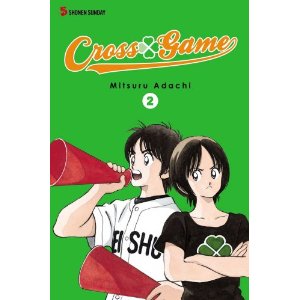
Cross Game Volume 2

Cross Game Volume 2 by Mitsuru Adachi

The first volume of Cross Game was my favorite new shonen manga of 2010, so when I got a new box of Viz goodies, this was the first manga I grabbed. I was happy to see that the second volume delivers on all the character development that was built up in the first volume. This omnibus edition contains volumes 4 and 5 of the manga. At the end of the first volume Ko and his “farm team” companions are gearing up to play against the elite varsity team at their high school.

The second volume opens with one of those deceptively simple scenes that serve to illuminate the relationships between the characters. Ko shows up at the Tsukishima household, asking to see Aoba. Mr. Tsukishima is slightly perplexed, but tells him to go into the house. Aoba’s oldest sister pops up suddenly into the panel with her hand on her forehead in disbelief, “Ko..? Here for Aoba?” Ko tells Aoba to follow him, and she goes with him, striking a fighting pose when he turns to throw her a baseball glove. It turns out that Aoba is the only person Ko can trust to give him a realistic assessment of his pitching abilities. His teammates haven’t said much to him, but they wouldn’t say anything to disrupt his confidence. Ko starts throwing the ball to Aoba and the sound effects start to kick in. Boom! Couples strolling in the park turn and stare. Boom! The sounds of Ko’s pitch echo in the night. Aoba catches every ball and when asked for her assessment, she says “You’re okay…I guess.” Ko is psyched and pumped up for the game, because Aoba’s “okay” is the best compliment she could give him. He challenges her to a bet, if he only lets the opposing team score 10 times, she’ll buy him a treat. Aoba changes the terms of the bet by yelling “Five runs!” Ko says “No fair.” and walks off into the night. Aoba nurses her battered catching hand and thinks “No fair for who?”

The game begins, and the corrupt coach and principal of the high school are unprepared for the farm team that they previously dismissed. The better players on the varsity team are aware of Ko’s talent, even while the coach tries to pretend that Ko’s pitching ability isn’t extraordinary. Even though the baseball game stretches over a good portion of the book, I was kept entertained by the skillful ways Adachi manages his cast of characters. Azuma, the ace batter on the opposing team begins to view Ko as a true rival. Aoba sits in the stands and provides a running commentary on all the players, which demonstrate that since she isn’t able to play with the boys on the field she might be better employed as an additional coach. The ancient but tricky coach of the farm team demonstrates some underhanded but effective ways of managing players, as he tells a false but inspiring story to his selfish third year players, and secretly arranges a different type of bat for a player who swings too hard but won’t work to change his approach.

One of the many things I appreciate about Cross Game is that the more poignant moments aren’t milked for melodrama. Ko’s still dealing with the tragedy that struck in the first volume, and the reader sees this in a couple scenes. He works himself tirelessly in the secret summer training camp of the farm team, saying that summer is a time he doesn’t want to think too much. He willingly humiliates himself just to get an item on Wakaba’s birthday list. These scenes are presented in the same slice-of-life manner as the rest of the manga, but I can’t help but think that in the hands of a less skilled creator, something like that would be presented with extra tears or emphasis. Cross Game just shows events unfolding with a natural rhythm that is deceptively effortless.

Review copy provided by the publisher.

Categories
Manga Reviews

Mizuki

Mizuki Episode 1 by Nao Yazawa

I’m happy to see that Digital Manga Publishing is bringing out more shoujo manga, but I’m a little disappointed that Mizuki is going to be available only in electronic format for the foreseeable future. It seems like magical girl shojo has fallen out of favor a little bit in recent years, but I’m hoping that the reprinting of Cardcaptor Sakura and series like Mizuki might signal a return to more magical girls manga being available. I am a sucker for transformation sequences, and the general frivolous tone of much magical girl manga makes it a perfect thing to read when I want to relax. I haven’t read Nao Yazawa’s other series Wedding Peach, but I do admire it from a distance just because I think magical girl transformations involving wedding dresses are hilarious.

Let’s sit back and bask in the bridal glow of Wedding Peach for a moment:

Mizuki has an interesting twist on the magical girl conventions, because instead of transforming into something sparkly with ribbons, her transformation option is limited to turning into a half-demon, complete with horned head. Mizuki’s family is descended from traditional Japaneses demons (oni) and as a result Mizuki is extremely uninterested in using her mystical powers. She doesn’t want to turn into a demon and have her classmates think that she’s scary or gross. The boy next door Seikito just thinks she should stop whining and get to work fighting mystical disturbances. Seikito’s family and Mizuki’s family have teamed up for generations to fight ghosts, and now he thinks that it is his turn to be Mizuki’s partner. Mizuki has a crush on popular baseball player Yamaguchi, so she just wants to be a normal girl.

Of course, there is some haunting near the school and Mizuki has to go into Oni-battle mode despite her reluctance. Yazawa’s character designs are attractive in a very retro sort of way. Her art style reminds me a bit of a slightly less skilled 1980s Rumiko Takahashi, which isn’t a slam on Yazawa at all because 1980s Takahashi was pretty awesome. Sekito has long hair that he keeps tied back, as befitting a ghost hunter who embraces his family tradition. Mizuki’s hair is short and sassy, which fits with her personality. Even though Mizuki looks plenty cute in her half oni form, I thought her reluctance to transform and the lack of traditional magical girl accessories and ribbons made this series interesting. I’m guessing Mizuki will have to deal with both a love triangle and her growing demonic powers in the future. Horrible ghosts do seem to have a habit of taking up residence near Japanese schools inhabited by teen ghost hunters. I’m looking forward to future episodes of this manga, it looks like a big first chapter is currently available on emanga now.

Access to electronic copy provided by the publisher