Categories
Manga Reviews

Butterfly Volume 1

I’m probably much harder to please with monster-hunting manga than any other subgenre. There’s just so much of it, it usually has to be both outstanding and irresistible to really catch my attention. Butterfly doesn’t really fit into this category for me, but there are a few things about it that make it quirky and potentially interesting. First of all, this series is actually seinen manga written by a woman. I have great fondness for other seinen by female authors like Soryo’s ES (Eternal Sabbath), so those publication details did make me more intrigued about the title. While this is a seinen series, it is set in high school with a male main character who is not all that great at school. Ginji refuses to write any career goals as he heads into his final months of school. His life is changed when he meets Ageha, an elementary school kid with glasses and long hair who promises to pay his debts if Ginji will work them off by doing some ghost busting.

Ginji hates the idea of ghost, but he’s haunted by an event that happened to his older brother. When Ageha suddenly appears before him, asking if he wants to “Go and kill…all the ghosts in the world together,” Ginji is extremely skeptical. He tags along on one of Ageha’s missions and finds out that the exorcisms he’s going to be involved in are a little different than he expects. It turns out that Ageha has the ability to manifest images of the things that haunt people, and Ginji has the ability to destroy them. So Ageha is effectively exorcising people’s worries and fears by giving them a form that Ginji battles with. Ageha and Ginji have complementary powers, but the way they work isn’t fully explained in the first volume. Ageha is a bit of a mysterious being as well, because while people tend to assume she’s a girl, others maintain that she’s a cross-dressing boy.

Aikawa’s art is clear and easy to follow during the action scenes, but lacks a unique style. I was fond of Ageha’s mannerisms, just because after reading The Secret Notes of Lady Kanako, I’m happy to see yet another glasses-wearing protagonist with social issues. While Butterfly didn’t totally win me over with the first volume I was intrigued by the idea that Ageha is manifesting people’s internal demons, and Ginji’s destruction of those illusions brings the afflicted some peace. I’m curious to see if some of the mysteries behind Ageha’s origin and the nature of the duo’s complementary powers are explored more in the next volume. I think that Butterfly would probably appeal most to older high school students and adults who want a slightly different spin on monster hunting manga.


Review copy provided by the publisher

Categories
Manga Reviews

X-Men: Misfits

X-Men: Misfits Volume One by Raina Telgemeier, Dave Roman, and Anzu

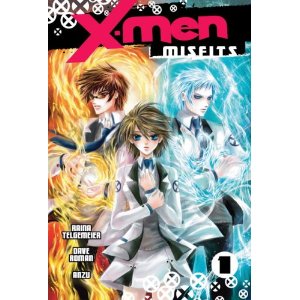
Of all the American manga-style productions, I think X-Men: Misfits must be one of the oddest ones. Why did Marvel lend out one of their franchises for manga treatment? Who had the idea to write a reverse harem shoujo version of the X-Men? What audience was this supposed to appeal to? I think most X-Men fans wouldn’t be fans of the loose way general X-Men continuity was handled in this book, and would manga fans care about the opportunity to look at Quicksilver’s tanned abs? I’ve read plenty of X-Men comics and I’m a big fan of reverse harem shoujo so I found this title incredibly entertaining, if a little flawed.

Kitty Pryde is having a rough year. She keeps accidentally falling through things. Silver Fox Magneto shows up at her house to announce that she has a scholarship to the Xavier Academy. When she gets there, she finds out that she’s the only female teen student in a school full of boy mutants and she’s the object of everyone’s attention. When I realized that this X-Men adaptation was going to be a blatant reverse harem scenario, I thought it was a stroke of genius. The original X-Men comics were essentially reverse harem anyway, with Jean Grey being the only female mutant surrounded by boys. Kitty is torn between FIRE! (Pyro) and ICE! (Iceman). Bobby acts incredibly cold towards her, because he is AS COLD AS ICE! Pyro ensures that Kitty is invited to the Hellfire Club, which turns out to be a separate student faction headed by Angel and including Forge, Havok, Quicksilver, and Longshot.

Anzu’s art is a little overly pretty and occasionally features some stiff poses. I wish she’d spent more time on character design, because there are a few glimmers of enjoyable insanity in the way she depicted some of the older characters. The Beast is a puffy, Totoro-like cat. Colossus switches to his metal form and looks like a cross between one of the Mario Brothers and Tik-Tok of Oz. Sabertooth hangs around the Hellfire club wearing a choker collar and a chain, serving fondue. I think that reverse harem series are generally more effective if there are a manageable number of handsome male characters. X-Men: Misfits has far too many attractive men hanging around Kitty, to the point where they become indistinguishable from each other. I kept getting confused about who Havok and Longshot were, despite the fact that Havok always appears to wear sunglasses pushed back on his head. Gambit is introduced without wearing his customary trench coat, so I didn’t even recognize him. There are amusing cameos from some of the established X-Men characters. Cyclops is a cranky vegan, and Storm appears in her mohawk mode.

Despite some flaws, X-Men: Misfits has a certain loopy charm. I was amused by the endless parade of hot mutant guys and Kitty’s awkward reactions to dealing with her new social environment and her mutant powers. She spends the early portion of the manga wearing a bicycle helmet and skating pads because she can’t really handle her abilities. Kitty does well filling the traditional role of slightly clumsy shoujo heroine, and she discovers that her friends in the Hellfire Club aren’t as benign as they might appear. I’m honestly disappointed that there won’t be a second volume of this series published. As it is, X-Men: Misfits will remain a hilarious artifact of some of the inexplicable aspects of the manga publishing boom.

Categories
Manga Reviews

Skyblue Shore Volumes 1 and 2

Are hot janitors a Thing? After reading Dengeki Daisy and Skyblue Shore, which both feature handsome yet tortured twentysomething janitors, I am now convinced that anyone who wants to find cute men in Japan needs to start staking out custodial closets in local high schools. Skyblue Shore is a fun shoujo manga, with some hints of darkness that keep it from being overly sweet.


Skyblue Shore Volume 1 by Nanpei Yamada

Tomo used to visit the beach daily as a little girl. One day she met a boy who gave her an agate that he found while beach combing. While she went back to the beach daily, she never saw him again. Years later, Tomo’s grown older and she’s left her love of the beach behind. She’s on her way to school when someone starts feeling her up on the bus. A tall, dark and handsome man notices what’s going on and throws the groper off the bus, yelling that no one is going to touch one of his students. He leaves behind a keychain that has the same type of agate that Tomo keeps as a souvenir. This is a fairly formulaic beginning to a manga. Stories about children who reconnect as teenagers are common but even while Skyblue Shore evokes plenty of shoujo cliches, it does so in a refreshing way. The teenage Tomo is a fairly typical shoujo heroine. She’s pretty, popular, and enthusiastic but considers herself average. What makes her stand out a bit from her character type is her tendency to exhibit a strong nurturing streak due to the fact that she’s had to take care of her flighty mother. Tomo stumbles across a sullen boy who has a hairtie that exhibits the same construction techniques as the mysterious stranger’s broken keychain. Ten offers to fix her keychain and she trails him back to a shack on the roof of the school. She barges in and finds an apartment furnished with things from the beach, with elaborate driftwood assemblages. Ten, is of course, the boy who gave Tomo the agate when they were children. While he figures out who she is fairly quickly, she doesn’t connect Ten with her long-lost friend. His older brother Riku is the junior janitor at the school who has a habit of defending high school girls from perverts.

The pairing of an enthusiastic girl and sullen boy can be found plenty of times in shoujo manga. But I enjoyed seeing the relationship between this particular couple in Skyblue Shore. Ten starts taking Tomo beachcombing, and she’s delighted to rediscover one of her favorite childhood pastimes. She exhibits the same degree of excitement about being on the beach that she had as a little girl, but what happened to change Ten from being a happy little boy to a prickly teenager who hides behind his hair? Tomo spends more time with Riku, and promptly develops a hopeless crush on him despite his tendency to treat her like a little sister. Ten clearly cares about Tomo too, so the classic love triangle is all set up. Tomo starts appearing by Ten’s side after school, asking if he’s found any treasures at the beach. When Ten tells Riku that he’s taken on Tomo as his apprentice beachcomber, he says “I think…she’s been waiting a long time for me.”

I enjoyed all the details about the sea that Yamada included. Ten shows Tomo how to bleach sand dollars, and you can practically smell the salty air when the characters go down to the beach. Yamada’s character designs are clean and attractive, and I like the way she varied the body types of the brothers. Riku is clearly more mature, with more of a weighty, adult look while it is clear that Ten and Tomo haven’t finished growing yet.

Skyblue Shore Volume 2 by Nanpei Yamada

Skyblue Shore might initially seem like a charming, slice of life shoujo series that is only differentiated from other similar manga by the beach setting. Where it starts to stand out is the theme of past psychological trauma and potential insanity that is interwoven with all of the nice scenes of Tomo and Ten hunting for agates. A dark female character with unhealthy ties to Riku is introduced in the person of Michiru, who only sporadically attends school. When she comes back she definitely doesn’t approve of Tomo and Riku’s friendship. Tomo observes some close encounters between Riku and Michiru, and is dismayed. While Riku doesn’t cross any lines, it is obvious that they have a shared history and Michiru seems very emotionally damaged. Ten can see straight through Michiru and warns Tomo to be careful of who she makes friends with. Riku shares the fact that he and Ten lost their sister to the sea when Tomo almost drowns. She comforts him, and he asks her to be a good friend to Ten and Michiru. She starts to treat Michiru like a bit of a project, trying to bring her out of her shell and getting her to socialize with some of the other students. When Michiru stops coming to school, Tomo gets her to come by using the only threat she can. She says “Unless you drag your lazy carcass to school, I’m going to claim Riku for myself!”

Riku and Ten are clearly emotionally damaged by their loss, even though Riku might seem to do a better job of appearing normal. It doesn’t seem quite fair for Tomo to be put in the position of emotional caretaker for her group of friends. The blend of slice-of-life stories inter cut with past revelations of tragedy reminded me a little bit of Oyayubihime Infinity without the fantasy elements. Skyblue Shore is only six volumes long, and I’m curious to see if the characters actually manage to work through their various emotional issues and achieve some form of happiness.

Review copies provided by the publisher.
Categories
Manga Reviews

Harlequin Manga – Pregnant Women and Showbiz Babies

It has been far too long since I’ve read some harlequin manga! Much like the romance novels themselves, these manga are perfect to read when you want to switch your brain off for a little while. I’m coming down with a cold, so I relished the opportunity to read about pregnant women who somehow manage to attract the attention of millionaires. I think millionaires must really like motherly types, I have no other logical explanation. All of these books are available for rental at emanga.com.

Claiming his Pregnant Wife – Sometimes it can be tricky to adapt books, even formulaic ones like Harlequin novels. This is a middling example of Harlequin manga, just because there were so few transitions between scenes it felt more like an outline of a story than the story itself. Erin is a tourist in Italy when she becomes stranded and happens to meet a beautiful Italian man named Francesco. They start to date during her vacation and she discovers that he’s been hiding the fact that he’s an incredibly wealthy businessman. They quickly marry, but their new marriage starts to disintegrate when Erin suspects him of being a womanizer like her father. Some of the character motivations seemed to come out of left field – all of a sudden Erin starts not trusting Francesco due to her psychological issues with her parents’ marriage, but this isn’t really hinted at earlier in the manga. It generally had a very choppy feel, with characters suddenly introduced, and various reasons for the couple to be apart worked through. The art was a little static, and looked rushed, with the characters sometimes displaying awkward poses. Not the best example of a Harlequin manga.

The Millionaire’s Pregnant Mistress – This title had more of the loopy plot developments that I expect and enjoy in a good Harlequin manga. Tess is a hard-working chambermaid at a resort hotel who had a one night stand with a rich guest. He turns out to be Benjamin Adams, a millionaire movie producer who is haunted by the death of his wife and unborn son. He wasn’t haunted enough to stop himself from having a one-night stand with a maid though! He makes sure to tell Tess just how emotionally damaged he is after she tells him that she’s pregnant by saying “”Your existence itself will dig deeper into my wounds!” Benjamin decides that he doesn’t want a repeat of his past tragedy and will move her into his mansion to make sure she and the baby are safe during the pregnancy. While he’s planning on taking responsibility for the baby, he doesn’t plan to give Tess anything other than support payments after the baby is born. Tess has a hard time adjusting to the millionaire lifestyle and keeps trying to work at the hotel while she’s living at the mansion. Benjamin and Tess bond over their shared love for the movie Psycho (!) and begin to strike up a friendship. While the art in this title showed most people having problems with triangle-shaped chins, overall the art was a little more fluid and Tess’s glossy hair, limpid eyes, and devotion to her beater of a car made her an appealing heroine.

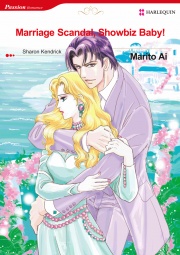
Marriage Scandal, Showbiz Baby!

I was happy when I started reading this volume and saw that instead of the rushed, less detailed art provided for many of these harlequin titles, it opened with a detailed scene of married but estranged actors confronting each other on the red carpet, complete with glossy hair and borders of floating flowers. If there aren’t flowers used as backgrounds in every few pages of a Harlequin manga I feel cheated. Jennifer is an actor and married to Italian superstar Matteo. They’re in the process of divorcing because Matteo romanced the actress that played the evil temptress in their most recent movie. Apparently she is also a temptress in real life. Temptress! There’s a series of flashbacks that show how they first fall in love, when Jennifer was appearing in a play and lured Matteo in because she didn’t care about his fame and wealth. Matteo liked a challenge! Now, as they split up Jennifer’s harpy of a mother keeps lecturing her about the evils of men, and Matteo’s trusty staff don’t put her phone calls through to him. Harpy! Betrayal! Jennifer gets cornered at a party by another womanizing actor named Jack, whose hairstyle, plucked eyebrows, and eyeliner somehow reminded me of John Taylor circa 1983. Duran Duran! Actually many of the fashions in this series ranging from Jennifer’s side-ponytail to the harpy mother’s blouse with attached bow evoked a certain over the top 1980s glamour, which I found amusing because this manga was produced in 2008. Matteo saves her, they get trapped in an elevator, and they make love. Love in an elevator! Jennifer finds herself pregnant, and she and Matteo begin to rebuild their relationship. Because if you need to trap a man, get pregnant! This was highly entertaining, and the lush art did a great job of evoking the fabulous lifestyles of the protagonists.

Categories
Manga Reviews

Manga Moveable Feast: Barefoot Gen and Manga! Manga!

I thought for the Manga Moveable Feast, I write a little bit about where I first encountered Barefoot Gen, in the back of the classic Frederik L. Schodt book Manga! Manga! The World of Japanese Comics. This might be a thinly disguised way of attempting to hide the fact that I didn’t hunt down the collected volumes so my only way of participating in the MMF is to go with what’s on my shelves, but the manga excerpts translated in the Schodt book were also some of the first manga I read. After presenting an overview of the history of manga, Schodt chose the following creators to illustrate the variety stories found in manga for an English speaking audience: Osamu Tezuka’s Phoenix, Reiji Matsumoto’s Ghost Warrior, Riokyo Ikeda’s Rose of Versailles, and Keiji Nakazawa’s Barefoot Gen.

I can’t think of a more jarring transition than flipping from the tribulations of Marie Antoinette to the aftermath of the atomic bomb. The story opens at the start of a normal day, with Gen getting ready to go to school. The bomb drops and his neighborhood becomes a nightmare of destruction, filled with injured people he can’t even begin to help. The schoolboy runs from person to person, seeing a woman with her face melted off, a burned man begging for water, and a little girl with a face full of glass shards. Finally Gen finds his family only to discover his father and most of his siblings trapped beneath a house while a fire rages nearby. Gen gets his pregnant mother away, and she gives birth to his little sister. The child’s first sight is the devastation of war.

Going back and reading this excerpt many years after first encountering it, I’m finding it easier to read. I think when I first read this sample of Barefoot Gen back in the eighties, I didn’t have the background in the visual vocabulary of manga to easily parse the contrast between the stylized, cartoony art style and the images of the bomb’s aftermath. After reading more Tezuka in the intervening years (whose deceptively simple artwork is used to portray any number of heavy situations), I’m finding these pages of Barefoot Gen less strange than I remember. Barefoot Gen is the essence of a didactic manga, with the sole aim to show the horrors of Hiroshima. I wonder if its value as a cultural artifact might be equal to or greater than its literary value. Shodt effectively added Barefoot Gen to the manga canon for English readers by just including it in his book.