Categories
Manga Reviews

Harelequin Manga Series: The Stanbury Crown: Royally Wed

One of the fun things about romance novels in general is the way they are often arranged in linked series, where the relationships of different couples are introduced but you still get a chance to peek in on the previous couples when they show up as supporting characters in subsequent books. Often these series will be linked by siblings, so there just happen to be three unmarried sisters or brothers who all find connubial bliss by the time the trilogy is over. The Stanbury Crown series focuses on an imaginary country called Edenbourg, and here’s a look at the first two volumes in this four volume series.

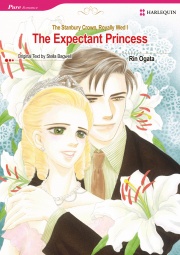
The Expectant Princess by Rin Ogata and Stella Bagwell

Princess Dominique has a hopeless crush on the lawyer for her family, Marcus Kent. She confessed her love for him and was rejected so she decided to throw herself into her studies by moving abroad. Dominique hides her identity while she’s in America. She returns to her family for a royal gathering. There’s plenty of drama in the first few pages of this manga. Dominique’s father the King goes missing under suspicious circumstances. His car crashes but his body isn’t found. Dominique is confused and anxious because she had an affair with a married man while she was in school, and she’s pregnant. Marcus is newly divorced. When Dominique and Marcus come together to investigate her father’s death, he makes it clear that he still sees Dominique as a child and any relationship between them would be in appropriate. Dominique tells Marcus about her condition and he promptly proposes in order to protect the royal family. Dominique rejects him because she doesn’t want a loveless marriage but Marcus begins to realize that he’s been lying to himself about his true feelings. The art and adaptation for this volume were fine, nothing spectacular but perfectly fine for a Harlequin manga.

The Blacksheep Prince’s Bride by Miho Tomoi and Martha Shields

The mystery of the King’s disappearance continues on in the next volume as Rowena goes undercover as a nanny in the royal household. Jake is forth in line for the throne and in need of domestic help because he’s divorced with a toddler son. Jake is the son of the King’s estranged and possibly evil brother, and thus a prime suspect for the kidnapping of the king. While Rowena struggles with an unearned reputation as a fast woman and Jake is trying to clear his name they grow closer. There were a few awkward poses and a little stiffness in the art, but this was offset by some cute character interactions. When Jake finds out that Rowena is a spy he’s annoyed not because she lied to him, but because he’s worried about how she views her own safety – what if he’d turned out to be an evil kidnapper and she went into his house unprotected? Everyone comments that while Jake may be a suspect he couldn’t possibly be guilty because he likes children and puppies. So, if you might find yourself suspected of kidnapping obscure European royalty, be sure to accessorize yourself with an adorable moppet and some wee doggies. Overall, I thought this volume was pretty much right in the average in terms of Harlequin manga quality. I’m still amused by the idea of finishing up this series by different authors and illustrators and I have to admit that my hopes are higher for the next book in the series, Codename: Prince because that title just seems intrinsically entertaining.

Access to electronic copies provided by the publisher.

Categories
Manga Reviews

Gente Volume Three

Gente Volume Three by Natsume Ono

More than anyone else, Natsume Ono’s manga excel in creating an atmosphere and sense of place. While I love reading manga set in many different places, there are few that I’d actually want to visit in real life. If it was possible to visit Natusme Ono’s Italy, I’d love to go there. With Gente‘s emphasis on good food, friendship, complicated relationships, and quirky bespectacled gentlemen, it easily inspires the reader to start packing for an imaginary vacation. The final volume of Gente continues in the slice of life trajectory established in the previous volumes. There aren’t any resounding conclusions, just the chance to visit the people of Casetta dell’Orso once again and see that their lives continue as always.

The first story in the volume focuses on a politician and restaurant customer who has an unusual way of ordering his day. He listens to fortunes told by his little granddaughter because they always seem to come true. He comes to a crossroads in his life and makes a decision, helped along by a prediction and a good meal. A darker side of love is explored in “Singore Rizzo’s Fancy,” where the womanizing half of an estranged couple finds himself hopelessly attracted to a woman who is uninterested in him. Rizzo decides to try to arrange for the happiness of the woman who has inspired his affection, even as he continues his relationship with his wife where passionate love has changed into a combination of hostility and familial feelings. The closing image is of Rizzo and his wife sitting in different chairs, smoking and looking off in different directions. Nicoletta observes all these relationships play out at the restaurant while still nursing her love for the waiter Claudio. In some ways, this volume does feel like a closing volume for Nicoletta’s story that began in Ristorante Paradisio. She talks with her stepfather Lorenzo about the ways he serves as a father for her and for the family of workers at the restaurant. He’s starting to grow older, and might be turning into a bespectacled older gentleman himself. The mysterious Gigi supports Nicoletta and then goes off to make an unexpected acquaintance. While the ending might not be a Hollywood style conclusion where Nicoletta takes her relationship with Claudio to the next level, it is nice to see her in such an emotionally supportive environment (perhaps because her mother is absent). The bonus story at the end shows the staff getting together to celebrate young Franc’s birthday, which provides a nice festive way to conclude the series.

As always, I enjoyed Ono’s loose and unfinished drawing style. Just as the subject matter of her manga provides place where I’d want to visit to relax, her illustrations manage to be both lively and restful, with just the essential details portrayed.

]]

Review copy provided by the publisher

Categories
Manga Reviews

Ai Ore: Clever Satire or Anti-Female Trash?

I wasn’t going to write about Ai Ore again so soon after posting my initial review, but I got into a conversation on twitter the other night that is causing me to rethink my initial reaction.

Jason Thomson posted: Dear Internet: Ai Ore is a comedy. I think it’s meant to be more like DMC than an actual romance. You can still find it offensive of course.

I was a little disappointed that Ai Ore didn’t completely follow through with the promise of its gender switching premise. I didn’t really react to the threat of rape at the end of the volume, other than to note that it was a disappointing way for the manga to end. I honestly am not surprised to see rape threats or coercive sex in a Mayu Shinjo series, I was actually a little bummed out that there was no bondage, amnesia, or evil hypnosis on display the way it was in Sensual Phrase. Other manga bloggers reacted more strongly to the rape scenes and cliched plot elements, and I can certainly understand why. When Jason compared Ai Ore to DMC I started thinking about this manga some more to see if I could find more evidence of parody. All the rape references in DMC are much funnier and easier to take, because they tend to involve inanimate objects like the Tokyo Tower or extremely improbable targets like sweet elderly grandparents. Nancy Thistlethwaite, who edits Ai Ore, said “…if Shinjo is subverting anything, it is how women are portrayed in ero manga. & she’s having fun with it.

Is Shinjo ever really trying to be taken seriously? I don’t have most of my issues of Sensual Phrase, but I did pick up volume 3 where rock star hero Sakuya has been shot up with drugs and chained to a wall while his brother tells the heroine Aine that she has to have sex with him or Sakuya will be killed. Later Sakuya shows up after surviving withdrawl through sheer willpower. He splits up his band in order to become an incredibly successful businessman in three months so he can bargain for Aine. He gets her and his band back, and then tells her that he’s going to withhold sex from her because she’s so happy she isn’t writing good song lyrics anymore. Does someone who writes a manga where events like that take place in the first 3 chapters turn around and write another manga without their tongue firmly in cheek?

But If Ai Ore is satirical, it doesn’t do a fabulous job of signaling this in the first volume. Perhaps it would have been easier to take if the masculine female lead Mizuki was a national landmark like Tokyo Tower or Nagoya Castle. If Ai Ore is more like DMC than a more straightforward gender switching shojo manga like Hana Kimi, how can we look at the characters and situations it portrays?

Is it commenting on stereotypical characters portrayed in Yaoi and ero manga? I’ve never been entirely comfortable with some of the rigid roles and forced sex in yaoi manga. The roles of seme and uke are taken on by Mizuki and Akira, with their appearances and gender serving as a start contrast to their roles. Mizuki’s masculine swagger is a mask for an insecure girl, and Akira’s feminine exterior is at odds with his alpha male/stalker/macho personality. The way the characters are drawn, it was impossible for me to read any scenes of Akira physically dominating Mizuki without thinking that something was seriously off. It might be a reflection of her confidence in her physical prowess, but I thought it was more than a little odd that a girl with Mizuki’s build was constantly getting into situations where she didn’t seem to be capable of using her advantages of strength and height to escape. But if Mizuki is a stand in for a uke who happens to be trapped in the body that resembles a male supermodel when she’s dressed up, maybe Shinjo is setting up these situations to make the reader uncomfortable deliberately. If some readers may accept these roles without question in other genres, perhaps the squicky elements that are introduced in Ai Ore when Shinjo plays out her gender-flipped scenario are a deliberate statement. If these roles are acceptable to some readers when presented in a yaoi context and unacceptable when presented in a heterosexual relationship, maybe Shinjo is being deliberately satirical. Ai Ore does seem like it could be read multiple ways. I’ve seen comments from readers that refer to it as being enjoyably trashy, a deliberate parody, and deeply offensive to feminists. Maybe it is all three things. In any case, I’m willing to sick around for the next few volumes of the series to try and figure it out.

Categories
Manga Reviews

Shoujo Quick Takes – Black Bird 8, Stepping on Roses 5, and Seiho Boys High School 5

Black Bird Volume 8

I read the first couple volumes of Black Bird and decided that the romance between a young girl and a dominating demon just wasn’t for me. I wasn’t all that thrilled with all the wound licking going on, and for whatever reason in my tawdry manga I prefer the flat out trashiness of something like Ai Ore to the more romanticized Black Bird although both titles display the same type of troubling and stereotypical gender roles in their main couples. At least Ai Ore is more open in its commitment to crazy plot elements, with all the rape threats, etc. right there on the page. In contrast, Black Bird tends to coyly hide elements of sexual coercion with all the accidental wounds and subsequent licking going on, along with a heroine who would happily sacrifice her existence for her demon boyfriend. This volume of Black Bird marks a bit of a turning point, as Misao and Kyo may finally have to get it on. Not because they mutually decide to take their relationship to the next level as an expression of their love, but because Kyo is afflicted by a horrible curse (which manifests in the form of exhaustion and tribal tattoos) and only Misao’s becoming his demonic bride can heal his affliction. I enjoyed this volume more than I expected but for a large section of the book I was really hoping that bad guy Raiko would prevail with his demon hunting mission and actually kill Kyo. I have a feeling I’m not supposed to be rooting for the death of the romantic lead in this manga.

Stepping on Roses Volume 5

I originally felt a little resentful towards this title because I thought it was more superficial than Ueda’s other series Tail of the Moon, which is one of my favorite historical shoujo manga. After reading a couple volumes I think the Perils of Pauline troubles that beset Sumi are starting to be more amusing than annoying, just because Ueda manages to pack so many problems into a single volume of manga. In the fifth volume Sumi is still in her marriage of convenience with wealthy businessman Soichiro. The evil Natsuki has succeeded in driving away Soichiro’s faithful butler and inserting a spying maid into Sumi’s household. Soichiro’s best friend Nozomu is still in love with Sumi but that didn’t stop him from marrying a random rich girl, who is not pleased that her husband is in love with someone else. So! Sumi and Soichiro are growing closer, but when he asks her if she loves him she replies no. He conveniently has forgotten that when they married he instructed her not to fall in love with him and he walks out in the rain. Sumi goes after him and gets soaked. Nozomo has moved out of his house, leaving his wife alone after she caused a scene at a party by attacking Sumi with a bouquet of flowers. Nozomo spends his time alone creepily working on an epic naked painting of Sumi, and when he finds her outside his house he decides to finagle her into posing for him. In the meantime Sumi’s hapless brother with a gambling addiction is trying to go straight by working at Soichiro’s company, and Soichiro’s long lost butler has moved in with Sumi’s poverty stricken family. Whew! I do wish that Sumi had a bit more of a personality, as her main function seems to be making futile attempts to ward off the attentions of almost every man who stumbles across her.

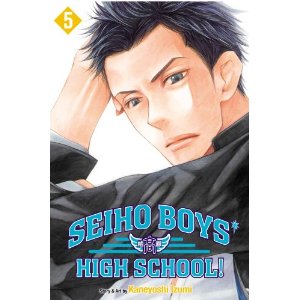
Seiho Boys High School! Volume 5

This volume was my favorite in this mini-batch of manga. I enjoy the self-contained short stories in each volume, but since the series uses the same rotating cast of characters, the reader still gets plenty of character development. Having the stories written more from a male point of view also provides a nice contrast to more conventional shoujo titles. The first couple stories explore Maki’s situation as he remembers his dead girlfriend and struggles on a first date with his new girlfriend. A ghostly image starts appearing to many of the guys at the dorm, and Maki wonders if his girlfriend Erika is trying to signal something to him. The ghost ends up being a hermit-like male student, but Maki has an unexpectedly touching dream triggered by the episode that may be a signal that he’s truly ready to let go and move on with his life. Unfortunately moving on can be difficult, as he attempts to go on a date with his current love interest and starts tensing up and making the situation even more awkward. Stories about relationships are balanced out by more comedic episodes, as Hanai accidentally finds his photographic ambitions recognized when he starts getting besieged by girls from other schools who want pictures of his classmates. The ongoing storyline about ordinary girl Miyaji and extraordinary male specimen Kamiki gets a little bit of progression as well. This manga strikes me as a good series to have around to reread. The episodic nature of Seiho Boys High School makes it easy to pick up a random volume to read, and the short stories provide plenty of humor and emotion.

Review copies provided by the publisher.

Categories
Manga Reviews

Manga Moveable Feast: Rumic World Trilogy Volumes 2 and 3

Rumiko Takahashi is one of those manga artists whose influence it is impossible to overstate, but the prolific nature of her manga series might make her works seem a bit daunting to the average reader who might not feel like picking up 56 volumes of Inuyasha or 36 volumes of Ranma 1/2. Many manga bloggers are choosing to focus on shorter series and her short stories this week, and I’m no exception as I decided to finally read a couple volumes of the Rumic World Trilogy that I’ve been hoarding for just such an occasion. Somewhere in a closet I have stashed a few single issues of Uresei Yatsura and one of my favorite Takahashi stories, Firetripper, which appears in collected format in the Rumic World Trilogy Volume 1. Firetripper is probably a contributing factor to why I like Shinobi Life so much, as it features a time traveling romance about a girl from modern times who ends up meeting a warrior from the past.

The second volume of the Rumic World Trilogy is almost a self-contained volume, as it features five stories with the same characters bookended by two short stories, “The Golden Gods of Poverty” about an unfortunate boy who is used by his rapacious parents to summon the lucky gods who don’t seem to be very lucky anymore, and “The Entrepreneurial Spirit” about fundraising seances in high school.

“Wasted Minds” are the five linked stories in this volume, which are a comedic adventure story about two spies with special powers. Yura Enjoji functions as the team’s strongman, and she is fiercely protective of her long hair. Tamuro Gomi’s last name (trash in Japanese) is a reflection of his skills because he is a teleporter who can only teleport from trash heap to trash heap. They start investigating a rival spy agency along with their hapless handler. They run into pigs that transform machines into trash, sea monsters, and a school for teen juvenile delinquents. As they flit from garbage dump to trashcan, there’s plenty of adventures and a little bit of romance. Whenever I pick up a Takahashi title, I’m struck by the simplicity of her illustrations and clear action sequences of her art. It seems like many manga titles today rely on an abundance of screen tone and occasionally confusing panel composition, so it is a relief to my eyes to pick up a title like this that is so easy to read.

The third volume of this series features a nice selection of short stories. I enjoyed the first one, “Wedded Bliss” about a new couple who happily fights all the time to the detriment of their neighbors. “War Council” was an amusing take on the “evil student council” type story that so often pops up in manga, as an ordinary boy who agrees to serve as student council president because he has a crush on the vice president is caught between the warring factions of the jock student organization and the nerd student organization. “When my Eyes Got Wings” shows more of a horror influence as a sick boy with a scary pet bird develops a crush on a high school girl, and strange things begin happening around her boyfriend. “Sleep and Forget” is a dramatic romance that resembled “Firetripper” in plot and tone. A girl and boy with a connection to dogs relive and reenact events from their past lives, as they struggle with the vicious spirits of a dog and the old woman that was its master. “The Face Pack” is a goofy story about a group of students dedicated to the art of disguise. Also included is an autobiographical sketch of what happened to Takahashi when she suddenly found herself cat-sitting. Out of all of the stories in this volume, I found “Sleep and Forget” the most memorable, just because tend to enjoy Takahashi when she turns her hand to more serious stories that blend action and romance.

If you’re a little intimidated by the thought of tackling Takahashi, I think that these Rumic World Trilogy volumes are a worthwhile investment. While they might be out of print, they are still easy to acquire. Sometimes when reading anthology manga volumes, I put them down thinking that most of the stories were auditions for longer series that didn’t quite make the grade. I didn’t get that feeling when reading the Rumic World stories, as everything seemed nicely resolved and self-contained.


Check out the Manga Moveable Feast for more bloggers talking about Rumiko Takahashi
.