Categories
Manga Reviews

Demon Sacred #4, Shinobi Life #7, and Karakuri Odette #6

Ah, the last volumes of series published by Tokyopop. I can’t help but feel wistful when I think about not being able to read the end of these series. And since a decent number of volumes for both of these were published, I can’t imagine another company would pick up the licenses. Fortunately after feeling mournful about Demon Sacred and Shinobi Life, I was able to read the concluding volume of the ever delightful Karakuri Odette.

Demon Sacred #4

After the first few volumes of non-stop insanity with all the demons manifesting on earth as pop idol duplicates and reverse aging syndrome, the fourth volume is a little bit more settled. It felt to me like Itsuki was digging in a bit with her typical slow world building. One revelation I found interesting was that the immortal demons are attracted to humans due to their mortality. If a human ever truely loves a demon, the demon may finally receive the gift of a revered type of death. Shinobu’s evil sister Zophie manages to coax her way into his apartment by bribing K2 with pastries, and as soon as she gets a glimpse of the demon she decides to use her cougar wiles on him. Mona is less than thrilled about her demon running off with an older woman. Rina is dealing with the emotional effects of her reverse aging. Shinobu’s family and the government are introducing an anti-demon military and propaganda campaign and they’ve decided to approach Keito to act as their celebrity spokesperson. I love the way Itsuki manages to construct a story out of the most improbably elements but still manage to make everything happening seem believable and natural. With so many volumes left in this series, I’m really curious about where the story would have gone.

Shinobi Life #7

It seems like with every volume of this series there’s a surprising character revelation. Beni is trapped in the past with a younger version of Kegetora, while Kagetora travels to a time in Beni’s past when she is a little girl and her mother is alive. Beni is navigating through all the treachery and suspicion that surrounds Kagetora’s ninja clan, struggling with her feelings for a teenage Kagetora who hasn’t turned into the man she loves yet. Kagetora gets to observe a young Beni’s interactions with her mother, and he makes the discovery that Beni’s father is a time traveler as well. Beni’s mother describes what happens when travelers meet themselves, and Kagetora is determined to keep jumping through time until he finds her again. This was another great volume of Shinobi Life, and I’m sorry that I won’t be able to read the rest of the series.

Karakuri Odette #6

The final volume of this series has one of those open-ended conclusions that I sometimes find annoying, but Karakuri Odette has always been so episodic it didn’t bother me that no big plots were wrapped up at the end. Odette’s robot girl uniqueness is explored further when the sibling robots of rival creator Dr Owen cause further complications in her life. Travis has decided that Odette should be his robot bride. Even though Grace has a lower level of artificial intelligence, she’s jealous of Odette. Owen sees that Odette is superior to his own creations and is determined to grab her so he can find out how she became so advanced. Owen’s strategies to capture Odette result in horrible failure. He underestimates the capabilities of his own robots to decide on their own actions. He approaches Odette himself with a “Hey little girl” type line that she immediately sees through. Finally, he tries to get Odette’s human best friend Asao to deliver Odette to him, with disastrous results. Odette is working through the idea that she might not have a companion for life. Asao is moving on and graduating, and as much has he professes not to care for the robot girl, he still appears to help her whenever she’s in trouble. Chris just lurks in the background being silently supportive and Travis isn’t suitable for a number of reasons. Odette’s final lesson in her journey to becoming human is understanding the nature of change. As the school year ends, all the characters seem to be capable of moving on in their own ways.
Categories
Manga Reviews

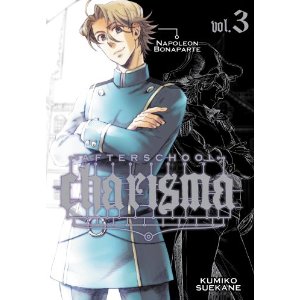
Afterschool Charisma Volume 3

I’m always happy to read a new volume of Afterschool Charisma. This series about teenage clones of historic figures, their vaguely menacing high school, and the seemingly normal boy trapped with them just has a certain kind of pulpy appeal that I find enjoyable. The cover model for this volume is the uncharacteristically tall teenage Napoleon Bonaparte. At the end of the previous volume non-clone Shiro got a nasty shock when an older version of himself showed up with a pint-sized resurrected Marie Curie, nicknamed Pandora. Mozart yells “Welcome to the clone world, Shiro!” Freud points out that other than the fact that there’s someone that looks a lot like Shiro, they don’t have any confirmation that Shiro actually is a clone. Shiro wants to find his dad so he can ask him about what’s going on. Mozart goes around acting unhinged, and Joan of Arc is preparing to reenact her predecessor’s fiery death.

School director Rockwell reveals a maniacal side underneath his seemingly breezy personality. The shadowy group of people orchestrating the Dolly the Sheep religion finally make themselves known as the school festival draws a variety of visitors who wish to observe the clone’s special talents. One disappointing thing about this volume for me was that we didn’t see much of Clone Freud being awesome. He’s mostly just taking in everything about Shiro, wondering who he actually is, and observing the reactions of those around him. I’m expecting something dramatic from Clone Freud in the future. The pacing for this manga is very good if sometimes a little frustrating. There’s always a dramatic cliffhanger at the end of each volume which leaves me wondering what will happen next.

Review copy provided by the publisher.

Categories
Manga Reviews

Blue Exorcist Volumes 1 and 2

When I start to read this I realized that I was going to sample the first two volumes of this series on two different platforms. I bought the first volume on the Viz iPad app when it was on sale, then I was sent a print review copy for the second volume. I expect as I transition more to reading things on my iPad that my physical and virtual bookshelves will fragment even more, with volumes of the same series scattered between them.


Blue Exorcist Volume 1 by Kato Kazue

I tend to skim rather than read closely reviews of series that I might later end up reviewing myself, but my general impression of the response to this first volume is that most manga bloggers thought it started out sort of rocky and then stabilized a bit in the final chapters. This was pretty much my response to the first volume as well. The intriguing elements of this manga for me initially were the character designs and art. The story seemed poorly paced, with too many elements and twists introduced in so few pages it was hard to keep track of what was going on. Rin is a troubled young man who lives in a monastery with his guardian/priest and his seemingly timid younger twin brother Yukio. In the first few chapters it is revealed that Rin’s guardian is a powerful exorcist, Rin is the son of Satan and thus demonic, and evil demons walk the earth that must be battled. Rin gets a magic key and a special sword, Rin’s guardian is possessed by Satan, there’s a terrible fight, a headmaster who enjoys wearing knickers and a top hat tells Rin he has to enroll in a special school for exorcist, Rin goes to boarding school and finds out that his younger brother has been hiding his identity as a gifted student of exorcism all along. All of this happens in roughly the first chapter. That is a lot of plot to wade through in order to set up what is essentially a Harry Potter like situation of a young, not very gifted boy suddenly enrolling in exorcism boarding school.

Once Rin is at school, things settled down a bit and I was able to enjoy the manga a bit more. The visual design of Blue Exorcist is appealing. The characters are all wearing gothy punked out clothes that would serve as good inspiration for a cosplayer. I was really interested in the few glimpses of Blue Exorcist’s setting. True Cross Academy is shown as a mini city full of buildings with different architectural styles stacked up in a hill, with multi-level roads running through it. There seems to be a system of different keys acting as dimensional portals, and Rin soon finds out that school is going to be challenging, as he has to hide his identity as Satan’s son while attempting to study for the first time in his life. Rin’s slight fangs and sloppiness contrast with Yukio’s buttoned up personality and glasses. Rin finds out that the little brother he always thought he had to protect is more competent at demon fighting than him.

Blue Exorcist Volume 2 by Kato Kazue

Like most shonen manga, after the inital set-up, Rin starts gathering a team of allies around him. The first is a gentle girl named Shiemi, who is devoted to gardening and traditional clothing. When Rin helps save her, she promptly decides to enroll in exorcism school too. The second volume focuses on the rocky relationships between the characters. Rin keeps falling asleep in class and is shunned by the other students. Shiemi is bullied by her female classmates. Rin’s classmate Suguro hates Rin because it seems like he’s not taking school very seriously. The confrontation between Suguro and Rin soon becomes physical as they take risks during their demon fighting lessons. The students begin to explore their powers. Shiemi’s affinity for plants allows her to summon a familiar that can produce healing herbs on command.

Kazue’s character designs are very distinct, so it was easy to keep track of Rin’s classmates. The second volume mixed classroom action with the students getting to know each other. It seemed a lot more consistent, and even though “students train to develop super powers” isn’t a particularly innovative concept to build a manga around, so far I’m enjoying the way it is executed in Blue Exorcist. If the third volume continues the upswing in story quality, I’ll likely be hooked on this series. Blue Exorcist is certainly one of the more stylish shonen manga to come out recently, and it seems like the author is improving. I’d recommend reading the first two volumes at once, because the first volume isn’t really enough to give a reader a full picture of what the series is going to be like.


Review copy of volume 2 provided by the publisher

Categories
Manga Reviews

Harlequin Manga: Ridge: The Avenger, Codename Prince, and An Officer and a Princess

Ridge: The Avenger by Leanne Banks and Keiko Kishimoto

I tend to like Harlequin manga the most when the art is ridiculously old fashioned. If the adaptation has art that looks a little bit like a throwback to the 80s, I tend to enjoy the goofy storylines of these books even more. Kishimoto has a lush style, featuring bee-stung lips. In some scenes I was reminded a tiny bit of Yumi Tamura’s Basara, especially with the angular proportions of the hero’s face. The hero in question is bodyguard Ridge, assigned to protect the goddaughter of a presidential candidate. He thinks Dara is spoiled and silly. Ridge has an ulterior motive in being assigned as Dara’s protector. What could it be? He is out for REVENGE! Ridge’s tortured past (this must be why he seems to be pouting so much) has led him to want to destroy Dara’s godfather and his political future.

Ridge and Dara bond with each other over assassination attempts and their horrible fashion choices when rollerblading. While they fall in love, Ridge is still out for REVENGE and he might destroy Dara’s life! But he loves her! The art in this title is really much better done than most Harlequin manga. There were interesting panel layouts, perspective shifts, and the character designs were attractive in an old fashioned way. This was a fun read.

Codename: Prince by Megumi Toda and Carla Cassidy

Codename Prince is the third book in the Stanbury Crown series. Royal cousin and military man Ben is posing as his cousin Prince Nicholas in order to get himself kidnapped and collect intelligence on the group who has kidnapped the King of Edinburg. His captor is the attractive woman Megan who has been blackmailed into helping her brother with his nefarious schemes. Megan has a young daughter who the kidnappers threaten to hurt if she doesn’t help them. The story opens with Ben tied up on a bed with a teddybear placed next to him, slowly developing a hopeless crush on Megan. Codename Prince is very short, and doesn’t really contain the type of spying shenanigans I was hoping for based on the title. The art is simple and fluid, without some of the stiffness that seems to plague many of these quick romance novel adaptations.

An Officer and a Princess by Megumi Toda and Carla Cassidy
This series wraps up with the final volume, where the princess of the family decides to go undercover with her crush to unravel the mystery behind her father the king’s disappearance. Isabel had to give up her dream of serving in the military for her princessy duties, and her good friend and fellow officer Adam tends to view her only as a princess and not as a woman. When they pose as man and wife, will their love finally blossom?

By the end of the series, I think I liked the concept of linked books with overlapping characters a little more than the actual execution of it. The King certainly managed to stay kidnapped for a long time, as four royal couples managed to get married off while he was missing. A certain level of sameness started to settle in with the plots of this series, so while these manga weren’t the worst Harlequin manga ever, they ended up not being all that great either. These were still perfectly serviceable for someone wanting a quick summer read.

Access to electronic copies provided by the publisher.

Categories
Manga Reviews

Kaze Hikaru 15-18

Some series I find immediately appealing and others grow on me over time. In the case of Kaze Hikaru, I liked it well enough when I read the first volume but it wasn’t until I was able to check out a bunch of volumes from the library at once that I was completely won over and decided to slowly collect the entire series. I worry a bit about this series, because I get the impression that it isn’t a very strong seller and it is 29+ volumes in Japan. Kaze Hikaru is a meticulously researched romantic adventure about a girl named Tominaga Sei who decides to disguise herself as a boy with the alias Kamiya Seizaburo and enter the ranks of the Shinsengumi (shogunate special police) to avenge the deaths of her family. She quickly falls in love with her mentor Okita Soji who knows her true identity but remains willfully oblivious to his own feelings for her.

In the 15th volume Kamiya struggles with the idea of undergoing the male coming of age ceremony called Genpuku. She’d have to shave off her bangs, and then she’d lose the ability to occasionally dress as a woman by rearranging her hair. Everything gets thrown into even more confusion when a visiting doctor shows up who used to train with Kamiya’s father. Soji and Kamiya struggle to protect her identity, sending her into town when the doctor announces that he’s going to give everybody at the compound a physical in order to improve the health of all the men. Kamiya accidentally blurts out “Uncle Droopy Eyes” when she sees the doctor, and wonders if he’s recognized her from when he saw her before as a little girl.

Doctor Matsumoto ends up finding out Kamiya’s secret through some trickery by suggesting to Soji that she’s sick. Soji runs off to find her and rushes her to the doctor, not realizing that his extreme anxiety is due to the fact that he loves her. The doctor promptly starts trying to arrange her marriage to Soji. She says that she’s content to stay by his side to support him as a colleague. Matsumoto quickly diagnoses with the terrible disease of “feminitus,” which causes regular men to grow feminine characteristics, and her colleagues are instructed to support her manly efforts and avoid mentioning her girlish looks. This has the fortunate effect of throwing off the suspicions of some of Kamiya’s colleagues, at least for a little while.

Matsumoto appears again in the next volume, this time to give Kamiya perspective on her lost family. When she was a little girl she almost never saw her father because he spent so much time away pursuing his medical training. Kamiya still feels betrayed and resentful, and her closeness to her older brother was largely due to her father’s absense. Matsumoto points out that Kamiya’s father and Soji share similar characteristics. Both have entirely dedicated themselves to their studies, leaving little time for personal attachments even though they both feel deeply. Other romantic entanglements are highlighted, as Sanosuke wishes to make a merchant’s daughter his bride and a woman is coming to Soji with a marriage proposal. Kamiya is filled with anxiety. Soji’s attitude towards meeting a woman is that he’ll do it if it is a direct order from his superiors. In keeping with his continued obliviousness, he speculates to Kamiya that it might be better for him to marry a woman that he doesn’t love, because it won’t get in the way of his duties.

It was nice seeing Kamiya’s relationship with Matsumoto continue. She doesn’t really have any confidants so it was good to see that she finally had someone she could go to to talk with, even though his general reaction to her situation and decisions is disbelief that such a stubborn girl could exist.

The next two volumes move away from romantic angst towards political issues with the Shinsengumi. In Kyoto a troop captain is managing to alienate the locals with his policies, and his extremely suspicious nature is damaging towards morale. When Kamiya goes to visit him along with Soji and Kondo, Sanjuro promptly fixates on Kamiya as a possible spy since she seems so friendly to men in different troops. Sanjuro tasks his younger brother to spy on her, and Kamiya yet again faces her secret being revealed. Soji comes to the rescue, but Kamiya decides she has to figure out what on earth is wrong with Sanjuro to cause him to act in such an extreme way.

It seems like factions among the Shinsengumi are being set up as an even bigger problem, as the sneaky Ito has decided to set himself up to subvert the leadership of the troop by recruiting the men to his side. We see Kamiya training on firing a gun, and the philosophical differences between those who prefer the way of the sword to gunpowder and bullets are explored. Soji tries to help the woman he has a long-term relationship with. Kohana served as a cover for his vow of celibacy, he visited her and used his time to take naps. He explores the possibility of setting her up in a house with her daughter, but she’s come to have feelings for him and refuses. Kohana doesn’t want to be with Soji due to his sense of duty, if he doesn’t actually see her as a woman. Kamiya finds out what’s going on, but as usual the unarticulated feelings between her and Soji mean that their relationship will continue to function mainly as mentor and mentee. While Soji is trying to look out for Kohana, he also commissions a special lightweight sword for Kamiya. The next problem everybody will face is the love of the Captain for a mysterious woman. Kamiya is tasked by the Vice Captain with finding out about her true nature, as the Captain suffers in silence.

I think Kaze Hikaru is best read in multiple volumes like this. The story unfolds at a measured pace, and even though plenty of things happen, it doesn’t usually have any real end of volume cliffhangers to incite anxiety in the reader. I always enjoy Watanabe’s notes at the end, where she’ll clarify some of the historical information and point out where she took artistic license with known people and historic practices. Except for a few stray volumes, I’m all caught up with the English release for this series! Kaze Hikaru might not be the flashiest series out there, but the rich historical detail and slow building romance reward the patient reader.