Categories
Manga Reviews

Shoujo Goodness – Library Wars and Kaze Hikaru

I will concede that there are many shoujo series out there that are better executed than Library Wars, but I will always love this manga because I am a librarian and this manga is about paramilitary librarians falling in love. While some of the plot contrivances in Library Wars are a bit on the thin side, it still functions wonderfully for me as a cute fluffy read. The main story in this volume centers around the enigmatic Komaki and a young deaf girl who he picks out library books for. Komaki might be deluding himself that he’s only performing reader’s advisory services for an old family friend, but as Marie grows up she falls in love with him. Their relationship is totally innocent, but this doesn’t stop the Media Betterment Committee from making false accusations, kidnapping Komaki, and tying him up and torturing him. Because that’s what happens if you are accused of making insensitive book recommendations. With the eyes of a young girl in love herself, Iku clearly sees that Marie cares for Komaki and takes her along on a rescue mission, even though Dojo objects.

I do wish that Dojo would stop slapping Iku whenever she’s trying to strike out on her own to do her job. He usually does this just before she’s supposed to rush into danger, but it suggests an unhealthy relationship dynamic, which I don’t think the author is going for. Aside from foiling the Media Betterment Committee and dodging her parents, Iku does have a great moment where she gets a surprise makeover as part of her guard duty at a literary event and Dojo spends most of his time fending off other men. So nothing earth shattering in volume 5, this installment is pretty much exactly what the previous volumes delivered but it is good enough for me. I was amused that when Dojo was chiding Iku about her reference duties, he called it “referencing,” which I thought was a bizarre but charming way of referring to the classic reference interview.

I love the cover for this volume! Most of the previous volumes had daytime scenes, so it seemed like a nice change to feature the characters against a night time backdrop. I’m a little concerned about Kaze Hikaru. I’d been behind on this manga but then decided to read a good chunk of the most recent volumes. I hadn’t realized that there was a year between volumes 18 and 19. Now there are 28 or so volumes out in Japan and the series is still ongoing, and I’m wondering if we really will get the complete series out here. Kaze Hikaru isn’t a manga that clobbers the reader over the head with tortured vampire bishonen but it is exceedingly well-crafted, with plenty of historic charm and angsty cross-dressing.

As always, Kaze Hikaru blends historic details with the drama provided by the slowly developing relationship between Sei, disguised as a boy to enter the Shinsengumi and her mentor Okita who knows her true identity. This volume was a little more heavy on the historic politics front, as it detailed some of the maneuvering from the arrival of foreign ships outside Japan. Sei is on a mission to locate a mysterious geisha Captain Kondo fell for, as he is overcome with illness. Sei’s girlish good looks become a problem for her mission, as she heads into a confrontation with a man named Ukinosuke who appears to be a dissolute drunkard. Okita arrives just in time to help out, and Kondo is able to finally meet the woman he fell in love with. Ukinosuke is revealed to be an alias for a very important man, and Kondo’s devotion to his duty ends up influencing a critical decision from the shogun. Sei ends up comforting and supporting Okita for a change, when he thinks he’s been put aside by the captain. The volume concludes with a delightful stand-alone story where Sei and Okita confront the bad reputation of the Shinsengumi and meet a pioneer of photography in Japan.

I’m always amazed at how much story Watanabe is able to pack into one volume and the fact that even though the relationship between Sei and Okita is progressing at such a slow pace, I don’t feel impatient about the idea of the story of Kaze Hikaru needing to resolve anytime soon. I think I’ll start to get impatient if I have to wait a year for volume 20 though!

Review copy of Kaze Hikaru provided by the publisher.

Categories
Manga Reviews

Shonen Quick Takes – Arata, Nura, and Seiya

Arata Volume 5 I think I’m really hampered from fully enjoying this series due to my familiarity with Watase’s other works. Modern Japanese Arata still is putting together the pieces of his quest in a fantasy world with an imperiled princess, while the Arata he switched places with is back in Japan navigating the difficulties of modern school life. Watase does do quest storylines very well, but there’s not much new here to someone that’s already read the piece/people collecting narratives of Fushigi Yugi and Fushigi Yugi: Genbu Kaiden. I continue to me more interested in the other Arata’s adventures in Japan, and in this volume he gets an unexpected ally when a classmate sees through his disguise. What disappointed me was the plot twist at the end, which seemed so reminiscent of the whole Miaka/Yui dynamic in Fushigi Yugi that it didn’t carry much suspense or dramatic tension for me.

Nura: Rise of the Yokai Clan Volume 3

Nura: Rise of the Yokai Clan continues with its well-executed story of a boy who happens to be the heir to a clan of demons. Nura confronts the rebellious Guyki, and comes up with some clever maneuvering with clan politics when his grandfather announces his intention to make Nura his formal heir. Nura’s classmate Kana is menaced by yokai, and when Nura’s older and stronger form comes to her rescue a little bit of a Lois Lane/Clark Kent dynamic develops when Kana suspects that her classmate and the powerful yokai boss might be connected. The volume wrapped up with a story where Nura’s grandfather meets the powerful exorcist Yura, who attempts to defend the old man she assumes is human from a yokai assassination attempt. There’s plenty of action in this manga, which is enlivened by all the off-kilter character designs used for the yokai. I think this is one of the more solid recent shonen manga series from Viz.

Saint Seiya: Knights of the Zodiac #27

My favorite of this recent batch of shonen manga was by far Knights of the Zodiac. I don’t collect every volume, but I’m always happy to read it when I come across one. The over the top manly shouting and endless battles between gods ensures that it isn’t too hard to just pick up a ransom volume and enjoy it, without worry too much about the ongoing storylines. Basically I read Knights of the Zodiac for two things: crazy battle shouts and ridiculous moments of insanity. The Bronze Knights are about to battle the henchmen of Hades, but there are horrible complications that might prevent them from being effective in battle. Awesome battle cries were in evidence from the first few pages as Dragon fights a trio with their “Grand Axe Crusher!, Blood Flower Scissors!, and Annihilation Flap!” No! Not the Flap! The craziest image in this manga occurred when Thantos was describing to Seiya how he trapped Athena in a vampiric urn, which slowly turns red as it absorbs all of her blood, thus killing her. Athena is shown sleeping with her head sticking out of an urn, tendrils of hair spread out everywhere. Phoenix shows up, as does Seiya’s long-lost sister. Everybody is gearing up for the final battle in the next volume, which I am going to have to get. I certainly hope Athena manages to escape from her vampiric pottery prison.

Review copies of Arata and Nura: Rise of the Yokai Clan provided by the publisher.

Categories
Manga Reviews

Rereading Saiyuki Volumes 1-3

The manga moveable feast for this month is Wild Adapter. I’m not able to participate fully, because I only read the first two volumes of that series a long time ago. I didn’t follow through with collecting Wild Adapter because I was much more taken by Minekura’s other series, Saiyuki. I’ve read most of the first series and have collected a decent chunk of Saiyuki: Reload, but I haven’t read Reload yet. This Manga Moveable Feast is a good excuse to go back and remind myself why I liked Saiyuki so much in the first place. Hopefully I’ll be able to make a second pass through this series over the summer and finally read most of Reload.

Minekura’s Saiyuki is very loosely based on the classic Chinese tale Journey to the West. Saiyuki’s quartet of womanizing and drinking heroes set off on a journey to prevent the escape of a great and destructive Yokai who was sealed away centuries ago. The land they journey through is Shangri-La, an uneasy mixture of Heaven and Earth, populated by both humans and yokai. Many of the yokai have started to turn on humans and the great priest Genjo Sanzo is charged with preserving Shangri-La. With him are yokai companions, the powerful and irrepressible Monkey Kin Son Goku, the womanizing half-breed Sha Gojyo, and the enigmatic Cho Hakkai. The bickering relationship between the characters makes their quest sometimes seem like a very strange episode from one of the National Lampoon Vacation movies, if it was cast with a boy band who makes frequent stops to murder insane demons.

When rereading the first few volumes of this series I was struck by how well Minekura paces her story. It starts out quickly with the quartet heading out on their quest and quickly getting into trouble. In between the fights are stories that showcase the individual characters and giving the reader insights as to why their combative friendship works. They see how distrusting humans are of yokai. Sha Gojyo shows an uncommon degree of gentleness to a woman who is pining for her lost yokai lover. Son Goku seems to spend most of his time getting into trouble and obsessing over food, but he’s devoted to Sanzo and is likely to be the most powerful of the group if he was ever unleashed. Cho Hakkai’s smiling and calm exterior hides a tragic past. Sanzo resolutely maintains his cynical exterior.

As the character’s personalities become more defined, it is also fun to see the world they navigate through on their quest. Minekura blends fantasy elements with modern anachronisms. Cho Hakkai’s dragon transforms into a Jeep that the characters drive through the landscape of Shangri-La. The heroes are chain-smoking beer drinkers who love gambling. When other monks encounter Sanzo they are horrified by his dissolute habits, but he’s able to put down rogue yokai with his awesome sutra chanting or his gun. With a cast of bickering cuties with tortured casts and Minekura’s growing habit of drawing her men in random pin-up poses, it is easy to see why Saiyuki developed a huge female following. I’m not even sure if this manga ever actually ended, because it seems to spawn any number of sequel and prequel series. But the point of Saiyuki is the journey, not the destination. I think I liked it just as much when rereading these volumes that I last read several years ago.

Categories
Manga Reviews

Tenjo Tenge: Full Contact Edition

Tenjo Tenge is infamous as the manga that caused anguished otakus to rage at CMX for the censored edition that was put out during the earlier days of its publishing history. I’m wondering what the economic impact would be if everybody that complained about the CMX editions were to pick up this new Viz edition of the series. I generally am not a big fan of fighting manga where female nakedness is as much of a story element as the battles, but I have an inexplicable fondness for Oh!great. He did pick as a pen name a moniker that wouldn’t be out of place in the discussions of pseudonyms in Even a Monkey Can Draw Manga. It takes a certain kind of moxie to design a pen name for yourself that incorporates an exclamation point in it. I read and enjoyed the first few volumes of Air Gear. Air Gear had plenty of great action scenes, and I enjoyed the visuals and over the top idea of rival gangs fighting it out on flying roller blades. I hadn’t read the CMX version of Tenjo Tenge, so I was curious to see what this earlier Oh!great series would be like in the uncensored edition.

Complaining about misogyny in an Oh!Great series is a bit like protesting all the skulls used to decorate female private parts in Tarot: Witch of the Black Rose or the spinelessness exhibited by Miki Aihara heroines. Certain things just go with the territory for series like this, and there are plenty of illustrations of large bosomed girls busting out of their clothes in fights, a bizarre rape, and a weird habit of staging scenes in women’s bathrooms. Todo High appears to be a school that exists mainly as a staging ground for fights, because there are never any scenes of students actually attending class. New kids Bob and Soichiro arrive and announce that they’re going to be number one, but the members of the Juken fight club think differently. Maya Natsume spends most of her time in the form of a small child, but she transforms into a robust teenage girl when she wants to take down an opponent. Aya Natsume has untapped hidden power and an unfortunate habit of falling madly in love with the first boy (Soichiro) to fall on top of her when she’s taking a shower. Masataka Takayanagi is a skilled martial artist who spends most of his time mooning over Aya. Bob and Soichiro join the Juken Club, and the Juken club has to fight the evil Executive Council. So the fighting begins!

It is probably unfair to compare a later series with an earlier work from the artist, but I did like what little I read of Air Gear more than the first couple volumes of Tenjo Tenge. In the first few volumes at least, Air Gear had less frequent nudity, better proportioned female character drawings, and much more innovative action scenes. I hadn’t read far enough into Air Gear to encounter the time one of the characters is basically dressed in string while wearing a paper bag over her head, so I understand plenty of that stuff happens in that series but it seemed to be toned down a bit at first. One of the things that annoyed me a little bit about Tenjo Tenge is that the female characters often are drawn as if they have shrunken heads on much larger bodies. I understand a certain amount of exaggeration is going to happen in a title like this, but it gets a little ridiculous if one person’s boob is three times the size of their head. I did find Tenjo Tenge’s absolute commitment to endless fighting in school to be somewhat amusing. There are a few interruptions like when someone watches porn, a minor character explains how her rape wasn’t a rape using incredibly bizarre logic, or a bowling trip goes wrong, but mostly there’s an endless parade of fights or people training to get better at fighting. For people who like plenty of action scenes in their fighting manga, Tenjo Tenge certainly delivers. The girls fight just as much as the boys, with Maya being particularly deadly.

It wasn’t until the end of this volume that I started having a bit more fun reading Tenjo Tenje. I always enjoy it when martial arts techniques like “Linking Heavenly Iron Blossom Strike!!” are incorporated into the action, but this happened far too infrequently. The endless parade of panty shots seems to be there more to distract from the lack of compelling storyline or more stylish fights. There seemed to be more exuberance on display in Air Gear, so I’m sure that as this series goes along the art improves. While I read Tenjo Tenge and concluded that it isn’t for me, I do think that the Tenjo Tenge fans who were put off by the CMX editions will like this edition. The series get the full Viz Signature treatment with an oversized edition and color pages.

Review copy provided by the publisher.

Categories
Manga Reviews

Dengeki Daisy Volumes 4 and 5

Only in shoujo manga would you find yourself rooting for the romance between a peppy orphaned high school girl and an emotionally damaged ex-hacker turned school custodian. When this series first started I was hoping that the industrial espionage aspects would be more fully explored. As this series settles down for the long haul, it is clear that the mystery behind the death of Teru’s brother and the secret he left behind is really going to be used as more of a background element to either bring Teru and Kurosaki closer together or further complicate their relationship. I don’t mind the lack of industrial espionage at the forefront of the series, because I’ve come to care about the characters. Plus, wishy washy industrial espionage is a little more compelling than school club activities, evil student councils, sudden sibling scenarios or any of the other slightly shopworn plots used in much shoujo manga nowadays.

Dengeki Daisy Volume 4

The third volume ended with a plot development that had the potential to move things along nicely. Teru discovered that Kurosaki has been acting as her mysterious guardian and best friend via cell phone Daisy. As the fourth volume opens, she’s struggling with the fact that she knows Kurosaki’s secret but isn’t sure if she should admit it to him. She’s afraid of how their relationship might change if everything is out in the open. Teru is acting uncharacteristically awkward around Kurosaki and struggles to keep her usual tone when texting Daisy. Eventually they work through their issues, helped out by the memory of Teru’s brother and the revelation of the violent reason behind Daisy’s nickname. The comedic relief in this volume comes in the introduction of the school director. Ando was also linked to Teru’s brother, and he seems to spend most of his time skulking in odd corners, so the students start thinking that the school is haunted. It is interesting that at least three positions at the school are populated by people with a connection to Teru’s brother. Someone starts posing as Daisy in a cell phone hacking attempt, and Teru’s school life grows even more complicated.

Dengeki Daisy Volume 5

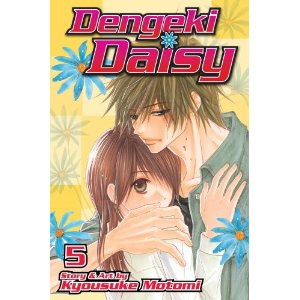
The shadowy menace gets emphasized in this volume as Kurosaki gets injured protecting Teru. Her other protectors kick into high gear. It is clear that Kurosaki knows that Teru knows that he’s Daisy, but she doesn’t know that he knows that she knows. So complicated! Kurosaki’s guilt may prevent him from ever having a relationship with Teru, and she seems to want things to remain as they are so she can just enjoy spending whatever time she can with him. Events from previous volumes are brought up again as Arai, the former student council advisor is investigated for possibly being the source of the fake Daisy scheme and the attacks on Teru. Teru struggles with what to do to help solve the situation and Kurosaki has one of his scary but cool moments when he targets the manipulative Miss Mori. Kurosaki’s glares and evil demeanor brought some extra energy to this volume, I always enjoy it when he starts acting as menacing as he was in the initial volumes.

I’m still enjoying this series very much. The slightly unconventional relationship, the mystery of Teru’s brother, and the slow revelations about Kurosaki’s past are all very satisfying. I realize that popular series like this will probably get spun out over several volumes but I’m still enjoying the slowly developing relationship in Dengeki Daisy.


Volume 5 provided by the publisher