Categories
Manga Reviews

Black Blizzard by Yoshihiro Tatsumi

Black Blizzard by Yoshihiro Tatsumi

I haven’t read Tatsumi’s critically acclaimed The Push Man or A Drifting Life, so I’m probably starting at the wrong place by reading the earlier Black Blizzard. This manga has a pulpy appeal and when you consider that it was produced in the 1950s when the author was 21, it is pretty amazing.

Black Blizzard opens with a piano player frantically practicing. His fingers are jittery and drops of sweat are flying off him. A man in a fedora and trenchcoat enters the room. The piano player is expecting him. He collapses on the piano, saying “I killed someone, but it can’t be…it can’t be true!” The story picks up again with a train moving through a desolate winter landscape. The piano player is now handcuffed to a hardened criminal. There’s a crash, and the criminal takes the opportunity to escape, dragging the hapless musician along with him. They move through a blizzard trying to evade capture and take refuge in a desolate cabin together. The criminal is keen on sawing the musician’s hand off so the duo can separate, but the piano player objects. He starts telling the sad story of how he wound up handcuffed to a murderer, beginning with his involvement with a circus girl with a lovely voice. The escaped prisoners grow more frantic to detach from each other, leading to a surprising bargain and a plot twist that requires a healthy tolerance for contrived endings.

Tatsumi’s art style is sparse and dynamic. The characters are rendered with just a few effective lines for their facial expressions. The blizzard is depicted with slashing diagonal lines, making it easy to picture the horrible winds that buffet the escaped prisoners. Tatsumi relies on some straightforward square and rectangular grids but he varies his perspective often for effect – focusing on a face, a broken glass, and the snow building up on a deserted building. The production by Drawn and Quarterly plays up Black Blizzard’s pulpy heritage. The pages are tipped in yellow, and the jacket copy imitates the text you’d see on an old noir paperback. This manga is flipped, which I adjusted to ok. What I found distracting was the way the sound effects were handled. In some places the sound effects are left in the Japanese, with a note providing translation but on most pages the sound effects are translated. The original sound effects just looked so much more stylish on the page even though the translated effects mimicked the same style.

This wintery crime manga was a perfect thing to read on a hot summer night. The ending of the manga wrapped up things a bit too nicely, but I put the book down amazed that this was the work of such a young creator. There’s an interesting interview with Tatsumi in the back of the book that provides some background on the creation of the book. It was interesting to hear that single volume manga like Black Blizzard was produced for the rental book market in 1950s Japan.


Categories
Manga Reviews

Moon and Blood Volume 1 by Nao Yazawa

Moon and Blood Volume 1 by Nao Yazawa

Despite the general cultural mania for vampires that has overrun popular culture recently, I still enjoy a good vampire manga. Moon and Blood by Nao Yazawa seems like a slight format experiment from Digital Manga Publishing. The online and print versions of this volume are around half the size and price of a typical manga. As a result, this volume just feels like the very start of the story, with all the characters and conflicts established but not elaborated on.

Sayaka is a normal cheerful teenage girl who is coping with everyday life after the loss of her mother. She fends off the advances of boy next door Takeshi and deals with her father and brothers. One morning when she’s getting ready for school she comes downstairs to find a handsome boy sitting with her family. Her father makes the announcement that Kai is the son of an old family friend and he’s going to be living with them for awhile. Sayaka immediately starts building up scenarios of romance in her head, but when she gets to school she finds that Kai seems very disaffected and sleepy. He naps through math class, but when the teacher calls on him to demonstrate a problem Kai has no difficulties at all. When the other boys tease him during PE, he manages a slightly hungover slam dunk. Kai takes refuge in a school closet and sleeps the day away. At home, Sayaka gets a glimpse of a possibly kinder boy as he helps her with cooking and goes on moonlit walks with her. Kai tells Sayaka not to get too close to him, because they are opposite types of people. Kai is a vampire, and his vampire mother is a young girl who sometimes has the form of a cat. She enjoys feeding on Sayaka’s male relatives, and wonders why Kai isn’t taking advantage of his closeness to the girl. There’s an undercurrent of melancholy romantic tension in the way Sayaka and Kai deal with each other, and while she thinks he’s odd she doesn’t seem to suspect his true nature yet.

Yazawa has the type of deceptively simple but expressive art style that I enjoy. Takeshi is like an energetic puppy dog bouncing around Sayaka. Sayaka exhibits all the mood swings of a typical teenage girl, but she exhibits genuine concern and caring when she thinks Kai is lonely. Kai’s otherworldly nature is signaled by his more angular eyebrows and slightly smaller pupils eyes. Kai isn’t above goading Takeshi when he can, but it seems like his attempts to distance himself from Sayaka aren’t going to work. Moon and Blood seems like a good choice for people wanting a simple paranormal shoujo romance without all the overblown angst of Vampire Knight

Access to electronic copy provided by the publisher.

Categories
Manga Reviews

Kamisama Kiss Volumes 3 and 4

I’m a big fan of Julietta Suzuki. I hosted the Manga Moveable Feast for Karikuri Odette, so it isn’t a surprise that I’m finding her latest series Kamisama Kiss absolutely delightful. In some ways Karakuri Odette, with its android protagonist and the way it explored romance without leading to a typical shoujo manga conclusion, was an anti-shoujo shoujo manga. Kamisama Kiss is a little more typical as Nanami, the human girl turned shrine goddess struggles with her feelings towards her shrine’s protector, the fox spirit Tomoe. While the storyline may be a bit more expected, Suzuki seems to be stretching her artistic skills a little bit more in this series. The characters are cute, with a bit of an edge. The opportunities to portray spirits attached to different types of landscapes allows for some refreshing character designs from Suzuki.

The third volume shows Nanami struggling with the realization of her feelings for Tomoe. They have to go on a visit to see swamp goddess Himeneko, but Nanami opts to attend in her school uniform instead of taking fashion advice from Tomoe. Himeneko’s underwater palace is bright and luxurious, with fish swimming by as Nanami admires the decor. Three bitchy carp princesses immediately attach themselves to Tomoe, while Himeneko takes Nanami aside for a bit of a makeover. Tomoe tells Nanami that she’s beautiful and she’s overcome with emotion. He keeps vowing to never fall in love with a human, so Nanami continues to suffer. A rival for Nanami soon appears when she gets rid of a white snake at her shrine. It leaves a mark around her wrist which is the equivalent of a snake engagement ring. Mizuki is a lonely snake spirit, and he’s selected Nanami as his new companion. There’s a hilarious story later in this volume, as Tomoe uses his powers of disguise to attend school as Nanami when she’s back at the shrine nursing a cold. Tomoe-Nanami has some interesting encounters with Nanami’s school friends, and Nanami’s hair starts whipping around almost like tentacles when Tomoe’s temper accidentally shows through his disguise.

Nanami continues to struggle with her feelings for Tomoe in somewhat superficial ways, testing his devotion to her and trying to get him to go out on a date with her. But when she asks Tomoe to go into the sea even when it is forbidden to him in order to rescue one of her friends, she starts displaying her feelings for him in a very substantial way. When Tomoe enters the sea he alerts a vengeful god who he tangled with years ago. The sea god promptly kidnaps Tomoe as payment for past wrongdoings, but agrees to a bargain with Nanami. If she can find the eye that Tomoe stole from him long ago, he will restore Tomoe to her. Mizuki the snake comes along on Nanami’s quest and she shows how far she’s willing to go to protect Tomoe. It seems like Mizuki is going to be sticking around for some time, so I’ll be looking forward to Tomoe’s reaction to that in the next volume.

The textiles of the yokai outfits and the undersea backgrounds in this volume were very detailed. When combined with Suzuki’s charming knack of rendering her facial expressions just exaggerated enough for humor but still realistic enough to inspire sympathy from the reader, Kamisama Kiss provides great summer escape reading.

Review copy of volume 4 provided by the publisher.

Categories
Manga Reviews

Story of Saiunkoku Volumes 3 and 4

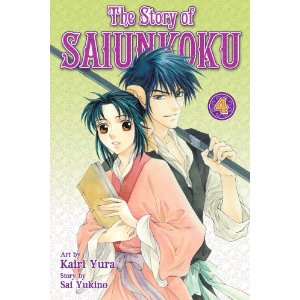
It was a happy day in my house when I realized I had two volumes of Story of Saiunkoku stacked up to read. This manga featuring a heroine who is dedicated to her dream of becoming a civil servant and the quirky men who surround her is one of my favorite current series. I’ve seen a bit of the anime adaptation of this series, so these early volumes have a feeling of pleasant nostalgia as I see characters I’m already familiar with in manga form.

As the third volume opens Shurei has left her position as royal consort and is back to her old life with her family, worrying about repairing her house and studying again for the civil service exam that she’s unable to take because she’s a woman. The emperor Ryuki sends her letters signed “Lord Anonymous” every day, along with ridiculous presents like buckets of flowers, a giant block of ice, and far too many hard boiled eggs. It is summer, the season when Shurei’s mother died. Shurei doesn’t respond to the Emperor’s overtures, thinking “If I get too worked up I’ll just overheat myself in this weather. It’s a waste of energy and of sweat…which means a waste of household resources!” Shurei stumbles across a scruffy bearded man who has collapsed near her house. She invites him inside for a meal, and when he exhibits superior staff-fighting skills when subduing an errant chicken, Seiran recognizes him as a man named Ensei. Ensei and Seiran have the type of bickering relationship that I think is only exhibited by people who’ve been through a war together. Ensei decides to stick around for awhile. Shurei gets a taste of the civil servant’s life when she’s given the opportunity to work for the Minister of the Treasury in the Outer Palace. She has to masquerade as a boy, but she’s delighted to be given the opportunity to work even if it is only temporary.

Shurei’s new boss is the incredibly strict Minister Ko, who always wears an elaborate mask whenever he is in the presence of other people. Ryuki continues to be an intriguing mixture of innocence and cleverness. While he’s imagining the horror of Shurei marrying Seiran, he is actually working hard to change the laws in his country that limit Shurei’s opportunities. His enthusiasm might derail the entire process. Shurei struggles through the summer month, dealing with her fears of thunderstorms that trigger memories of the day her mother died. Ensei’s lighthearted personality goes a long way in making sure she doesn’t get too depressed. One of the reasons why I like this series so much is that even though it might sound like a typical reverse harem scenario, Story of Saiunkoku has so much depth. The idea of romance is a burden more than anything else to Shurei, because she’s so focused on achieving her goals. While she’s surrounded by cute men who want to support her, they all have their own concerns as well as their own friendships to deal with.

There’s some intrigue and action as Ensei’s true identity is revealed. Ensei and Shurei take refuge from bandits in the house of a nobleman who is almost distractingly beautiful. They are aiding a pair of Sa bandit children who attempted to rob the treasury earlier. Their mysterious benefactor doesn’t seem to mind being invaded by sudden house guests, and Shurei notices that his hair and mannerisms seem a little familiar. Ryuki shows up at Shurei’s house for a “Midnight Tryst” only to find out that she’s gone somewhere with the mysterious Ensei. Ryuki, Seiran, Koyu, and Shuei decide to crash the party too, since Ensei is still being targeted for attack.

I like that there are so many side stories that aren’t centered on the heroine. We get a glimpse of the possibility of romance for Shurei’s father as he spends time talking to a noblewoman who is willing to drink his horrible tea in order to converse with him. The relationship between Shurei’s uncle and Minister Ko has hints of a long shared past, and Ensei undergoes a transformation that isn’t only confined to his physical appearance when he shaves off his beard and decides to start applying himself to his work. Even Shurei’s opportunity to take the civil service exam isn’t only for her, as Koyu informs her that she has to pass with extremely high marks in order to be an example that will help other women follow in her footsteps. One of the things I like about the adaptation is the way so many of the characters have a distinctive way of speaking. Ryuki’s speech is the most formal, as you would expect from his position as emperor. The ragamuffin Sa bandit children speak in grand excited tones, as though their actions and thoughts are the most important and dramatic things in the world.

These volumes were very satisfying, and I’m looking forward to reading more. This is the type of series that I know I’ll keep on my shelves for a long time because I know I’ll enjoy reading it.

Review copy of Volume 4 provided by the publisher.

Categories
Manga Reviews

Toradora Volume 1

I think this is the first title I’ve tried from Seven Seas. Toradora is a cute but not very original shonen romantic comedy manga adapted from a light novel series. Ryuuji is a marshmallow on the inside, but he constantly seems to be glaring as his natural expression. As a result, his classmates all fear him as a fearsome juvenile delinquent. Ryuuji starts school making a horrible impression on his classmates yet again, although he has one male friend named Kitimura. Ryuuji also has a hopeless crush on one of the girls at school, a cute and outgoing girl named Minori. As with most protagonists who want a “normal high school life” Ryuuji’s dreams are shattered when he meets the “Palmtop Tiger,” a tiny, insane, ill-tempered girl named Taiga.
While the students quail in fear about the prospect of being glared at by Ryuuji, they dive out of the way to avoid encountering Taiga. An accidental encounter turns into a confrontation when Ryuuji discovers that Taiga accidentally let a love letter for Kitimura in his backpack. Taiga’s response to this accident is to break into Ryuuji’s apartment in the middle of the night and attack him with a wooden sword.

The unlikely duo agree to team up to help each other target their objects of affection. But Ryuuji’s plans to bring him closer to Minori and Taiga closer to Kitimura always seem to end in disaster. There’s plenty of slapstick action and exaggerated emotions in this manga. While the situation and plot in the manga is fairly typical, Ryuuji’s interior live and motivations are well-portrayed, probably because this was adapted from a novel. The art is well done, but not distinctive. It was a little odd but not unexpected in a shonen comedy that Ryuuji’s mother (who works as a bar hostess) seems to spend most of her time lounging around her house in lingerie. Overall, Toradora is a solid entry in the shonen comedy genre. Toradora is the type of manga I’d be happy to check out of the library, but it isn’t likely to make it into my regular reading rotation, especially when there’s genuinely absurd shoujo comedy like Oresama Teacher currently being published.