Categories
Manga Reviews

Cardcaptor Sakura Omnibus Volume 2

Cardcaptor Sakura Omnibus Volume 2 by Clamp

I finished this volume and I immediately felt frustrated that the third Cardcaptor Sakura omnibus from Dark Horse doesn’t seem to be scheduled to be released anytime soon. I’m feeling a little frustrated with some of the more modern Clamp series – they just seem to either go on for far to many volumes (Tsubasa) or lean towards the insipid (Kobato). But since I’ve only read a couple scattered volumes of Cardcaptor Sakura I am happy to enjoy it from the beginning in all of its pink magical girl glory.

The opening storyline of this omnibus shows Sakura struggling to master the Clow card “The Maze.” She’s aided by her enigmatic Mizuki, who has an alarmingly direct way of dealing with her students being trapped in a maze that automatically adjusts itself to create more confusion. Syaoran is immediately suspicious of Mizuki, but it turns out that she used to know Sakura’s older brother. The question of Mizuki being helpful or having some other agenda runs through much of this omnibus, because she seems determined to remain mysterious. Sakura doesn’t really care because Mizuki makes her feel “floaty inside,” but Syaoran is constantly trying to figure out what Mizuki is up to. Other episodes include a scary class trip and a class play put on by selecting roles without considering gender, with the result that Sakura ends up playing the Prince and Syaoran the Princess. Crossdressing Syaoran is pretty hilarious in the way his dialog is portrayed at being flatly shouted and peppered with exclamation points.

While magical girl activities are the general focus of the book, there’s also a nice summer vacation episode when Sakura and her father go on vacation and she befriends the old man next door who turns out to be her estranged great-grandfather. Having the card battles interrupted by occasional school event or family interaction helps keep Cardcaptor Sakura from feeling too quest-focused. The end of this omnibus is a giant battle as Sakura has to prove herself worthy of the cards she’s collected. One thing I was surprised about was that by the end of this omnibus Sakura has collected all of the Clow cards, so in six volumes the first stage of her quest is complete. I somehow thought the card collecting aspect of the manga went on for much longer, but as you might expect when Sakura masters one challenge she is set up to face new tests in the next volume.

As always from Dark Horse, this omnibus features plenty of color pages and nice paper quality. It might take them forever to release these volumes but they are a treat for Clamp fans. Now, when is volume 3 coming out?
Categories
Manga Reviews

Otomen Volume 11

Otomen Volume 11 by Aya Kanno

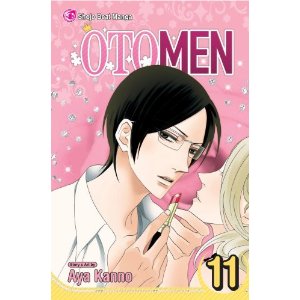
I’d collected a fair amount of Otomen when I stopped feeling the need to keep preordering it. I like it, but the episodic nature of the book means that most of the volumes revolve around the same conflict – will Asuka’s secret talents for feminine pursuits like knitting and baking be revealed and destroy his facade of manliness? The 11th volume is pretty much the same, but it wasn’t very hard for me to pick up on what was going on after skipping several volumes and Otomen is consistently funny.

Asuka is on a class trip/feudal Japan reenactment when he and his friends find themselves stranded in the wilderness. Asuka’s enigmatic and tomboyish girlfriend Ryo promptly starts foraging, while Asuka decides to lift everybody’s spirits by constructing lovely origami flowers. Ryo gets stranded in the woods and ends up cheerfully and capably rescuing Tonomine, who comments to Asuka “She may be a girl…but she’s a true samurai.” Other episodes in this volume includes Asuka attending secret baking lessons for men and a showdown at school over Valentine’s chocolate between Asuka and “Pheromone Prince” Suzaku Oji, the school nurse. Kanno’s sense of humor really comes through in her character designs, as Oji is drawn with flowing hair and a ruffled shirt worn under his white labcoat. He makes pronouncements like “come to me, my kittens,” and all the teenage girls swoon.

Asuka’s better nature begins to make inroads against the strict gender roles enforced by his school, but things are about to take a turn for the worse when his mother comes back from overseas. My major complaint with this volume was that there wasn’t enough focus on Ryo and mangaka Juta Tachibana. A bonus story of “Love Chick” the manga Juta wrote based on Asuka and Ryo with their genders swapped was included in the back of the volume. This was fun to see, since Kanno drew it in a deliberately more simple and insipid style.

Review copy provided by the publisher

Categories
Manga Reviews

Butterflies, Flowers Volume 8

Butterflies, Flowers Volume 8 by Yuki Yoshihara

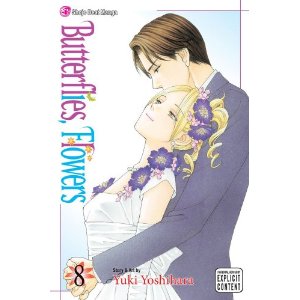
This is the final volume! I’ve enjoyed this series, which I tend to think of as “stealth josei” because even though it was released under the Shojo Beat imprint it skews a lot older. This series about a rich woman working in an office under the direction of a former servant to her family who she winds up dating might seem incredibly frivolous, but it ends up being enlivened by Yoshihara’s offbeat sense of humor and the caring exhibited in the relationship between Choko and Masayuki.

After dating for some time, Choko and Masayuki face the ultimate test when Choko goes on an arranged marriage meeting and Masayuki appears to be doing nothing to stop it. Of course he reveals his objections in a dramatic and hilariously crude manner, but will this odd couple be able to take the next step in their relationship? Choko resorts to hiding marriage registration papers around the office, trying to get Masayuki to sign the documents in a moment of distraction. When Masayuki finally comes around and asks her to marry him, he’s unable to call her by her first name because he’s so fully internalized their master/servant relationship. Choko wants a relationship of equals, and wants to move forward but Masayuki seems pathologically unable to see her as his equal. There isn’t really any doubt that the couple will get together, but despite all the weird master servant jokes, otaku Gundam references, and random crossdressers, there’s a certain level of sweetness present when Choko and Masayuki are able to move on from their roles as lady and servant.

I wish more series like Butterflies, Flowers would be published over here. I don’t mind plenty of high school romance shojo, but it is nice to have a little bit of variety in the settings of romance manga. I hope Viz licenses more Yoshihara manga because her quirky sensibility makes this series unique and weirdly endearing.

Review copy provided by the publisher

Categories
Manga Reviews

Dengeki Daisy Volume 6

Dengeki Daisy Volume 6 by Kyousuke Motomi

I have to admit after six volumes, the storylines in Dengeki Daisy are getting a bit predictable. Fortunately Motomi is such a skilled author that I don’t really care! The slowly developing relationship between plucky orphan high school student Teru and grumpy janitor/hacker Kurosaki is still moving forward at a glacial pace. Teru and Kurosaki are both pretending that she hasn’t discovered that he’s her mysterious guardian known as Daisy. I think one of the reasons why I tolerate the slower plot developments in Dengeki Daisy is that Teru and Kurosaki’s inaction about their relationship is tied in to their emotional states. In more predicatable shoujo manga, there would be plenty of outside forces popping up to prevent a couple getting together such as the sudden appearance of a long-lost fiance or an evil male model. Teru and Kurosaki both aren’t in an emotional place to deal with being honest with their feelings, so everything goes unsaid even as they face danger yet again.

I have learned now through this manga that school nurses are even more dangerous than male models. Teru investigates the possible guilt of Arai in a stabbing incident centered around the ex-school nurse Ms. Mori. It turns out that while Arai is guilty of some things, he’s really being set up as a patsy. Teru places herself in danger yet again, but she trusts that Daisy will be able to save her. While this scenario might make it seem like Teru’s a typical captive heroine, she does actually fight back and continues to use her cell phone strategically in summoning help. When I was reading this I was struck again by how well Motomi conveys the vastly different moods of the characters. There’s cynicism, playfulness, repressed emotion, and gloom. Teru and Kurosaki seem to go through so much in this volume, but their relationship is summed up in a scene where she’s perched on the monkey bars at school and he coaxes her to jump down in to his arms. Kurosaki thinks about the guilt he bears over her brother’s death and how much better off his life is with Teru in it. She thinks he’s acting strangely and wonders if he’s drunk, and he makes a crude joke about her youthfulness. So in just a few panels we go from reflection and intimacy to reinforcement of the teasing that keeps a safe distance between the couple. Scenes like this, with so much packed into a few panels are why I continue to enjoy reading Dengeki Daisy.

Review copy provided by the publisher.

Categories
Manga Reviews

Ichigenme: The First Class is Civil Law

Ichigenme: The First Class is Civil Law Volumes 1 and 2 by Fumi Yoshinaga

For the Manga Moveable Feast I wanted to read something I hadn’t read before by Yoshinaga, and since I’ve read most of her other series already, the only thing left was some of her yaoi titles. I decided to go with Ichigenme: The First Class is Civil Law.

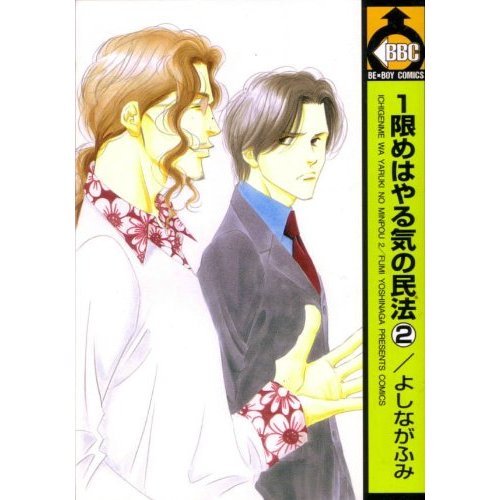
Tamiya joins a new zemi (seminar group) for law school. Although he’s a hard-working student, he’s ended up in a peer group full of rich kids who devote their time to goofing off. As part of a hazing ritual for third year students Toudou, a long-haired spoiled son of a politician performs an elaborate striptease for his fellow classmates. He winds up by giving Tamiya a kiss in order to distract everyone from making Tamiya strip too. Tamiya’s classmates make casual plans to go to Hokkaido to ski for the weekend. When they invite him along and offer to pay for him, he says that he’ll go along with them if it is something he can pay for but “I don’t want anyone paying for something I can’t pay them back for.” Tamiya’s seriousness and integrity provide a stark contrast to the attitudes of his classmates, and Toudou decides that Tamiya is “pretty cool.”

The first volume centers on the growing friendship between Tamiya and Toudou. When his father is caught up in a political scandal, Toudou is ostracized by all of his classmates except Tamiya. While Toudou is comfortable with his sexuality, Tamiya isn’t quite willing to admit that he’s gay even though he’s never been attracted to women. This manga is one of Yoshinaga’s earlier works, but her facility for creating compelling slice of life stories is in full effect. The students get drunk, avoid studying, have unfortunate run-ins with faculty, and in some cases slowly grow up. Toudou and Tamiya’s relationship progresses slowly, and while they do get physical Toudou is left wondering if Tamiya only wants him to stay over due to the elaborate breakfasts he prepares the next morning. When Tamiya turns down a classmate’s advances saying that he doesn’t think he could ever be with a woman. She says “I’ll…have to tell people, okay?” Tamiya replies that he doesn’t care, and his expression switches from blank to peaceful. He says to himself “Somehow…I feel much better.”

The second volume shows Tamiya and Toudou in a more established relationship. Toudou is breaking away from his family’s expectations and working at a games development company and Tamiya has become a teacher. They struggle with having enough time to spend with each other. Toudou’s younger brother is also the focus of some of the stories in this volume, as he takes up with a professor. The first volume of Ichigenme had a few sex scenes, but was more focused on character interaction. The second volume flips the formula, with sex scenes punctuated by occasional glimpses of the characters going out to dinner, struggling with pressure from work, or dealing with the aftermath of a new haircut.

As a whole, I liked Ichigenme more than most of the yaoi I’ve tried. It doesn’t have some of the problematic genre elements that tend to annoy me in many yaoi titles, like a reliance on rape scenarios or the insistence that the men in the story aren’t really gay, they’re just “truly in love.” Instead Yoshinaga creates stories about believable people who fall in love with each other.