Categories
Manga Reviews

Sakura Hime: The Legend of Princess Sakura

Sakura Hime: The Legend of Princess Sakura Volume 1 by Arina Tanemura

Arina Tanemura can be a somewhat polarizing manga creator. Some people love her detailed art and others might find overly cluttered. Some people may enjoy her plotting and characters which are girly to an extreme. Others might find her manga a bit hard to relate to. The main series of Tanemura’s that I’ve read in its entirety is Kamekaze Kaito Jeanne, about an art thief named Maron who is the reincarnation of Joan of Arc. I have a lot of lingering affection for Tanemura due to Kamekaze Kaito Jeanne sheer craziness (Maron goes to talk to God in the final volume), and I’ve been slowly collecting volumes of her other series Full Moon and Gentlemen’s Alliance Cross. So to people who say “Artwork too busy!” I say “Galaxy Eyes!” If somebody says “Too many shoujo cliches!” I say “Look at the ribbons! LOOK AT ALL THE BILLOWING RIBBONS!”

Sakura Hime is set in the Heian period, which gives plenty of room for Tanemura to display her love of detail with all the flowing costumes the nobles wear. Sakura is a princess who has grown up in isolation, promised in marriage at a young age to Prince Oura. The introduction page of the manga encapsulates the whole story, as it has a picture of our cheerful heroine and a potentially tortured young man with the text “Always I watch you. I hate you. I hate you. Always I’ve hated you. Always….I watch you.” This might be getting a little dark, despite all the magical girl trappings of Tanemura’s story. Sakura is visited by an arrogant emissary named Aoba who claims to be a representative of the prince. Sakura wants to make her own decisions and isn’t happy about being sold into marriage. Aoba (who is of course the prince in disguise) and Sakura naturally fall in to the type of bickering relationship that usually signals a romance drawn out over at least four volumes. But there are complications, as it turns out that Sakura is a descendant of one of the legendary Moon Princesses and thus her fate is to transform into a fighting sailor outfit and armed with a sword that she can’t exactly control, fight demons!

The rest of the volume shows Sakura gradually starting to stand up for herself. Romance isn’t working out for her, and she has to flee, accompanied only by her tiny sidekick. She soon makes new friends but dealing with Aoba and her own mystical nature ensure that she’s still going to experience rough times ahead. If you have a low tolerance for silly magical girl manga, Sakura Hime isn’t for you. If you have a tendency to be distracted by billowing ribbons and always appreciate it when characters yell things like “Sakura Descends! There is no escaping the moon’s divine retribution!” Sakura Hime seems like an amusing way to pass the time while you’re waiting for the new Kodansha editions of Sailor Moon. Tanemura’s billowing ribbons really are the best.

Review copy provided by the publisher.

Categories
Manga Reviews

Beast Master Volume 1


Beast Master Volume 1 by Kyousuke Motomi

Motomi’s Dengeki Daisy is one of my favorite new shoujo series, so I thought I’d check out the earlier series Beast Master. I think often mangaka’s earlier series tend to suffer in comparison when compared with the manga that become hits. But while Beast Master doesn’t have the more stylish illustrations and emotional depth that Dengeki Daisy does, it does share the same quirky sensibility that makes it stand out from more run-of-the mill shoujo series.

Yuiko is a typical teen girl with a passion for animals. Unfortunately she has an uncontrollable tendency to smother any animal she meets with too much affection, causing them to flee from her. Leo is an animalistic boy whose demonic eyes and strange mannerisms cause him to be misunderstood by everybody he meets. Leo transfers into Yuiko’s school, and she is the first and only person to make friends with him. She treats him a little bit like a stray pet at first, but as they get to know each other a real friendship develops. Where Beast Master stands out is in its depiction of Leo. While he is handsome, his animal-like rage is contrasted with a playful mode where he’s drawn to look a little bit like a playful giant cat. It is unusual to see the male lead of the series being portrayed in an unhandsome way so many times. Although there’s a little bit of a Jane taming Tarzan dynamic in Yuiko and Leo’s relationship, seeing how she was gradually able to integrate him into school life was fun. Leo’s tendency to watch over Yuiko saves her from some sticky situations. I’m not feeling as invested in this story as I am with Dengeki Daisy, but since there’s only one more volume in this series, I’m going to finish reading Beast Master. After trying both of Motomi’s series that are available in English, I’m hoping that more from this creator gets released over here.

Categories
Manga Reviews

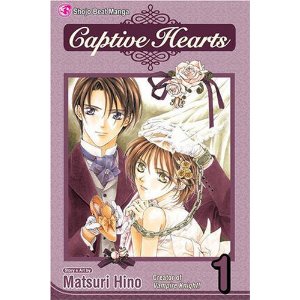
iPad Manga Review: Captive Hearts Volume 1

When it comes to my iPad and buying digital content, I tend to spend the most money buying ebooks. While it is great that Viz is one of the few companies to put multiple manga series on the iPad, the initial offerings were either series that I wasn’t that interested in or manga that I’d already collected in print format like Death Note or Kenshin. But the month of March is Manga Madness Month and ALL VOLUME ONES ARE .99 cents in the VIZ MANGA APP(picture me saying that in the voice of a crazy car salesman). Viz has also added a few series that I haven’t already read, and at .99 cents it is very cheap to sample the first volume of a manga I might find interesting.

Captive Hearts Volume 1 by Matsuri Hino

Captive Hearts is the first series by Vampire Knight powerhouse Matsuri Hino. I’ve read the first few volumes of Vampire Knights, traded them away, regretted it, and am slowly building up my print collection again. I’ve also read Hino’s frothy fantasy MeruPuri. Captive Hearts is very cute, but the first volume shows very little traces of Hino’s detailed art style and the story is fairly predictable. Megumi is the son of the butler to a rich family. He grows up in an empty mansion because the Kogami family went missing on a trip to China, and the late master’s will (written before the birth of his daughter) left his fortune split between his wife and his butler. Megumi’s lesiurly life as a student is interrupted when his father announces that the Kogami family has been found. The long-lost daughter Suzuka has been found. Megumi’s father makes dark pronouncements about Megumi finding out about his fate and a family curse, and when Megumi meets Suzuka the curse takes effect.

As soon as Megumi sees the new mistress of the house something is triggered in his brain, and he becomes the perfect servant. He finds himself saying “Welcome home, Princess” and kissing her hand while on the inside his thoughts are protesting. It turns out that one of Megumi’s ancestors tried to steal from the Kogami family and a guardian god appeared to place a hundred generation curse on Megumi’s family, forcing them to become the perfect servants. Megumi spends his time helping Suzuka adjust to life in Japan, and his tendency to have random attacks of subservience hinders their relationship. Does he care about her because of the curse? What would happen if the curse was broken? Suzuka seems to like Megumi, but she’s extremely distressed about the effect she has on him and just wants to spend time with him normally the way they did as children.

There are faint suggestions of Hino’s eventual drawing style, which features plenty of detail and characters that all seem to be wearing a healthy coating of eyeliner, but Captive Hearts isn’t nearly that refined. As a first volume, I would expect that the art gets a lot better as the series progresses. Hino’s later facility with extreme angst isn’t really on display here either. Instead there are plenty of sweet and humorous moments between Megumi and Suzuka as they strike up a friendship in between his uncontrollable servant attacks. For .99 cents, I was happy to have the chance to try out this series. Even though there were quite a few cute moments it didn’t really draw me in, partially because I think that while Hino’s other series might be less funny they are executed much more competently. Although after seeing the sense of humor on display in Captive Hearts, I am tempted to reread Vampire Knight again as paranormal romance parody.

I had no problems downloading and reading this manga on the iPad, and the pages looked very clean and crisp. Even though I wasn’t hooked by this first volume, I wouldn’t hesitate recommending it for anyone who wants to sample some insanely cheap shoujo manga during this March promotion.

Categories
Manga Reviews

Shojo Beat Quick Takes – Rasetsu and Butterflies Flowers


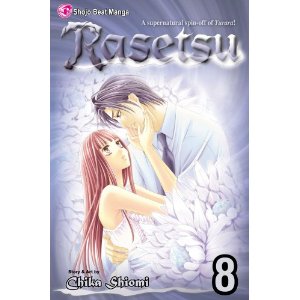
Rasetsu Volume 8 by Chika Shiomi

I generally enjoy Chika Shiomi series. She has a predilection for creating male leads that are both attractive and somehow possessed by demons, which causes her heroines to be tormented by their love for these ultimate bad boys. I tried the first 4 volumes or so of Rasetsu and then stopped getting the series. While I enjoyed it, I wasn’t feeling as much of an emotional connection to the story as I did with Yurara, the series it was spun off from. But dipping back into it, I was pleasantly surprised by how much I enjoyed this volume. The more episodic monster-hunting plot elements are cast aside in favor of the ongoing dilemma of Rasetsu’s love life. If she doesn’t find true love by the age of eighteen, a demon is going to come to claim her. Rasetsu and Yako’s attraction has been growing, but she doesn’t want to use him to escape her curse. Kyuru has always been Shiomi’s prototypical bad boy, and the reader finally gets an explanation as to his true nature. The series finally seems to be heading towards a final confrontation between Rasetsu and the demon who cursed her, and I’m curious to see what happens next. I am team Yako all the way, if he doesn’t get the girl at the end of Rasetsu after his heartbreak at the end of Yurara I am going to be very disappointed.

Butterflies, Flowers Volume 6 by Yuki Yoshihara

After six volumes Butterflies, Flowers isn’t exactly heading into new territory as it details the odd relationship between “Lady” turned office worker Choko and servant turned boss Masayuki, but each volume of this series usually has at least one incident that really makes me laugh. The panel in this volume that I thought was hilarious was Masayuki’s crestfallen expression when he realizes that Choko has been stolen away from him and he realizes that he has neglected to place his customary tracking bug in her underwear.

There’s plenty of the usual office hijinks as the staff travel to a hot springs for a vacation and Masayuki tries to protect Choko from potentially lecherous coworkers. Choko shows her tougher side when she faces down a bunch of thieves to protect Otaki, a strict new boss who transfers in to her company. Unfortunately seeing Choko in action causes Otaki to develop a strong crush on her and Masayuki is faced with more trouble ahead when his ex-girlfriend returns to work with him again. I’m actually impressed that the evil ex hasn’t made an appearance in this series until the sixth volume. For all the machinations and problems that get thrown in Choko’s and Masayuki’s path, they still seem to have a strong foundation as a couple. I’m still enjoying this manga’s combination of heartfelt proclamations of love and bizarre sex comedy.

Categories
Manga Reviews

Skyblue Shore Volumes 1 and 2

Are hot janitors a Thing? After reading Dengeki Daisy and Skyblue Shore, which both feature handsome yet tortured twentysomething janitors, I am now convinced that anyone who wants to find cute men in Japan needs to start staking out custodial closets in local high schools. Skyblue Shore is a fun shoujo manga, with some hints of darkness that keep it from being overly sweet.


Skyblue Shore Volume 1 by Nanpei Yamada

Tomo used to visit the beach daily as a little girl. One day she met a boy who gave her an agate that he found while beach combing. While she went back to the beach daily, she never saw him again. Years later, Tomo’s grown older and she’s left her love of the beach behind. She’s on her way to school when someone starts feeling her up on the bus. A tall, dark and handsome man notices what’s going on and throws the groper off the bus, yelling that no one is going to touch one of his students. He leaves behind a keychain that has the same type of agate that Tomo keeps as a souvenir. This is a fairly formulaic beginning to a manga. Stories about children who reconnect as teenagers are common but even while Skyblue Shore evokes plenty of shoujo cliches, it does so in a refreshing way. The teenage Tomo is a fairly typical shoujo heroine. She’s pretty, popular, and enthusiastic but considers herself average. What makes her stand out a bit from her character type is her tendency to exhibit a strong nurturing streak due to the fact that she’s had to take care of her flighty mother. Tomo stumbles across a sullen boy who has a hairtie that exhibits the same construction techniques as the mysterious stranger’s broken keychain. Ten offers to fix her keychain and she trails him back to a shack on the roof of the school. She barges in and finds an apartment furnished with things from the beach, with elaborate driftwood assemblages. Ten, is of course, the boy who gave Tomo the agate when they were children. While he figures out who she is fairly quickly, she doesn’t connect Ten with her long-lost friend. His older brother Riku is the junior janitor at the school who has a habit of defending high school girls from perverts.

The pairing of an enthusiastic girl and sullen boy can be found plenty of times in shoujo manga. But I enjoyed seeing the relationship between this particular couple in Skyblue Shore. Ten starts taking Tomo beachcombing, and she’s delighted to rediscover one of her favorite childhood pastimes. She exhibits the same degree of excitement about being on the beach that she had as a little girl, but what happened to change Ten from being a happy little boy to a prickly teenager who hides behind his hair? Tomo spends more time with Riku, and promptly develops a hopeless crush on him despite his tendency to treat her like a little sister. Ten clearly cares about Tomo too, so the classic love triangle is all set up. Tomo starts appearing by Ten’s side after school, asking if he’s found any treasures at the beach. When Ten tells Riku that he’s taken on Tomo as his apprentice beachcomber, he says “I think…she’s been waiting a long time for me.”

I enjoyed all the details about the sea that Yamada included. Ten shows Tomo how to bleach sand dollars, and you can practically smell the salty air when the characters go down to the beach. Yamada’s character designs are clean and attractive, and I like the way she varied the body types of the brothers. Riku is clearly more mature, with more of a weighty, adult look while it is clear that Ten and Tomo haven’t finished growing yet.

Skyblue Shore Volume 2 by Nanpei Yamada

Skyblue Shore might initially seem like a charming, slice of life shoujo series that is only differentiated from other similar manga by the beach setting. Where it starts to stand out is the theme of past psychological trauma and potential insanity that is interwoven with all of the nice scenes of Tomo and Ten hunting for agates. A dark female character with unhealthy ties to Riku is introduced in the person of Michiru, who only sporadically attends school. When she comes back she definitely doesn’t approve of Tomo and Riku’s friendship. Tomo observes some close encounters between Riku and Michiru, and is dismayed. While Riku doesn’t cross any lines, it is obvious that they have a shared history and Michiru seems very emotionally damaged. Ten can see straight through Michiru and warns Tomo to be careful of who she makes friends with. Riku shares the fact that he and Ten lost their sister to the sea when Tomo almost drowns. She comforts him, and he asks her to be a good friend to Ten and Michiru. She starts to treat Michiru like a bit of a project, trying to bring her out of her shell and getting her to socialize with some of the other students. When Michiru stops coming to school, Tomo gets her to come by using the only threat she can. She says “Unless you drag your lazy carcass to school, I’m going to claim Riku for myself!”

Riku and Ten are clearly emotionally damaged by their loss, even though Riku might seem to do a better job of appearing normal. It doesn’t seem quite fair for Tomo to be put in the position of emotional caretaker for her group of friends. The blend of slice-of-life stories inter cut with past revelations of tragedy reminded me a little bit of Oyayubihime Infinity without the fantasy elements. Skyblue Shore is only six volumes long, and I’m curious to see if the characters actually manage to work through their various emotional issues and achieve some form of happiness.

Review copies provided by the publisher.