Categories
Manga Reviews

Kaze Hikaru 15-18

Some series I find immediately appealing and others grow on me over time. In the case of Kaze Hikaru, I liked it well enough when I read the first volume but it wasn’t until I was able to check out a bunch of volumes from the library at once that I was completely won over and decided to slowly collect the entire series. I worry a bit about this series, because I get the impression that it isn’t a very strong seller and it is 29+ volumes in Japan. Kaze Hikaru is a meticulously researched romantic adventure about a girl named Tominaga Sei who decides to disguise herself as a boy with the alias Kamiya Seizaburo and enter the ranks of the Shinsengumi (shogunate special police) to avenge the deaths of her family. She quickly falls in love with her mentor Okita Soji who knows her true identity but remains willfully oblivious to his own feelings for her.

In the 15th volume Kamiya struggles with the idea of undergoing the male coming of age ceremony called Genpuku. She’d have to shave off her bangs, and then she’d lose the ability to occasionally dress as a woman by rearranging her hair. Everything gets thrown into even more confusion when a visiting doctor shows up who used to train with Kamiya’s father. Soji and Kamiya struggle to protect her identity, sending her into town when the doctor announces that he’s going to give everybody at the compound a physical in order to improve the health of all the men. Kamiya accidentally blurts out “Uncle Droopy Eyes” when she sees the doctor, and wonders if he’s recognized her from when he saw her before as a little girl.

Doctor Matsumoto ends up finding out Kamiya’s secret through some trickery by suggesting to Soji that she’s sick. Soji runs off to find her and rushes her to the doctor, not realizing that his extreme anxiety is due to the fact that he loves her. The doctor promptly starts trying to arrange her marriage to Soji. She says that she’s content to stay by his side to support him as a colleague. Matsumoto quickly diagnoses with the terrible disease of “feminitus,” which causes regular men to grow feminine characteristics, and her colleagues are instructed to support her manly efforts and avoid mentioning her girlish looks. This has the fortunate effect of throwing off the suspicions of some of Kamiya’s colleagues, at least for a little while.

Matsumoto appears again in the next volume, this time to give Kamiya perspective on her lost family. When she was a little girl she almost never saw her father because he spent so much time away pursuing his medical training. Kamiya still feels betrayed and resentful, and her closeness to her older brother was largely due to her father’s absense. Matsumoto points out that Kamiya’s father and Soji share similar characteristics. Both have entirely dedicated themselves to their studies, leaving little time for personal attachments even though they both feel deeply. Other romantic entanglements are highlighted, as Sanosuke wishes to make a merchant’s daughter his bride and a woman is coming to Soji with a marriage proposal. Kamiya is filled with anxiety. Soji’s attitude towards meeting a woman is that he’ll do it if it is a direct order from his superiors. In keeping with his continued obliviousness, he speculates to Kamiya that it might be better for him to marry a woman that he doesn’t love, because it won’t get in the way of his duties.

It was nice seeing Kamiya’s relationship with Matsumoto continue. She doesn’t really have any confidants so it was good to see that she finally had someone she could go to to talk with, even though his general reaction to her situation and decisions is disbelief that such a stubborn girl could exist.

The next two volumes move away from romantic angst towards political issues with the Shinsengumi. In Kyoto a troop captain is managing to alienate the locals with his policies, and his extremely suspicious nature is damaging towards morale. When Kamiya goes to visit him along with Soji and Kondo, Sanjuro promptly fixates on Kamiya as a possible spy since she seems so friendly to men in different troops. Sanjuro tasks his younger brother to spy on her, and Kamiya yet again faces her secret being revealed. Soji comes to the rescue, but Kamiya decides she has to figure out what on earth is wrong with Sanjuro to cause him to act in such an extreme way.

It seems like factions among the Shinsengumi are being set up as an even bigger problem, as the sneaky Ito has decided to set himself up to subvert the leadership of the troop by recruiting the men to his side. We see Kamiya training on firing a gun, and the philosophical differences between those who prefer the way of the sword to gunpowder and bullets are explored. Soji tries to help the woman he has a long-term relationship with. Kohana served as a cover for his vow of celibacy, he visited her and used his time to take naps. He explores the possibility of setting her up in a house with her daughter, but she’s come to have feelings for him and refuses. Kohana doesn’t want to be with Soji due to his sense of duty, if he doesn’t actually see her as a woman. Kamiya finds out what’s going on, but as usual the unarticulated feelings between her and Soji mean that their relationship will continue to function mainly as mentor and mentee. While Soji is trying to look out for Kohana, he also commissions a special lightweight sword for Kamiya. The next problem everybody will face is the love of the Captain for a mysterious woman. Kamiya is tasked by the Vice Captain with finding out about her true nature, as the Captain suffers in silence.

I think Kaze Hikaru is best read in multiple volumes like this. The story unfolds at a measured pace, and even though plenty of things happen, it doesn’t usually have any real end of volume cliffhangers to incite anxiety in the reader. I always enjoy Watanabe’s notes at the end, where she’ll clarify some of the historical information and point out where she took artistic license with known people and historic practices. Except for a few stray volumes, I’m all caught up with the English release for this series! Kaze Hikaru might not be the flashiest series out there, but the rich historical detail and slow building romance reward the patient reader.
Categories
Manga Reviews

Shoujo Quick Takes – Black Bird 8, Stepping on Roses 5, and Seiho Boys High School 5

Black Bird Volume 8

I read the first couple volumes of Black Bird and decided that the romance between a young girl and a dominating demon just wasn’t for me. I wasn’t all that thrilled with all the wound licking going on, and for whatever reason in my tawdry manga I prefer the flat out trashiness of something like Ai Ore to the more romanticized Black Bird although both titles display the same type of troubling and stereotypical gender roles in their main couples. At least Ai Ore is more open in its commitment to crazy plot elements, with all the rape threats, etc. right there on the page. In contrast, Black Bird tends to coyly hide elements of sexual coercion with all the accidental wounds and subsequent licking going on, along with a heroine who would happily sacrifice her existence for her demon boyfriend. This volume of Black Bird marks a bit of a turning point, as Misao and Kyo may finally have to get it on. Not because they mutually decide to take their relationship to the next level as an expression of their love, but because Kyo is afflicted by a horrible curse (which manifests in the form of exhaustion and tribal tattoos) and only Misao’s becoming his demonic bride can heal his affliction. I enjoyed this volume more than I expected but for a large section of the book I was really hoping that bad guy Raiko would prevail with his demon hunting mission and actually kill Kyo. I have a feeling I’m not supposed to be rooting for the death of the romantic lead in this manga.

Stepping on Roses Volume 5

I originally felt a little resentful towards this title because I thought it was more superficial than Ueda’s other series Tail of the Moon, which is one of my favorite historical shoujo manga. After reading a couple volumes I think the Perils of Pauline troubles that beset Sumi are starting to be more amusing than annoying, just because Ueda manages to pack so many problems into a single volume of manga. In the fifth volume Sumi is still in her marriage of convenience with wealthy businessman Soichiro. The evil Natsuki has succeeded in driving away Soichiro’s faithful butler and inserting a spying maid into Sumi’s household. Soichiro’s best friend Nozomu is still in love with Sumi but that didn’t stop him from marrying a random rich girl, who is not pleased that her husband is in love with someone else. So! Sumi and Soichiro are growing closer, but when he asks her if she loves him she replies no. He conveniently has forgotten that when they married he instructed her not to fall in love with him and he walks out in the rain. Sumi goes after him and gets soaked. Nozomo has moved out of his house, leaving his wife alone after she caused a scene at a party by attacking Sumi with a bouquet of flowers. Nozomo spends his time alone creepily working on an epic naked painting of Sumi, and when he finds her outside his house he decides to finagle her into posing for him. In the meantime Sumi’s hapless brother with a gambling addiction is trying to go straight by working at Soichiro’s company, and Soichiro’s long lost butler has moved in with Sumi’s poverty stricken family. Whew! I do wish that Sumi had a bit more of a personality, as her main function seems to be making futile attempts to ward off the attentions of almost every man who stumbles across her.

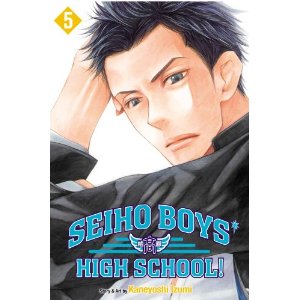
Seiho Boys High School! Volume 5

This volume was my favorite in this mini-batch of manga. I enjoy the self-contained short stories in each volume, but since the series uses the same rotating cast of characters, the reader still gets plenty of character development. Having the stories written more from a male point of view also provides a nice contrast to more conventional shoujo titles. The first couple stories explore Maki’s situation as he remembers his dead girlfriend and struggles on a first date with his new girlfriend. A ghostly image starts appearing to many of the guys at the dorm, and Maki wonders if his girlfriend Erika is trying to signal something to him. The ghost ends up being a hermit-like male student, but Maki has an unexpectedly touching dream triggered by the episode that may be a signal that he’s truly ready to let go and move on with his life. Unfortunately moving on can be difficult, as he attempts to go on a date with his current love interest and starts tensing up and making the situation even more awkward. Stories about relationships are balanced out by more comedic episodes, as Hanai accidentally finds his photographic ambitions recognized when he starts getting besieged by girls from other schools who want pictures of his classmates. The ongoing storyline about ordinary girl Miyaji and extraordinary male specimen Kamiki gets a little bit of progression as well. This manga strikes me as a good series to have around to reread. The episodic nature of Seiho Boys High School makes it easy to pick up a random volume to read, and the short stories provide plenty of humor and emotion.

Review copies provided by the publisher.

Categories
Manga Reviews

Ai Ore Volume 1

Ai Ore Volume 1 by Mayu Shinjo

I don’t think I’ve ever blogged much about Mayu Shinjo’s series Sensual Phrase, mostly because I wrote about it for Library Journal’s Xpress Reviews online a long long time ago. If you scroll down this page you can see my review of the final volume. Sensual Phrase was pure trashy soapy fun, as you might expect from a series about a virginal (but not for long) girl who inexplicably becomes recruited to be the lyricist of a popular rock band. Shinju’s series fill a niche that isn’t often explored here for translated manga – more mature shoujo. We’ve got some other examples like Butterflies, Flowers (which I consider to be josei masquerading as shoujo) but not much else.

Ai Ore deals with superficially swapping traditional gender roles and romance in a teen rock band saga format. An androgynous band named Blaue Rosen is faced with the loss of their lead singer. All the pretty boys in the band are actually girls who attend the same all female high school. A cute girl named Akira asks to audition for the part, but the stoic lead guitarist Mizuki doesn’t want anyone else singing her songs. Of course Akira turns out to be a boy, and a romance between the tall and rangy Mizuki and the short and cute Akira begins. Mizuki’s handsomeness cause her to be treated as a major crush object by all the girls at her school, and Akira’s feminine charms have given him the title of his school’s “princess”. When Mizuki and Akira are together, misunderstandings abound as Mizuki’s classmates don’t understand why she is favoring a single girl with her attention and the boys at Akira’s school are disappointed that a handsome boy is monopolizing the attention of their princess. Shenanigans!

Unfortunately the switch in outward appearances doesn’t mean that Shinjo’s characters personalities are switched as well. For all his girlish features, Akira is a fairly typical alpha male, relentlessly pursuing his goal of dating Mizuki and joining her band despite her not very convincing protestations. While Mizuki professes to hate men, and is committed to maintaining her princely outward appearance, her inexplicable feelings for Akira turn her timorous. She doesn’t project the self-confidence and cool that she’s able to maintain as part of her stage performance. Shinjo’s romantic plot devices have a striking similarity to many of the tropes that pop up in old school romance novels. Threats of rape and sexual assault are common, and I was a little bummed out yet unsurprised that the end of this volume focused on several scenarios of this type. I am generally a big fan of cross dressing manga but Ai Ore didn’t totally win me over, despite plenty of over the top pronouncements like Akira saying “Instead of singing about love, drown yourself in me!” It was a little hard for me to believe that Akira is more physically dominating than Mizuki when he’s drawn to be around a foot shorter than her.

Existing Mayu Shinjo fans will find a lot to like about Ai Ore. It is an oversized edition of 300 pages, with color pages in the front and a character gallery in the back. Even though I’m not finding this manga as immediately addicting as Sensual Phrase, I’ll want to check out the second volume.

Review copy provided by the publisher

Categories
Manga Reviews

Gatcha Gacha Volumes 7 and 8

I’ve procrastinated writing about the last couple volumes of Gatcha Gacha because I didn’t really want this series to end. In a world filled with cookie cutter shoujo, this series is genuinely weird, somewhat endearing, and occasionally disturbing. I’m assuming that based on the long stretches of time between the series debut and the translation of the final volume that this series didn’t do so well in the sales arena, so kudos for Tokyopop for finishing it. While I’m unhappy about so many series being unfinished with Tokyopop shutting down, I’m trying to comfort myself with the idea that at least Gatcha Gacha was finished. There are plenty of spoilers ahead, so be warned.

Gatcha Gacha Volume 7 by Yutaka Tachibana

The seventh volume was the first one where I felt like Tachibana was stalling for time before the end of the series. Instead of focusing on the relationships between the main characters, we get an extended flashback of what happened between Motoko and a girl from her past named Sae. Motoko gets involved in Sae’s life, and while Sae thinks that she’s using Motoko, it is clear that everyone’s favorite tough girl has her own motivations for intervening. The next story arc in this Motokocentric volume touches on the possibility that she has a different family background than everybody previously assumed. It is interesting to see the agony Yuri goes through when confronted with the idea that Motoko might be disappearing from her life. Motoko ends up solving the issue with her customary directness, and it reminded me how much I enjoy reading a manga that features a character that just says whatever she wants without fear. In another series, the situation probably wouldn’t have been taken care of in half a volume, because everyone would sill be sneaking around without saying anything.

Gatcha Gacha Volume 8 by Yutaka Tachibana

The final volume confirms that the great love affair in this manga wasn’t between Yuri and Yabe or Yuri and Hirao, but Yuri and Motoko. Someone with a better background in gender studies than I would probably have a field day with Gatcha Gacha. It certainly shows a quirky yet positive proto-lesbian relationship between Yuri and Motoko, but it also uses gay characters and situations as fodder for soap opera sleaze of the highest order, as the cute girl who has been stalking Hirao is revealed to be a guy with an overprotective brother/gang leader who makes his displeasure known when the male objects of his cross dressing brothers affection reject his advances. The image of Yuri being menaced by a gang member in full gimp costume is one of the most incongruous things I’ve seen in mainstream shoujo, and one of the reasons why I love Gatcha Gacha is that it can be both surprising and weird.

The ending is one of those open-ended conclusions that often seem to plague manga. The characters are all a little different thanks to knowing each other, but all of the ongoing relationship issues are hinted at instead of given a clear resolution. Hirao is still enamored of Yuri, but even as she tries to give their relationship a chance and acts jealous if other girls give him attention, she’s probably slotted him into a non-romantic category in her mind. His emotional sensitivity and generosity has her thinking of him as princess she wants to protect. In contrast, when Yuri needs someone to rescue her, the person she calls for is Motoko. Motoko sweeps in, ready to fight for Yuri. When I first put the volume down I felt a little cheated because the end of the manga didn’t totally feel like a static conclusion. After reflecting a bit, I realized that even though there might not be major changes, the personalities of all of the characters have shifted a little bit just from their interaction over time. Motoko really views friendship with Yuri as something precious. Yuri is able to stand up for herself a little bit. Hirao is still going after Yuri, but he’s aware that it may already be too late. One of the funniest bits in this volume came with the omake at the back where the characters react to the lack of an ending, and Hirao is complaining that everything’s come back to where it started, only to be answered with the comment that “the girls have all grown into strong, sensitive men.” Gatcha Gacha has been one of the quirkiest shoujo manga that I’ve read, and I’ll horde these precious volumes until I die since they’ll be going out of print. I’m already looking forward to rereading the series next year.

Thanks so much to Sean Gaffney for sending me his extra copy of Volume 8!

Categories
Manga Reviews

Oresama Teacher Volumes 1 and 2

Oresama Teacher Volumes 1 and 2 by Izumi Tsubaki

Izumi Tsubaki is the author of the high school massage club manga Magic Touch, that didn’t generally get favorable reviews from most manga bloggers. I read one volume from Magic Touch that was from the middle of the series and didn’t think it was horrible, although it didn’t inspire me to pick up the rest of the series. Oresama Teacher seems so much better! There’s an element of subversive humor on display that many shoujo series
lack, and some of the unconventional interactions between the characters made me think that Oresama Teacher seemed a bit like a kinder and gentler version of an Ai Morinaga series. And I love Ai Morinaga.

One of the things that I liked right when I first picked up Oresama Teacher is the fact that the heroine is a semi-reformed juvenile delinquent being packed off to an alternative school. I wish we had more teacher-centric female juvenile delinquent manga released in English, and can only hope that one day we get Gokusen translated over here. Mafuyu is able to fight and lead a gang with great competence, but she is utterly incapable of living alone and cooking for herself. When she goes out to replace the instant ramen she destroyed, she happens upon a handsome older man who is getting beaten up. He acts mysterious and bizarre and steals her food. Of course, when Mafuyu shows up at school the next day she discovers that the man is her homeroom teacher Takaomi.

Tsubaki comes up with something I didn’t think was possible – an interesting twist on the old “I have met my beloved childhood friend again as a teenager” plot device that is used so often in shoujo manga. Takaomi is Mafuyu’s long lost neighbor, but he carefully trained her to be a delinquent from a young age. Mafuyu at first remembers her old friend tenderly, but when her real memories start to come back she realizes that due to Saeki, her childhood was filled with brutal training sessions and savage beatdowns. While she starts school determined to act like a normal girl, join clubs, and fall in love, Mafuyu soon finds herself confronting her former ways. She sits next to young delinquent Hasakaya who is able to detect her innate bloodlust. Hasakaya is so eager to fight that he takes on large groups alone, and Mafuyu decides to rescue him while disguising her actions. Hayasaka is just dim enough to believe that she had no involvement when he wakes up with bodies piled around him. Saeki appears to be sociopathic and manipulative, getting Mafuyu and Hayasaka to join his “Public Morals Club” and indulging in the occasional bit of sexual harassment.

Many of the characters in Oresama Teacher are hilariously dimwitted, the better to set up Tsubaki’s jokes. This is the type of thing that gets a little tiring after multiple volumes of a comedy manga series, but Tsubaki’s characters have a bit more depth than usual, because she’s careful to develop everyone’s individual motivations. Hasakaya’s weird code of honor ensures that he’s always going to get into trouble by challenging multiple people to fight him at once, and Mafuyu’s impressive fighting skills and desire to save her friend ensure that she’s always going to come to his rescue. Her new found friendship is important to her and she doesn’t want Hasakaya to think that she’s odd, so she makes a rather pathetic attempt to hide her identity by wearing a bunny mask. Mafuyu’s penpal by way of carrier pigeon, the macho guys in the crafts club, her growing friendship with Hasakaya and the inexplicable relationship between her and Takaomi have me looking forward to the next volume. Oresama Teacher is a great manga to pick up if you’re looking for something light and funny that also serves as an antidote to more typical shoujo.

Review copies provided by the publisher