Categories
Manga Reviews

Black Bird Volumes 9 and 10

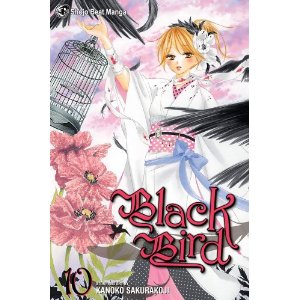
I know Black Bird is wildly popular, but I have a hard time getting into it. I read the first couple volumes and couldn’t get into all the weird wound licking, although I suppose demonic wound licking is at least a twist on the whole vampire romance trope. My main problem with this manga is that I find both of the main characters unappealing. Misao is basically the ultimate trophy bride, since she is a human girl who gives extra powers to whichever demon claims her. The demonic Kyo is just generally unsympathetic.

In Volume 9 Misao and Kyo deal with the aftermath of her allowing herself to be “claimed” by Kyo. Now that she’s Kyo’s woman officially, all the demon clans are on the prowl after her. Kyo’s clan wants Misao for the healing properties of her blood and the other demon clans are fighting back because they don’t want to support the sudden imbalance of power in the demon world. As a result other humans are targeted in the demonic civil war. Innocent humans are possessed by demons and sent after Misao, and Kyo has to fight them off. Misao is filled with guilt, but her response to the situation is to have a nervous breakdown instead of doing something more productive. Kyo is as contradictory as ever, as he orders Misao to “choose humanity” and throws her at demon hunter Raikoh only to suddenly appear and put on a big show by asking Raikoh if he wants to watch him rape her. Now, I’m pretty forgiving of the horrible sexual politics in manga just because I’m willing to forgive a lot for a story that is either humorous (Ai Ore, Butterflies, Flowers) or has a certain over the top soap opera tone (Hot Gimmick). But Black Bird doesn’t have this lighter touch which is why I find myself utterly unengaged in the story after scenes like that.

Volume 10 starts off a little more promising as Kyo’s estranged father pops up to give Misao the lowdown on Kyo’s tragic family past. The wars between the demon clans start to get more serious and it turns out that Kyo’s evil brother is alive and wearing an eyepatch (so you know he is extra evil). Kyo continues to act weirdly schizophrenic as he brings Misao to tears by telling her that she can’t come with him on his mission to restore order to the demon village only to suddenly change his mind and say “Just kidding….silly.” Seriously, Ryoki “You are my slave!” from Hot Gimmick seems like Prince Charming compared to Kyo.

Sakurkoji’s art is fine, with distinct character designs and interesting yet easy to follow panel layouts. I actually liked her short two volume series Backstage Prince, so I just wish that she’s hit it big with a series featuring characters that aren’t acting like jerks or spineless wimps all the time.

Categories
Manga Reviews

Cardcaptor Sakura Omnibus Volume 2

Cardcaptor Sakura Omnibus Volume 2 by Clamp

I finished this volume and I immediately felt frustrated that the third Cardcaptor Sakura omnibus from Dark Horse doesn’t seem to be scheduled to be released anytime soon. I’m feeling a little frustrated with some of the more modern Clamp series – they just seem to either go on for far to many volumes (Tsubasa) or lean towards the insipid (Kobato). But since I’ve only read a couple scattered volumes of Cardcaptor Sakura I am happy to enjoy it from the beginning in all of its pink magical girl glory.

The opening storyline of this omnibus shows Sakura struggling to master the Clow card “The Maze.” She’s aided by her enigmatic Mizuki, who has an alarmingly direct way of dealing with her students being trapped in a maze that automatically adjusts itself to create more confusion. Syaoran is immediately suspicious of Mizuki, but it turns out that she used to know Sakura’s older brother. The question of Mizuki being helpful or having some other agenda runs through much of this omnibus, because she seems determined to remain mysterious. Sakura doesn’t really care because Mizuki makes her feel “floaty inside,” but Syaoran is constantly trying to figure out what Mizuki is up to. Other episodes include a scary class trip and a class play put on by selecting roles without considering gender, with the result that Sakura ends up playing the Prince and Syaoran the Princess. Crossdressing Syaoran is pretty hilarious in the way his dialog is portrayed at being flatly shouted and peppered with exclamation points.

While magical girl activities are the general focus of the book, there’s also a nice summer vacation episode when Sakura and her father go on vacation and she befriends the old man next door who turns out to be her estranged great-grandfather. Having the card battles interrupted by occasional school event or family interaction helps keep Cardcaptor Sakura from feeling too quest-focused. The end of this omnibus is a giant battle as Sakura has to prove herself worthy of the cards she’s collected. One thing I was surprised about was that by the end of this omnibus Sakura has collected all of the Clow cards, so in six volumes the first stage of her quest is complete. I somehow thought the card collecting aspect of the manga went on for much longer, but as you might expect when Sakura masters one challenge she is set up to face new tests in the next volume.

As always from Dark Horse, this omnibus features plenty of color pages and nice paper quality. It might take them forever to release these volumes but they are a treat for Clamp fans. Now, when is volume 3 coming out?

Categories
Manga Reviews

Butterflies, Flowers Volume 8

Butterflies, Flowers Volume 8 by Yuki Yoshihara

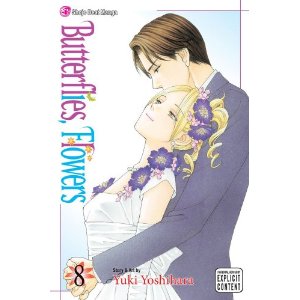
This is the final volume! I’ve enjoyed this series, which I tend to think of as “stealth josei” because even though it was released under the Shojo Beat imprint it skews a lot older. This series about a rich woman working in an office under the direction of a former servant to her family who she winds up dating might seem incredibly frivolous, but it ends up being enlivened by Yoshihara’s offbeat sense of humor and the caring exhibited in the relationship between Choko and Masayuki.

After dating for some time, Choko and Masayuki face the ultimate test when Choko goes on an arranged marriage meeting and Masayuki appears to be doing nothing to stop it. Of course he reveals his objections in a dramatic and hilariously crude manner, but will this odd couple be able to take the next step in their relationship? Choko resorts to hiding marriage registration papers around the office, trying to get Masayuki to sign the documents in a moment of distraction. When Masayuki finally comes around and asks her to marry him, he’s unable to call her by her first name because he’s so fully internalized their master/servant relationship. Choko wants a relationship of equals, and wants to move forward but Masayuki seems pathologically unable to see her as his equal. There isn’t really any doubt that the couple will get together, but despite all the weird master servant jokes, otaku Gundam references, and random crossdressers, there’s a certain level of sweetness present when Choko and Masayuki are able to move on from their roles as lady and servant.

I wish more series like Butterflies, Flowers would be published over here. I don’t mind plenty of high school romance shojo, but it is nice to have a little bit of variety in the settings of romance manga. I hope Viz licenses more Yoshihara manga because her quirky sensibility makes this series unique and weirdly endearing.

Review copy provided by the publisher

Categories
Manga Reviews

Dengeki Daisy Volume 6

Dengeki Daisy Volume 6 by Kyousuke Motomi

I have to admit after six volumes, the storylines in Dengeki Daisy are getting a bit predictable. Fortunately Motomi is such a skilled author that I don’t really care! The slowly developing relationship between plucky orphan high school student Teru and grumpy janitor/hacker Kurosaki is still moving forward at a glacial pace. Teru and Kurosaki are both pretending that she hasn’t discovered that he’s her mysterious guardian known as Daisy. I think one of the reasons why I tolerate the slower plot developments in Dengeki Daisy is that Teru and Kurosaki’s inaction about their relationship is tied in to their emotional states. In more predicatable shoujo manga, there would be plenty of outside forces popping up to prevent a couple getting together such as the sudden appearance of a long-lost fiance or an evil male model. Teru and Kurosaki both aren’t in an emotional place to deal with being honest with their feelings, so everything goes unsaid even as they face danger yet again.

I have learned now through this manga that school nurses are even more dangerous than male models. Teru investigates the possible guilt of Arai in a stabbing incident centered around the ex-school nurse Ms. Mori. It turns out that while Arai is guilty of some things, he’s really being set up as a patsy. Teru places herself in danger yet again, but she trusts that Daisy will be able to save her. While this scenario might make it seem like Teru’s a typical captive heroine, she does actually fight back and continues to use her cell phone strategically in summoning help. When I was reading this I was struck again by how well Motomi conveys the vastly different moods of the characters. There’s cynicism, playfulness, repressed emotion, and gloom. Teru and Kurosaki seem to go through so much in this volume, but their relationship is summed up in a scene where she’s perched on the monkey bars at school and he coaxes her to jump down in to his arms. Kurosaki thinks about the guilt he bears over her brother’s death and how much better off his life is with Teru in it. She thinks he’s acting strangely and wonders if he’s drunk, and he makes a crude joke about her youthfulness. So in just a few panels we go from reflection and intimacy to reinforcement of the teasing that keeps a safe distance between the couple. Scenes like this, with so much packed into a few panels are why I continue to enjoy reading Dengeki Daisy.

Review copy provided by the publisher.

Categories
Manga Reviews

Oresama Teacher Volumes 3 and 4

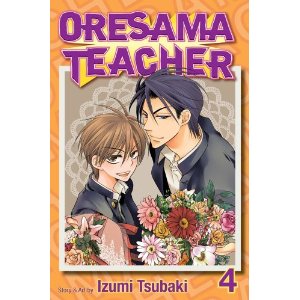
Oresama Teacher is rapidly becoming one of my favorite shojo series due to the fact that it isn’t like most of the other manga in the Shojo Beat imprint. Instead of exploring teen romance, this manga focuses on dumb comedy. Even though many of the characters are idiots, they are also endearing because their idiocy stems from personality quirks that also make them strong. Mafuyu is going away for high school in an attempt to put her juvenile delinquent past behind her, but she finds out that her teacher Takaomi is her long-lost neighbor who trained her in all of her fighting techniques.

In the third volume of Oresama Teacher, Mafuyu goes home to visit her old gang. She’s curious to see how they’re doing without her leadership, and she misses her friends. Mafuyu gets caught up in her old school rivalries and winds up kidnapped with her two former sidekicks, the enthusiastic Kanagawa and the masochistic Maizono. There is nothing that better expresses the differences between Oresama Teacher and more typical shoujo manga than a great scene of Mafuyu lecturing her former lackeys about the proper way to position one’s hands when being tied up by kidnappers. She gives a full on mini-tutorial about techniques to escape binding, then realizes that her instructions are useless because the boys are already tied up. She breaks the boys out, only to be pushed aside as they face their confrontation with their rivals. Mafuyu wonders about the nature of their friendship, only to realize that everyone’s acting unconcerned about her help because they need to stand up for themselves on their own. This was actually a cute message, delivered with a light touch along with Mafuyu’s humorous MacGyver-like fighting techniques.

One of the reasons why I like Oresama Teacher so much is that there isn’t very much conventional romance in it. Mafuyu may be a hardened juvenile delinquent, but she has very little idea what to do about the opposite sex, other than registering that she may have confusing feelings for someone before she moves on to give an enemy a well-deserved beatdown. The fourth volume of the manga brings back Mafuyu’s gender swapped disguise as Natsuo when Takaomi announces that the Public Morals Club has to fight the Yojimbo club. Mafuyu is worried about Hayasaka’s fighting abilities. He’s good at fighting but is so single-focused that he lets himself get hurt. As Natsuo, Mafuyu tries to teach Hayasaka how to dodge and block and think more strategically in a fight. Hayasaka doesn’t seem to be clued in that Natsuo and Mafuyu are never in the same place at the same time, and look alarmingly similar.

One of my favorite moments in this volume was the depictions of torturous mental calculations Mafuyu does about Hayasaka’s fighting abilities while she’s thinking in class. She stares at him intently, throws her head down, bangs on her desk, mopes, and then indulges in an evil smirk when she hits on her training plan. Hayasaka looks mystified and then both confused and alarmed.

Both volumes end with a Mafuyu/Takaomi story. In one, she’s forced to stay over at his place when she accidentally gives her house key to the school’s bancho. In another, they go to the beach with complications as Mafuyu doesn’t even remember that she can’t swim until she’s floating on a swim toy in deep water. While the prospect of a student/teacher relationship isn’t a plot point that comes up very often in the manga that gets translated here, it is hard to picture anything happening with Mafuyu and Takaomi at this point in the series. Takaomi is so manipulative and evil, yet weirdly protective when it comes to Mafuyu actually suffering any harm.

I enjoy Oresama Teacher a lot more than other shoujo humor titles. There’s something about the juxtaposition of all the dumb, character based humor and violent fights that just has me much more invested in wanting to know what will happen to the characters even after four volumes.

Review copies provided by the publisher.