Categories
Manga Reviews Reread Reviews

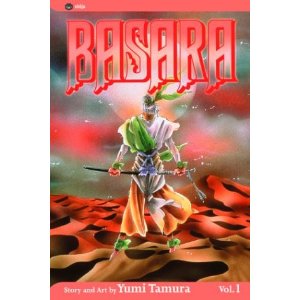
Basara Volumes 1 and 2

When I write manga reviews for this blog, sometimes I feel like I get stuck reading only new volumes. Which is fine, because there’s plenty of exciting new manga coming out these days. But I don’t often take the luxury of time to go back and reread some of my favorite completed series, and there are plenty of manga series that I’ve enjoyed but not necessarily written about all that extensively. So I’ve added a new category of Reread Reviews for series that have come out some time ago but I feel still deserve plenty of attention. I thought I’d start this new feature by working my way through one of my favorite series, Yumi Tamura’s Basara.

Viz started releasing Basara in 2003, and as a result some volumes are out of print or hard to find. But this is one of those series that is well worth collecting, because even though it is long at 27 volumes, this is one of the few series that I think actually deserves all that space. Tamura creates an epic adventure story with star-crossed lovers, cross-dressing, fierce battles, and political revolution in a post apocalyptic Japan. Even though this series is on the long side so much happens in each volume. I never felt like I was reading filler stories or being subjected to recursive battle scenes when reading this manga.

Basara Volume 1 by Yumi Tamura

Like the best adventure stories, Basara starts by introducing the heroine in the context of her home and family and then systematically strips everything away, forcing her to rise to the occasion and assert her true self. Sarasa was born with a twin brother named Tatara, and at their birth a prophet proclaimed “This is a child of destiny…one who will grow to lead the people and be the light in the sky of our nation’s future.” The people in Sarasa’s village are a rebellious group in a post-apocalyptic Japan that has been broken up into areas ruled by petty feudal kings. Everyone assumes that Tatara will be the leader of the next revolution, and Sarasa is shunted aside since she’s a girl. She’s introduced to the reader first as a young spirited tomboy who is acutely aware of the differences between the way she and her brother are treated. She’s heedless of her own safety, heading out to the desert when everyone celebrates her brother’s birthday and ignores her. She makes the mistake of crossing a column of troops headed by the cruel Red King and her life is saved only when a desert nomad named Ageha insinuates himself into the situation, losing an eye in the process. When Sarasa gets back to her village she finds out that the Red King’s army has struck there, killing her childhood friend who identified himself as Tatara in order to save the real “Boy of Destiny.”

The Red Army returns to the village again, and this time Sarasa’s brother is killed. She’s paralyzed with fear but remembers that her brother asked her to protect the villagers if he was gone. She cuts her hair, yells that her sister is dead and orders the villagers to follow her in order to save their own lives. While Sarasa’s ingenuity allows her to rescue her village’s sacred sword from the Red Army, her next attempt at battle fails and she’s cut off from her people. Determined to rally more people to her brother’s cause, Sarasa strikes out towards another rebel village. The Red King is shown throughout the volume with his face slightly obscured. He’s covered by a helmet or his face is partially shadowed or cut off by the borders of a panel. He’s a pragmatic ruler determined to hold on to his territory despite the manipulations of his family. Sarasa meets an arrogant and rich young man named Shuri when she’s visiting a hot springs, and they feel an instant attraction to each other. When Sarasa sees Shuri for the first time, it is also the first time the reader has seen the entire face of the Red King.

Basara Volume 2 by Yumi Tamura

The second volume of Basara shows Sarasa preparing herself to be a rebel leader and not having much time for the young man she keeps running into as she follows the path of the Red King on her way to Sakurajima to locate allies. She visits the city where the Red King lives and is struck by the riches there in contrast to the way her people live. She falls in with a group of traveling show people, who are anchored by a glamorous woman with a bejeweled eyepatch who happens to be Ageha in disguise. Ageha exhibits a sort of watchful antagonism to Sarasa. He’s suspicious that Tatara really is the boy of destiny who will bring revolution to the land, but he’s occasionally helpful. Sarasa as Tatara disguises herself as a dancing girl and slips out of the city into even greater danger in the form of a decrepit tunnel that leads to Kyushu. In the tunnel Sarasa faces a classic hero’s test where she can only call upon herself to get out of a dangerous situation, and she succeeds in reaching the other side, but not before she manages to finally bond with her late brother’s horse Yato. She also has a fateful encounter with a prisoner trapped in the tunnel who gives her valuable information about the rebel village she’s questing for.

Sarasa begins to understand the political nature of rebel leadership when she meets a young boy claiming to be Tatara who is rallying people to rebel against their local lord. It turns out he’s being blackmailed to identify potential rabble rousers in his region. Sarasa is shrewd, keeping quiet about who she is until she has a full grasp of the situation. The boy Hayato ends up attaching himself to Tatara as his new right hand man. In just a couple volumes Tamura has introduced characters on both sides of the Red King/Tatara war and managed to make each side sympathetic for different reasons. Shuri is shown growing up as a young boy with a sociopath for a father who brands his own son with a slave’s mark. Shuri is about to dispatch his cousin Shido to go after Tatara, but Shido is leaving his fiancee behind when he goes on his mission. Shuri and Shido see Ageha (the former slave of Shido’s family) tortured in an attempt to give up Tatara’s location.

Tamura’s art style might take a bit of getting used to. Her men have a tendency towards triangle face, with eyes that sometimes look like horizontal slits. But she varies her character designs quite a bit, making it easy for the reader to keep track of the cast of Basara even though it seems to expand with every volume. Sarasa has covered a lot of ground in the first two volumes of Basara in both her physical and internal journey. Tamura is moving all the pieces together to tell an epic story, and I’m entertained all over again when I’m rereading this series.

Categories
Manga Reviews

Dengeki Daisy Volume 7

Dengeki Daisy Volume 7 by Kyousuke Motomi

The cover design of this volume perfectly represents the odd combination of plot lines that end up getting featured in Dengeki Daisy. Kurosaki is tenderly kissing a tearful Teru’s hand on the front cover, and the back cover features the deranged Akira with a maniacal grin and a creepy red eye. The warm and fluffy part of this volume occurs when Teru and Kurosaki A mysterious man keeps popping up near Teru and she and Kurosaki gradually realize that it is the elusive and dangerous attacker Akira.

The first part of the book shows Teru and Kurosaki fighting off a manageable foe – one of the teachers at the school has decided that Kurosaki is a bad influence on Teru and is determined to separate them. Teru vows to prove that her grades won’t suffer because of the time she spends helping out with janitorial tasks and makes an impulsive bet involving her class standings and Kurosaki’s hair, only to abruptly fall ill the night before the exam. A boy Teru saw at the bus stop and was curious about because he reminded her of her brother abruptly kisses her, and she’s devastated. Kurosaki as Daisy sends her an emotional text, then quickly backs away. It is fairly typical of the dance that these characters do, as they grow closer but still maintain the polite fiction that separates them. The kissing bandit is of course Akira, and he engineers a situation that results in Teru learning a new piece in the puzzle about her brother’s death.

Despite the fact that the central mystery behind Teru’s brother hasn’t been fully explained and the series is now up to volume seven, I’m still interested in seeing what happens next in this manga. The relationship between Teru and Kurosaki is one of the more original pairings in shoujo manga, and despite the gulf in their ages and personalities I can’t help but hope they get together in the end. I’m perfectly happy reading an almost indefinite number of volumes before that ending appears.

Review copy provided by the publisher

Categories
Manga Reviews

Pretty Guardian Sailor Moon Volume 1

Pretty Guardian Sailor Moon Volume One by Naoko Takeuchi

Sailor Moon is back in print! When I was reading these new editions from Kodansha I decided to start chronologically, so I read Sailor V first and Sailor Moon second. It is interesting seeing the contrasts in character present from the first few pages. In Sailor V, Mina gets in trouble for attempting a daring gymnastics move. In Sailor Moon, Usagi is running off to school with tears in her eyes from dismay at being late. Usagi is presented as the typical not very bright, somewhat ditsy shoujo heroine that most manga readers will be familiar with. But part of the reason why I like Sailor Moon so much is that Takeuchi does manage a couple subtle spins on the well-worn formula that she’s working with.

Usagi has a fateful encounter with a mysterious cat, then goes to school for a typical day. She gets punished and gossips with her classmates about Sailor V. She visits the jewelry store belonging to the family of her friend Naru. Outside, she throws one of her abysmal school papers into the face of a boy wearing a tuxedo and sunglasses. She thinks he’s a pretentious jerk for being so dressed up during the day, and he tells her to “study harder Miss bun-head!” IT IS TRUE LOVE! Later that evening the mysterious cat Luna visits Usagi and tells her that she’s been chosen to be a guardian. She gets her magical girl accessories and the phrase that triggers her transformation sequence (Moon Prism Power Make Up!) and she is off to fight the forces of evil at the jewelry store. This first chapter shows how Takeuchi’s storytelling has improved in contrast to Sailor V. By starting out with an enemy that could be directly hurting one of her friends, there’s more dramatic tension in Sailor Moon as opposed to the endless progression of pop idols that Sailor V fights. Of course, Usagi as Sailor Moon barely fights at all on her first outing. She halfway thinks that she’s dreaming and is surprised that she’s getting hurt, then she reacts to the fight by throwing a tearful temper tantrum. Fortunately her tiara boomerang vanquishes her enemy, and she finds out that she’s being watched by a mysterious man who introduces himself as Tuxedo Mask and says “Sailor Moon, I’ll certainly take note of you.”

Now that Usagi’s general situation is set up, she has to deal with Luna’s demands that she train and gather allies. There are other sailor scouts out there and Usagi has to collect them all (like Pokemon!) while struggling with her feelings for Tuxedo Mask and her own ineptitude. Usagi’s companions are generally in some way more capable than her, but you can see how their different personality traits would contribute to the formation of a good team. Sailor Mercury is a teen genius. Sailor Mars has the moral certainty of a shrine maiden. Sailor Jupiter is strong and brave. The sailor scouts are going after the “Legendary Silver Crystal”, as are their mystical enemies and Tuxedo Mask. Usagi is uncertain if Tuxedo Mask is an enemy or an ally, because while he certainly seems to appear often if she’s in the need of a rescue his motivations are unclear.

Takeuchi’s art seems to have grown a bit smoother when comparing Sailor Moon with Sailor V. The paneling is slightly more complex, although it is still a manga the focuses most on the faces of the characters without much attention paid on setting scenes or background images. The battles and team building in Sailor Moon seem to owe a lot to shonen manga, but being as girly as it is the battles involve costume changes and awesome battle cries instead of violence. While it might be pretty silly for girls to don sailor suits to fight evil, there’s a certain exuberant girl power vibe about the scenes when Sailor Moon and her allies line up to announce that their enemies are about to be punished. I do not know how it is possible not to love a manga that features a girl yelling “You will refrain from underestimating women! And with Mars Power, you will burn! These high-heeled legs will deliver your punishment!”

Categories
Manga Reviews

Codename: Sailor V Volume 1

Codename: Sailor V Volume 1 by Naoko Takeuchi

I’ve had Sailor Moon and Codename: Sailor V in my house for a week, but even though I’ve read them for some reason I am still having a hard time believing that they’re real. Since Sailor Moon has been the holy grail of out of print manga series, it just seems wonderfully surreal that this series is finally getting a decent omnibus style release with a new translation. Sailor V was the prototype series for Sailor Moon, and Sailor V appears in Sailor Moon at first as a shadowy mentor figure. So many of the storylines that are explored more fully in Sailor Moon are introduced in Codename: Sailor V, which might not have as much depth but is still fun.

Like most shoujo heroines, Mina (short for Minako) is an aggressively average student. She prefers athletics and nursing crushes on unobtainable boys to her schoolwork. Her life changes dramatically when she meets a talking cat named Artemis who informs her that she’s been chosen as a protector of Earth. Once she’s equipped with some magical accessories she announces what she has become, “Champion of Justice! The Pretty Guardian in a Sailor Suit! Sailor Venus has arrived!” One of the things that I enjoy about magical girl manga is that although there’s certainly an element of makeover fantasy in the transformations, part of story also is all about power. When Mina transforms for the first time she says “I feel liberated! I’m overflowing with power! I’m struck with the urge to act!”

Unfortunately for Mina, the action she’s presented with gets repetitive. There seems to be an unending supply of demonic idol singers who are out to enslave the Japanese populace and feed off their energy, and Sailor V must battle all of them. In this way, Codename: Sailor V resembles a very simple shonen manga, except for the battles here are always needing to involve lots of cosplay and battle cries instead of actual punching. Still, there are flashes of humor on display that make the overall experience of reading the book a lot of fun. Mina seems to be very protective of governmental regulations, as when she’s battling one of her many rounds of evil idol singers she remarks that brainwashing is bad and “these are horrendous business practices and the Japanese Tax Office will not stand for it!” Later on when she’s talking to her mysterious boss about an enemy she encounters during a vacation she flies into action after the comment “I don’t know who he is, but I do sense a deep-seated grudge regarding Hawaii.” People with grudges regarding Hawaii must be punished!

One of the things that enlivens Codename: Sailor V is the supporting cast. As Sailor V grows in notoriety she is starting to get noticed by the police. The female Inspector General nurses her crush on V with giant posters in her office, and she arbitrarily orders around her more skeptical male sidekick. Mina gets an eye rolling reaction from one of her enemies to her proclaimed title of “Pretty Guardian.” I tend to grade magical girl shoujo for what it is. If there’s humor, costume changes, and a little bit of action I’m a satisfied reader. While I don’t think that Codename: Sailor V has all the elements that made Sailor Moon such a long and successful series, it was fun getting a glimpse of Sailor Moon’s origin and more of the origin of Sailor V.

Categories
Manga Reviews

Kamisama Kiss Volume 5

Kamisama Kiss 5 by Julietta Suzuki

I’m having a bit of a stressful week so I was happy when the fifth volume of Kamisama Kiss arrived at my house. This manga blends a mystical fish out of water story about a human girl taking on the role of shrine deity with whimsical character designs, producing a perfect comfort reading manga. Nanami is having trouble dealing with her fox spirit helper Tomoe and his new rival the white snake Mizuki. They all attend a summer festival at another shrine and Nanami gets so frustrated at the constant bickering that she squeezes the bickering spirits’ hands together and says that they have to hold hands forever unless they make up. Mizuki and Tomoe are now forced to have an actual conversation, and it is clear that Mizuki’s obnoxiousness stems from his loneliness after being stuck at an abandoned shrine for so long.

The festival at the neighboring shrine makes Nanami think that she has to do something to bring visitors to her own shrine. It has the reputation of being creepy, but she’s determined to put on her own festival to bring the worshipers back. Since it is unusual for a human to be a shrine deity, Nanami has to learn how to do the proper festival dances the hard way. Tomoe is initially discouraging of her efforts, but ultimately comes around to support her. One of things I enjoy about this manga is that minor characters keep reappearing in later chapters, making it easy to picture the odd new social circle Nanami now has surrounding her. Nanami gets help from the swamp deity Himeneko and even the tengu disguised as human idol singer Kurama stops by. Kurama is amazed to see how Nanami’s power as a shrine deity has grown even though she isn’t really aware of it. Tomoe comments to him “she doesn’t realize it herself…but she’s not an ‘ordinary girl’ anymore.”

Suzuki’s manga are always a visual treat and blending the world of shrines and modern day life give plenty of room for her to showcase wonderful costumes and quirky character designs. I liked Karakuri Odette so much that I didn’t think I’d be captured in the same way, but Kamisama Kiss is really growing on me. This manga has all the easily read episodic charm of her other series, but I’m hoping for a bit more of a romantic payoff at the end.

Review copy provided by the publisher