Categories
Manga Reviews Reread Reviews

Basara Volumes 7 and 8

Basara Volume 7

So the undercover Blue King Asagi’s manipulations are successful and Sarasa sets off to liberate her mother from the grip of the Red King’s General Kazan. As they travel on their ship, Tatara’s band encounters an unusual hunter – a young man who is taking on a whale all by himself armed only with a harpoon and a small sailboat. Asagi attempts to play the spoiler when they head into town, announcing Tatara’s presence in an arrogant and threatening manner. Sarasa yells at him, saying that isn’t the way they do things. The young whaler Nachi serves as the band’s guide, taking them on a meandering trip to meet his village that involves quite a bit of road reconstruction on the part of Tatara’s people. Tatara tries to gain the support of Nachi and his leader Hijiri. Chacha and Zaki head out to scout the situation and see something unexpected – Tatara’s mother refusing to leave the General even though she has the opportunity to do so. She comments to Kazan, “I cannot leave your side. Not until I witness your death.” Chacha vows to hide the potential complicity of his mother from Tatara. Up against impossible odds, Sarasa isn’t sure how she can succeed, but Hijiri promises to bring more allies if Tatara is able to successfully demonstrate his leadership.

At the same time, Shuri is traveling towards Kazan’s hideout, determined to punish his general for his insolence. As soon as Sarasa’s mother sees her, her internal thoughts highlight just how much her daughter has changed. She thinks “She’s only 15! She’s just a little girl!” and the General is determined to grab Tatara’s head as a trophy. Chacha confronts the General, thinking that the situation is her fault for not being more forthcoming with Tatara after her scouting mission. Sarasa is ironically saved by Shuri’s attack, but her eyes are injured and she throws herself into a burning building to rescue Chacha and Zaki. Hijiri tells Tatara that Zaki is risking his life for his leader, “Be proud of him boy! You have good followers.” Sarasa’s response is that no one is worth the sacrifice of a life and she blindly jumps on her horse to rescue Zaki. Hijiri decides that he’s figured out the secret to Tatara’s success as a revolutionary, “They don’t come to you looking for guidance…they just can’t bear to stand back and watch as you run ahead on unsteady feet bawling your eyes out.”

Basara Volume 8

The 8th volume of this series shows Sarasa and Shuri brought down incredibly low, but they’re about to head towards one of my favorite places in Basara, the Democratic Island of Okinawa. Sarasa has been blinded, and she doesn’t even have the consolation of her mother to help her with her illness. Sarasa’s mother confirms with Kaku that the prophecy identified Sarasa as the Child of Destiny all along. She decides to leave, saying “If I see her…if I hold her in my arms…I might undo… everything, turn her back into her mother’s girl.” Sarasa’s in a almost depressed fugue-like state as she deals with her injury and the burdens of leadership. Her people deal with the aftermath of battle in their own ways. Asagi, knowing Sarasa and Shuri’s secret, decides to scare her by holding her down and kissing her. Sarasa asks Nagi to make her eyes better sooner, and he points out that she has other senses she can now sharpen. Plots in the Red King’s city leave Shuri deposed and alone, dependent for the first time on the random kindness of his subjects who support him while the nobility turns on him. Even when being attacked, Shuri’s quick insight allows him to penetrate the truth behind the plot that is removing him from the throne, as he quickly grasps that one of his last trustworthy advisers has been turned only because his mother has been held captive. The scenes of Sarasa and Shuri facing their worst fears are juxtaposed with each other, showing how they deal with adversity in different ways.

Shuri escapes the city he’s worked so hard to build and ends up on the boat of Dr. Basho, the mentor of Sarasa’s trusted adviser Nagi. Shuri’s imperious mannerisms don’t tend to go over well with Basho’s apprentice Yuna and he soon finds himself doing the unthinkable – swabbing the decks. Sarasa is traveling towards Okinawa to meet Dr. Basho too, in the hopes that he’ll be able to assist with restoring her eyesight. Shuri realizes that for the first time he has no one to rely on but himself, and Sarasa tries to make the best of her own situation by exercising her other senses and visiting her people. Shuri sees Okinawa as a poorly-defended island paradise, noting that he’d have no trouble taking it over if he were still king. Sarasa is washed up on shore, and is rescued by another of Dr. Basho’s associates. Will the two lovers meet again in the next volume? Are there mysterious and complex geopolitical undercurrents tainting what appears to be a simple island paradise? Do you even have to ask?

Categories
Manga Reviews Reread Reviews

Basara Volumes 5 and 6

Basara Volume 5

As horrible as many people think the Red King is, the Blue King is clearly worse. People are starving in his lands, to the point where infanticide and suicide are common occurrences, sometimes at the same time. Sarasa and Shuri are captured by the Blue King’s most visible subordinate, a crafty captain of the King’s elite ninja/bodyguard squad. They’re placed in a holding cell with a bunch of other prisoners and forced to run an uneven race where the elites have horses and everybody else has to run on foot. The course is booby-trapped to an astonishing degree, and there can only be one winner of the race even if the semi-finalists are forced to kill each other. One of the things it is fun to observe is the way Shuri expresses the depths of his feelings for Sarasa. When one of the contestants asks if she’s Shuri’s girl, he replies “Someday she’ll be a woman the likes of you won’t even be able to address.” Which prompts the question “Is she going to be queen or something?”

Sarasa somehow ends up being able to inspire revolution wherever she goes, because when she sees the corrupt Blue King rooting for the slaves in the race to kill each other, she makes an impassioned speech. While the Blue King is unmoved by the words of someone he deems as his property, Shuri declares that she’s a good woman and proposes marriage if they manage to live. The Blue King decides to use Sarasa as a sacrifice in a bizarre ritual, while Shuri appears to die in an escape attempt. Of course, with over twenty volumes yet to go, he’s not actually dead. Sarasa is determined to bring down the Blue King, not as Tatara but as herself. Ageha in his guise as an androgynous dancing performer arrives in town, and he seems to know absolutely anyone who is anyone judging from a charged conversation he has with the Blue King’s Captain.

Sarasa befriends a local rebel leader, and he rallies the depressed subjects of the Blue King. Sarasa wonders if she’s started something that can’t be controlled, and he says “History brought you here. This may be a river we cannot swim against.” Shuri’s been alive and disguised the entire time, and he makes a move against his older brother. As the Blue King is destroyed the Captain of the Guards Asagi feels nostalgic for the death of his unwitting duplicate. Shuri and Sarasa are briefly reunited only to be torn apart by an inconveniently timed flash flood. Those flash floods, always interfering with young love!

Basara Volume 6

One of the nicest things about rereading a series that I was pretty much following from the beginning is that I’m able to go back and appreciate again some of the details I’ve forgotten. I’d forgotten how great Ageha was in these earlier volumes. He’s so enigmatic and merciless, yet the reader assumes he’s going to be taking action to support Sarasa at some point. When Asagi decides that he’s going to go undercover in Tatara’s organization and manipulate everybody there like puppets, Ageha silently hears all of his plans and says nothing to Sarasa because if she gets fooled by Asagi, she’s not worthy of being the “boy of destiny.” Asagi just keeps hugging Ageha, declaring that he’s the only one who understands him, while Ageha silently muses that “There will always be a destroyer at the boundary of a new age…Now it’s getting interesting.”

When Asagi and Shuri confront each other, Shuri’s internal poor little rich boy tendencies are in full force. When Shuri hears that Asagi’s mother protected her son from his father by sending him away to be raised and swapping in a changeling baby in his place, he thinks about how his own mother never made an elaborate attempt to protect him. Asagi assumes the pose of an abused servant of the Blue King and immediately gets to work making everyone who supports Tatara start being suspicious of their young leader. Hayato is particularly susceptible to Asagi’s insinuations. While Sarasa doesn’t trust Asagi at all, she plays into his plot by being secretive about her plans to go off on her own to rescue her mother from General Kazan. Asagi’s entrance to the story as a foil for Shuri and Sarasa means that Basara will keep being interesting from a more cerebral standpoint as opposed to fights that are only determined on the battlefield. Asagi’s intercepting secret letters between the lovers, sending out mystical spies, and generally being evil. While Sarasa doesn’t trust him, she hasn’t yet uncovered the truth behind his manipulations.

Categories
Manga Reviews

Oresama Teacher Volume 6

Oresama Teacher Volume 6 by Izumi Tsubaki

Oresama Teacher
is rapidly becoming one of my favorite shoujo comedy series. Sometimes pure comedy manga end up getting into repetitive plot lines where the same jokes are recycled over and over again, but Oresama Teacher continues to easily maintain my interest. One of the reasons why I enjoy this manga so much is due to the face-punching tendencies of the heroine Mafuyu. Perhaps it is my own violent tendencies that make me immediately sympathetic to stories about socially clueless juvenile delinquents, but the situations Tsubaki engineers for her heroine are so wacky I am usually surprised and amused whenever I crack open a new volume of Oresama Teacher.

The opening scenario of this volume was pretty hilarious as Shinobu, the evil ninja sidekick to the equally evil student president announces that he’s going to fight Mafuyu despite the fact that she’s a girl, saying “I fight fair and square and I believe in gender equality.” He basically implys that Mafuyu is a bad feminist if she doesn’t accept his challenge. She has no problem with fighting, but since she’s supposed to be leaving her juvenile delinquent ways behind her she says that Shinobu must fight her extremely poorly disguised alter ego Super Bun first. She goes to Takaomi for advice and he asks her why she’s really fighting. She challenges him saying “Aren’t you just like me?” He comments that he used to be. Mafuyu manages to defeat her opponent using a variety of ridiculous yet effective rabbit-like fighting techniques.

The rest of the volume centers around Mafuyu and her friends investigating the mystery behind their school. Mafuyu also has a moment of realization when she attempts to fulfill her dream of being a normal high school girl only to temporarily lose her friendship with Hayasaka in the process. The last part of the novel takes a turn towards the serious, as Takaomi’s mysterious past is filled in a bit and the reader begins to piece together some of the reasons why he decided to turn to teaching after a successful career as a juvenile delinquent. Overall, this was a very satisfying volume of Oresama Teacher, due to the way Tsubaki mixed comedic insanity with more poignant moments.

Review copy provided by the publisher.

Categories
Manga Reviews

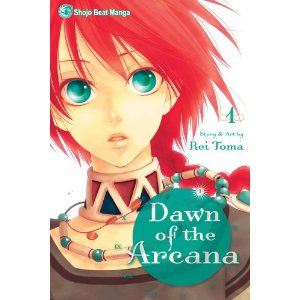
Dawn of the Arcana Volume 1

Dawn of the Arcana Volume 1 by Rei Toma

When I first saw that Viz had announced this title I was immediately intrigued because I am a sucker for fantasy shoujo series and I thought the cover art for this volume was very striking. After reading it, I found Dawn of the Arcana to be an intriguing new series that is well worth reading even if it isn’t executed perfectly. This is the first volume of manga from Rei Toma and as a whole it is very well-executed even if there are a few minor deficiencies in the plotting and art.

Two tiny nations that make up both halves of an island have been warring with each other for years. The political bickering is only interrupted occasionally by a political marriage. The latest poor maiden to be sacrificed to preserve the peace is Nakaba, a red-haired princess who is feistier than the reader might expect for someone who is willing to take part in an arranged marriage. Her new husband is Prince Caesar, an arrogant young man who is constantly referring to Nakaba’s red hair as a sign of her non-noble demeanor. Nakaba is accompanied into the hostile country by her servant, a man named Loki who is a member of the Ajin, an underclass of demi-humans. Loki seems more like a protector and partner than a servant to be bossed around, as seen in the first confrontation between the new husband and wife. Loki pulls a knife on the prince after Nakaba comments on his rudeness in manhandling her. Nakaba promptly smacks Loki across the face in order to prevent him from being killed or punished by anyone else, saying that since Caesar is her husband, “That makes him your master as well.” When Caesar stands there gloating Nakaba punches him in the face and comments to Loki “disciplining my husband is my duty.” With all the face-punching happening in the first few pages of the book, it made me immediately inclined to root for Nakaba.

As the volume progresses Toma lays out some plot elements that I can see will drive the manga forward for the next few volumes. Nakaba is haunted by memories and visions, suggesting that she isn’t exactly a normal princess. There’s conflict between Caesar, his father, and the older illegitimate brother who is the heir to the kingdom. Loki’s protectiveness of Nakaba may go way beyond their bodyguard/master relationship, and the political machinations of the nobility ensure that Nakaba’s first few weeks of marriage are going to be a test of survival instead of a honeymoon. I was surprised to see that Dawn of the Arcana appeared in the magazine Cheese! originally, because I always thought that Cheese! was the go-to source for more risque shoujo, but maybe things get more dramatic later on in the series. The art in Dawn of the Arcana is attractive but a bit generic. There isn’t really a distinct style to enjoy here, and occasionally several panels suffer from not having much going on in the background. This seems like a bit of a lost opportunity for some world building, but I’m hoping that the art will get more detailed as the series progresses. For a creator’s first collected volume, Dawn of the Arcana is quite accomplished. Not all of the plot details are conveyed with much subtlety, but I put down this manga very interested to see what would happen next with Nakaba’s story. This manga would also be an excellent choice for anyone missing the shoujo fantasy catalog from CMX, as the combination of quasi-medieval setting and political intrigue reminded me of several CMX series that I enjoyed very much.

Review copy provided by the publisher.

Categories
Manga Reviews

Sailor Moon Volume 2

Pretty Guardian Sailor Moon Volume 2 by Naoko Takeuchi

A ton happens in this volume! It takes a bit of an adjustment to get into the story pacing of Sailor Moon because everything moves so much more rapidly than most recent shoujo manga I’ve read. Usagi/Sailor Moon and Mamoru/Tuxedo Mask are inexplicably drawn to each other. Usagi knows that she should tell the rest of her team that Tuxedo Mask is aware of her secret identity, but she can’t bring herself to talk about it. The sailor senshi speculate about the crescent-shaped mark on the mysterious Sailor V’s forehead and wonder what her significance is to the lost Moon Kingdom. They fight a typical monster of the week scenario when they go up against an evil video rental shop and Sailor V finally makes an appearance, and Luna introduces her as the heir of the Moon Kingdom, the Princess Serenity. I have to say it was amusing to see Sailor V in her fully awakened state in this series, because it stands in stark contrast to the way she was portrayed in her own series. Here’s she’s calm and cool, immediately assuming the role of mentor to the other sailor senshi.

Usagi has been slowly losing her innate silliness as the series progresses, and with the appearance of Sailor V she willingly assumes the protector role she thinks she should have in her role as Sailor Moon. When she’d act like a wimpy crybaby about going into battle before, she announces “Then it’s our job to protect you!” when Sailor V is determined to investigate a mysterious disturbance on Tokyo Tower. Sailor V’s role as royal decoy doesn’t last long as it is quickly revealed that the real Princess Serenity is Usagi. She and Mamoru are playing out the lives previously lived by a princess of the Moon and a prince of Earth. By the end of this volume the Usagi and the sailor senshi have been to the moon (TO THE MOON!), encountered a hologram of Princess Serinity’s mother in a past life, experienced mystical hair growth, and dealt with the terrible heartbreak that happens when your desired future boyfriend has been turned into a minion of evil (MINION OF EVIL!). It is almost on the verge of being a little exhausting, but I find myself amused by all the little quirky touches in this manga, like the way Sailor Mars is always glaring off into the distance and making pronouncements that she senses evil, right before something evil appears. Sailor Moon continues to be both fun and cute, and the more complex mystical bits about mystical reincarnation and the sadness of decrepit architecture on the moon save it from being too sweet for me to enjoy.