Categories
Manga Reviews

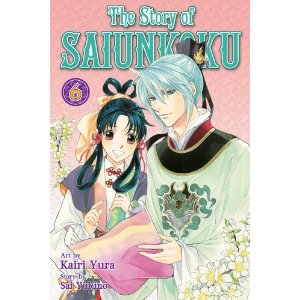
Story of Saiunkoku Volume 6

I’m always happy to see a new volume of this series, which features one of the most sympathetic heroines of shoujo manga. Here we see that while Shurei might pass her civil service exams, her troubles are just beginning. This volume picks up in the middle of a gang fight in a brothel, as Shurei and the young scholar Eigetsu fight the Blue Scarf Gang that has been running around stealing and ransoming examination tokens. Eigetsu turns out to be an unwitting master at drunken boxing, because when he gets splashed by alcohol he turns into the deranged fighter Yogetsu, making him a desirable recruit for anyone in the underworld needing a strong ally.

Ryuki shows his strong promise as a leader when he turns up to extract his future civil servants from gang fighting, striking an amiable deal with the underworld syndicates that control the black market in his city. Now Shurei and Eigetsu are ready to tackle their exams, and they pass while setting records. Eigetsu is the youngest student ever to pass first, Shurei passes in third place, and the eccentric Ryuren Ran passes in second place. Egitsu and Shurei are singled out for the type of harsh hazing that only lifetime bureaucrats would be fiendish enough to survive. While being able to take the exams as a woman was Shurei’s ambition for so long, now she has new tasks to endure if she’s going to fulfill her dream of being a civil servant. One of the things that makes Shurei such a pleasant heroine to root for is that even though she’s suffering, she isn’t held up as a model of saintly behavior. She has a temper and she rants about the horrible treatment she has to endure plenty of times before deciding to stick it out just a bit longer. Ryuki continues to do what he can to protect her, although his role is limited to just watching over Shurei without intervening. Seeing him watch Shurei work out her own problems shows how much he’s evolved as a character since the start of the series, when his previous impulsive tendencies would probably have botched Shurei’s attempts at carving her own path. He’s happy for her success, but ambivalent about her eventual role in government because it will naturally set her at a greater distance from him. Seeing these paradoxical feelings develop as Shurei and Ryuki grow as adults is part of what makes Story of Saiunkoku so entertaining.


Categories
Manga Reviews

A Devil and Her Love Song Volume 1


A Devil and Her Love Song, Vol. 1 by Miyoshi Tomori

If you find yourself fatigued by ordinary shoujo manga, A Devil and Her Love Song is a great series to try read to restore your enthusiasm for the genre. It has an unconventional heroine, two quirky guys, and the promise of an examination of teen social issues with actual psychological depth. The “Devil” referred to in the title is Maria Kawai. She’s introduced to the reader as the object of derision on the subway, as she sits without getting up to offer her seat to the old lady suffering in front of her. When she gets off at her stop, she jostles the sleeping old man sitting next to her and whispers in the old woman’s ear “You must be a lousy pickpocket if you’re targeting a sleeping man, you old crook.” Maria possess incredible powers of intuition. She can instantly see the true feelings and motivations of the people around her. She also has absolutely no filter on her speech, and the habit of bluntly sharing her insights. This ensures that Maria is going to be a target wherever she goes.

Maria starts a new school and soon attracts the attention of an outgoing boy named Yasuke who offers to help her settle in. She comments “I can tell you’re not really a people person, you don’t have to force yourself to talk to me.” Yasuke comments to his friend Shin, “How did she know? I’m upbeat, I’m fun, everybody loves Yasuke!” Shin says that Maria is either being malicious or thoughtful, but in either case he wants nothing to do with her. Maria soon finds herself singled out and bullied, but Shin and Yasuke help her in different ways. With his outgoing facade, Yasuke advises that Maria needs to put “a lovely spin” on what she says so people will get along with her. This results in Maria developing a terrifyingly mannered tendency to tilt her head to the side while saying something horrible to people. Maria begins to start caring about the way she relates to people, seeing “a lovely spin” as a way to view people in the most adorable light possible, while Yasuke attempts to explain that it is a mask he takes off at the end of the day.

Despite Shin’s protests he’s drawn to Maria, intervening in a number of bullying incidents while Maria returns the favor by finding his secret hiding place and dumping water on him when he’s taking a smoke break. Maria is actually able to talk to Shin in a direct way without driving him away, and she actually shares some of her own feelings and experiences instead of commenting on his behavior as though he is the subject of a psychological experiment. Tomori’s character designs are all very attractive, and she does a good job portraying Maria’s cool outer shell when dealing with other people contrasting with the more natural expressions Maria exhibits when she thinks about her own feelings.

I put down A Devil and Her Love Song feeling incredibly intrigued to find out how Maria is going to grow and evolve as a character. She has incredible reserves of inner strength, but I think it will take a long time before she’s able to make true friends or navigate the treacherous hallways of high school without incident. Maria is a refreshing change from the peppy or passive heroines that populate many shoujo series, and I’m excited to see where she’ll wind up.

Categories
Manga Reviews Reread Reviews

Hana Kimi 3 in 1 Edition

Hana Kimi 3 in 1 Edition by Hisaya Nakajo

I read Hana Kimi when it was coming out originally, and it is one of those series that I reread every couple of years. It is the reason why I remain such a sucker for cross dressing reverse harem scenarios, and I find it to be a great silly shoujo series. I was happy to see that Viz is releasing the earlier volumes in the 3 in 1 omnibus edition. Hana Kimi first started coming out several years ago, so hopefully this new edition will create some new readers for the series. This is similar to the other 3 in 1 editions from Viz, the first three books packaged together on fairly thin paper with no new extras.

One of the keys to enjoying Hana Kimi is being able to suspend a ton of disbelief for the first few chapters, because the heroine’s scenario in this manga relies on a staggering amount of coincidences that are possible only in manga land. Mizuki Ashiya has been living in the United States, where she became infatuated with a super-star track and field athlete named Sano Izumi. Sano’s high jumps are sublime, and Mizuki is inspired to take up track and field herself. Not content to only improve her athletic ability, she decides to move back to Japan, disguise herself as a boy, and enroll in Sano’s high school. Osaka High School happens to have dorms and she’s assigned as Sano’s roommate! Despite being a cross-dressing stalker, Mizuki is peppy and cute, with the type of reckless personality you might expect from someone who just casually moves to Japan as a boy because she digs someone’s high jump. When Mizuki gets to school she finds out that Sano has given up jumping due to a tragic past with accompanying psychological issues, and he finds her boisterous attempts at friendship rather annoying.

As you might expect from a manga set at a boy’s boarding school, there’s a large supporting cast. There’s the fabulously gay school doctor Umeda, soccer star Nakatsu whose feelings for Mizuki lead him to start questioning his sexuality, womanizing RA Nanba, and dorm mascot Yujiro. Sano and Umeda find out Mizuki’s secret very quickly, but Sano continues to pretend that she’s a guy. His attitude towards her gradually changes from annoyance to curiosity to fiercely protective. The three volumes cover Mizuki dealing with fitting in at school, the possible resurrection of Sano’s high jumping career, the sudden appearance of Mizuki’s older brother, and the consequences when Mizuki isn’t as watchful of her safety as she should be. The stoic hero with a tragic past is a pretty common type in shoujo manga, but I have to say that Sano is one of my favorite examples of this character. Nakajo does a great job showing the way he snaps to attention whenever anything that happens that might menace Mizuki.

Hana Kimi isn’t deep by any means, but it is one of my favorite comedic romance shoujo manga. Sano and Mizuki end up developing a close friendship partly because they aren’t at first relating to each other as a boy and a girl. I’m happy to see this series get more attention with this rerelease.

Review copy provided by the publisher

Categories
Manga Reviews Reread Reviews

Basara Volumes 9 and 10

Basara Volume 9

As the ninth volume opens, Sarasa finds herself just where she wanted to be – with Nagi’s mentor Doctor Basho. Rescued after a shipwreck, she overheard an assassination plot as she was regaining consciousness on the beach. Unaware that Sarasa is so near, Shuri meets with Okinawa’s democratically elected president Asato. His thoughts are full of military strategy and contempt for the island which appears to be unprotected to the point of almost provoking attack. When he questions the president about his plans if Japan attacks, he replies that he doesn’t want to turn his country into a battleground and prefers to avoid fighting. Nakajin takes Sarasa around to see if she can hear the voice of the person directing the assassination. She recognizes the plotter as Nakajin’s older brother and main rival to the president Unten!

One of the most consistent things about Basara is every so often seeing the flashes of brilliant insanity that make Sarasa/Tatara such an inspiring leader. In this case the dramatic scene occurs at a bullfight ceremony where despite the fact that she’s blind she climbs the rigging above the ring and yells a warning to the president. Shuri foils the assassination attempt with a well placed coconut and yells a warning himself. Sarasa hears his voice and calls for him, ripping of her eye bandages as she stands in the middle of a herd of rampaging bulls. I’m not sure how lovers could be reunited in a more dramatic fashion. Seeing Shuri and Sarasa reunite after dodging bulls and assassins was very satisfying. What follows is a brief idyll, and Sarasa and Shuri contemplate their experiences in a way that shows how they are so far apart as people even though they love each other. Shuri has decided that he’s tired of having everything handed to him and even though he has nothing after being kicked out of his city, he’s going to achieve his ultimate goal of ruling the world with his own power. The lessons about work that Doctor Basho were trying to teach him have some unintended effects. Sarasa sees the peaceful democracy in Okinawa and vows to use it as the template for the new Japan she hopes to build as Tatara.

Basara Volume 10

The reunion between the lovers is brief, as they are separated quickly. Shuri shows flashes of his usual military brilliance as he defends Okinawa from Japan’s fleet. Sarasa has her Byakko sword back, and she calls upon Tatara as she goes to defend President Asano. Things are more complex then they appear to be on the island nation, as the true nature between the breach between Unten and Asano is revealed. Sarasa is worried that Unten and Nakajin will end up killing each other. Shuri fights a piratical battle on the sea, with some surprise allies from the Japanese army and a fireworks display from the nearby foreign fleet.

Shuri’s quick thinking and tactical brilliance show that he’s just as inspiring a leader as Tatara. While Sarasa takes action based on her emotions, Shuri makes the educated bets of a high stakes gambler. The fate of Unten and Nakajin might foreshadow an ending for Sarasa and Shuri. Sarasa shares some heartfelt conversations with Unten, who challenges her about trusting her followers with her secret. A new chapter begins for Sarasa and Shuri. She leaves to go back to Japan, leaving Shuri to fume that he has no way to get in touch with her. The end of this volume concludes with new trust between Sarasa and her followers, and new dangers as she has to find out what happened to Hayato.

Thinking back about the series so far, it is really amazing how much Tamura has been able to pack into ten volumes. Shuri’s suffered what would be an enormous setback and is in the process of starting to put his empire back again. Despite Sarasa’s meandering journey, she’s put together a group of devoted followers and is beginning to grasp what becoming the leader of a rebellion really means beyond just following along with other people’s expectations of the “Boy of Destiny.” Sarasa and Shuri are apart but they both now have the support of new friends, and it is easy to understand and sympathize with the motivations from each side as they slowly move forwards to a place where they’ll have no choice but to confront each other as King and Rebel.

Categories
Manga Reviews

Sakura Hime: The Legend of Princess Sakura Volume 6

Sakura Hime: The Legend of Princess Sakura Volume 6 by Arina Tanemura

I’ve missed a bunch of volumes of this series (must go back and get them) and an extensive supporting cast now surrounds the protagonist moon princess Sakura and her fiancenemy Aoba. The lines are now drawn between the humans and the moon people led by Sakura’s older brother Enju. Sakura is trapped in the middle, faced with the fact that she’s going to cause the destruction of the side she chooses not to ally herself with. While I’ve missed a bunch of backstory, it wasn’t hard for me to pick up and enjoy this volume, because Tanemura excels at creating pretty manga. The main story here focused on the relationship of Asagiri and Ukyo and their distant history in a matriarchal village filled with snow spirit maidens.

Asagiri’s village has plenty of women and very few men. While Ukyo goes out of his way to be nice to her, she doesn’t have much use for him. All the other women keep trying to pursue him. The snow village has a legend which demands that a maiden sacrifice herself to ensure the safety of all the inhabitants. There are creepy snow hags in the mountains, and they seem to be increasing in number! I have to take a moment to note that the snow hags look like demons out of a horror manga, with wrinkly faces, empty eye sockets, and mouths of broken teeth. The snow hag images are quite disconcerting and effective when compared with Tanemura’s usual ornately pretty style. Asagiri and Ukyo end up developing a tentative romance, and this ensures Asagiri’s doom as jealous females in the village manipulate the sacrifice selection process to ensure that Asagiri is going to be the one chosen for this year. Asagiri and Ukyo’s story had a folktale feel to it, and Tanemura is always great at portraying the scorn and anger that result in love gone horribly wrong. Asagiri has a revelation about the true nature of the legend behind her village, and the effects of her new knowledge and subsequent loss of faith are profound.

There was an almost shocking shift of tone between Asagiri’s fate and the back-up stories that concluded this volume. The Angelic Gold Coin of Maple Rose is an entirely too sweet story about an angel who becomes human for a day. I was more amused by Mascot Sports Festival, which features all the sidekick characters from Tanemura’s other series fighting it out to see who is the cutest. Most of my amusement was centered around seeing all the characters line up with Finn, the angel from Kamikaze Kaito Jeanne drawn as so infinitesimally small that she needs her own arrow and name label. There’s an additional bonus story from Gentlemen’s Alliance Cross, which fans of that series should also find amusing.

Overall this manga reminded me of what Tanemura does best, and the character designs for the snow hags were a real surprise. I need to fill in the gaps in my manga collection!

Review copy provided by the publisher