Categories
Manga Reviews Reread Reviews REVIEWS

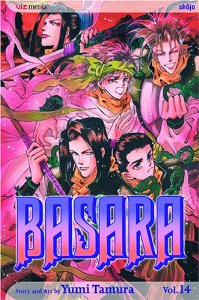
Basara, Vols 13-16

Whenever I pick up and read a few volumes of Basara, I’m always struck by how much story and emotion Yumi Tamura is able to pack into a few pages. I’d started rereading Basara last year, but got distracted by having too many volumes of shiny new manga. The Manga Moveable Feast seemed like a great excuse to dig up these volumes again. These volumes cover Sarasa’s journey as she escapes from prison and wages war on the desert city of Suo, only to encounter the Red King. The battle doesn’t go the way either of them planned.

Sarasa is able to escape Abashiri prison with her comrades, but she doesn’t have time to settle back and appreciate freedom again. It is time to head south and take up the struggle to determine the fate of Japan. Ageha leaves Sarasa, saying that he can’t become a crutch to make things easier for her. She has to execute her plans on her own, based on her convictions. Shuri heads to his precious desert city of Suo, but things have changed there for the worse as the administrator there Momonoi attempts to remake it in the image of Kyoto by displacing the poor and blowing up buildings. Asagi prevents a reunion between Sarasa and Shuri in a southern market, because he thinks if they each find out the truth about each other now, it would be “too dull.” Sarasa and Shuri both head to Suo with drastically different purposes.

The struggle in Suo is portrayed in mental as well as physical terms. Sarasa meets up with Hozumi, Momonoi’s son who his a non-violent artist. His girlfriend Renko runs an underground newspaper in the city. Sarasa starts unsettling the city by plastering notices that “Tatara was here” on the walls, and even flying the message from a kite. Sarasa starts to reflect a bit about what it means to be both a strong and feminine woman after spending some time with Renko. Hozumi stages his own form of protest by painting elaborate pictures on the walls of buildings slated for destruction, so people hesitate to blow them apart.

When Shuri sees the wreckage of Suo, he’s angry at what it has become. Momonoi brutalizes both Hozumi and Renko. Sarasa and Shuri both go after Momonoi for different reasons. Sarasa is nervous about being in close proximity to the Red King, the man who destroyed her village. Shuri sees that he’s not welcomed as a savior in his treasured city, and begins to reflect that his previous philosophy about a good leader inspiring fear was mistaken. Sarasa’s reinforcements come, but her plan to use Momonoi’s own explosives to cut off the palace kills the water supply for the city. The Red King’s army executes a tricky sneak attack, and the star-crossed lovers seem like they are headed towards mutual destruction. Sarasa is devastated when she realizes that she’s bring more destruction to the people of Suo. A horrible sandstorm prevents the battle from progressing further, but rather than regroup with her comrades, Sarasa runs off and finds Shuri in the chaos.

It is a little unbelievable that Sarasa and Shuri have managed to keep their identities from each other for so long, especially considering the way they both tend to show up and meet each other right around the time that Tatara and the Red King have a skirmish. It is clear now that part of reason is that they honestly don’t care, and they are both blinded by love for each other so much that they aren’t going to stop and ask inconvenient questions when they could just enjoy each other’s company. This idyll is very short, and the Red King and Tatara’s army clash the next day and Shuri and Sarasa finally get a glimpse of each other from across the battlefield.

What follows is one of the most emotionally devastating scenes in the series, as Sarasa and Shuri react to this newfound knowledge in different ways. Sarasa slips into a fugue state, forcing out commands to kill the Red King, while Shuri mechanically tries to kill himself at the suggestion of his followers because his group is so clearly outnumbered by the rebel forces. Both armies flee the battle as King Ukon’s army approaches and Ageha takes Sarasa away in an attempt to bring back Tatara. Ageha thinks “Was he…that good? Why not just take me instead?” Ageha concludes that Sarasa isn’t his “woman worth dying for” and decides to leave. Sarasa ends up finding shelter with a local priest and his family, but her destiny isn’t going to let her sit back and do nothing.

Sarasa strikes up an odd friendship with Kikune, one of the White King’s spies. Sarasa and Kikune end up befriending Lady Purple, the Black King’s estranged wife. Lady Purple ends up being another type of mentor to Sarasa, but Sarasa’s emotional healing really begins when she’s reunited with her mother. In a very nurturing way, Sarasa’s mother asks her some pointed questions about the reasons why she was fighting and what she wants the future of Japan to be.

There’s some funny yet poignant exchanges happening as Asagi has rescued Shuri, who is undergoing his own emotional rehabilitation. Asagi is all but twirling his non-existent evil mustache in an attempt to get Shuri to have some sort of emotional reaction to him, but Shuri calmly accepts the prospect of being sold into slavery by his half-brother.

Overall, these volumes server as a great emotional climax to the first half of the series. The central mystery about what would happen if Sarasa and Shuri would find out about each other has been answered, and now they have to pick up the pieces of their lives yet again. While Ageha might have given up on Sarasa, it is clear that her destiny as Tatara will not allow her to just retire into the countryside and life out the rest of her life peacefully. Shuri has his own set of trials ahead, and it will be interesting to see how both of these powerful leaders manage to build a new Japan with such strong and well-connected enemies lining up against them. One of the strengths of Basara is the way Tamura will intersperse shorter, more personal adventures into the larger struggle with the extended cast. Having Sarasa and Shuri both on their own a little bit, without their customary support systems allows them to grow more as individuals, making the battles much more human. I’m glad I set aside the time to get back with my Basara rereading program, and I’ll likely finish up rereading the rest of the series outside of this week’s manga moveable feast.

Categories
Manga Reviews REVIEWS

Kare First Love Vols 1-6

Kare First Love Volumes 1-3 by Kaho Miyasaka

I was excited to see the first volume of Kare First Love pop up on Viz Digital. I thought this would be a good excuse for me to reread the series. I checked out most of Kare First Love from a library a long time ago, and since then I’ve been slowly acquiring my own copies. Kare First Love was a shoujo manga released before the Shojo Beat imprint came into being. In terms of content, it would skew a bit older than some of the titles in the Shojo Beat line, although Miyasaka doesn’t straddle the josei/shoujo line the way I feel Ai Yazawa sometimes does.

Kare First Love sticks fairly close to standard shoujo plots, but it executes them in an engaging and sometimes slightly more realistic way. Kare First Love also piles on the drama. While there are humorous moments, there’s much more angst as the protagonists navigate their budding relationship. Karin Karino is a shy girl who hides behind her glasses and doesn’t stick up for herself at school. She’s thinking slightly snarky thoughts to herself as she endures her morning bus ride when she’s approached by Kiriya, a handsome student from a nearby boys’ school who is interested in the photography book that she’s reading. A mishap on the bus leaves Karin thinking Kiriya is a pervert, and she slaps him and leaves her book behind. Like many shoujo heroines Karin’s outward actions contract with her inner thoughts, as she meekly gives in when her frenemy Yuka demands her class notes while thinking of what she’d actually like to say in response. All the mean girl shenanigans are deflated a little bit by Nanri, a girl in Karin’s class with a worldly and cynical air about her. Nanri holds herself apart from the rest of the class, but she points out to Karin that she does have the ability to stop being taken advantage of if she would only speak up.

As much as Karin would like to go back to her simple anonymous life Kiriya will not go away. He shows up at her school to return her photography book, and they immediately start bickering. Yuko decides that she’s going to use Kiriya’s odd interest in Karin to pursue him and his group of hot friends. Karin finds herself maneuvered into a series of awkward group dates, and it becomes apparent that instead of being obnoxious, Kiriya is almost saintly for a 16-year-old boy. He goes out of his way to look after Karin, maneuvering her through awkward social situations. Karin can’t believe that Kiriya is actually interested in her, but around him she actually says what’s on her mind without her customary filter of shyness.

As Karin and Kiriya start to spend more time with each other, she learns that he’s estranged from his family and supports himself by working a series of part-time jobs. His main ambition is to be a photographer. There are plenty of misunderstandings and incidents where Karin is swept off her feet while Kiriya says things like “Let me take care of you…or I’ll do something horrible like kiss you again.” Kiriya encourages Karin to rediscover her love for music, which is something that she dropped due to the extreme pressure her parents placed on her studying for school.

One of the things that sets Kare First Love apart from other shoujo manga is the way Miyasaka details the trials and tribulations associated with Karin and Kirya developing the physical aspect of their relationship. The manga goes into more detail than is typical, with Nanri sometimes functioning as a peer counselor for the Japanese equivalent for Planned Parenthood because she keeps handing Karin condoms to ensure that when she does have sex, it will be safe sex. Karin is as scared and timid as you would expect a socially isolated girl to be, and Kiriya is about as patient as one would expect a 16 year old boy to be, which is not very patient. One difficult element of the characterization that Miyasaka manages to pull off is that for several volumes Kiriya is basically pressuring Karin to have sex, but he doesn’t seem like a jerk. He might attempt more physical intimacy in their relationship, but he always backs down when Karin appears uncomfortable.

Teenage romance is always both intense and complicated, and in short order the couple have to deal with Kiriya’s tragic past (the most important accessory of any shoujo hero), Karin’s overbearing parents, Yuka’s bullying, interfering photographers, and Kiriya’s attractive older sister-in-law. In addition to these outside complications, Kiriya and Karin’s relationship turns stormy due to their own lack of communication and misunderstandings with each other. The dynamic of the main relationship in Kare First Love reminded me a bit of Fuyumi Soryo’s Mars, but with much less psychological torture.

Miyasaka’s art is attractive, but most fluid and natural when she’s drawing teenagers. Karin’s father often looks a tad on the robotic side, but that could also be a function of his less than great personality. Karin is believable as a stunning shoujo heroine when she takes off her glasses, and Kiriya’s larger frame and shaggy blond hair contrasts with her more conservative look. Miyasaka does a good job alternating between the outward action and Karin’s thoughts, making all the scenes of breaking up and making up dramatic enough to satisfy any shoujo fan.

I’m very happy that Viz is making their backlist available on digital platforms, and I hope this series finds a new group of fans!

Categories
Manga Reviews REVIEWS

Crimson Empire, Vol 1: Circumstances to Serve a Noble

Crimson Empire, Vol 1: Circumstances to Serve a Noble by QuinRose and Hazuki Futaba

I have a weakness for romance titles with ridiculously long titles in either manga or prose format. There’s something about the inherent ridiculousness of a title like “The Sicilian’s Ruthless Marriage Revenge” that makes me want to read it! If a romance title has five words or more, I’m usually entertained if I’m in the mood for some light reading. My decision to pick up Crimson Empire was largely due to the title, combined with the fact that it is another Quinrose title. I enjoyed the first Alice in the Country of Hearts manga adaptation well enough, so I was curious to see if I’d also like a different manga title from the brand without the literary connection.

Crimson Empire has a potentially amusing protagonist in Sheila the former assassin turned royal bodyguard and head maid, but the story in the first volume isn’t all that compelling as it mostly involves Sheila meeting an endless progression of handsome men. This is only what one could expect in a manga based on an otome game, but there were enough interesting elements that I would probably check out the second volume. This manga opens in a very dark way as one of the turning points of Sheila’s childhood is portrayed when her assassin trainers tell her to kill a random man. She does fulfill her duty, but not without a lot of trepidation. Years later Sheila is ready to accept her first official assignment, and she ends up as a bodyguard to the royal Prince, instead of joining the assassin league that has served as her foster family.

Prince Edvard is blond, charming, and the target of frequent assassination attempts which Sheila foils. He also might be a bit of a sociopath, as his outward personality masks an inner emptiness and pathological self-regard. Edvard’s older brother Justin is the tall, dark, handsome, and tsundere hero of many a female protagonist’s dreams. His outward hostility towards Sheila leads her to wonder if he’s behind all the attacks on his brother, but Justin always seems to be in the right place at the right time if Sheila needs a bit of help. There’s an almost too-large cast of supporting characters that Sheila meets as she goes about her duties. While the art is capably executed, it doesn’t have much of a distinct style. Fortunately the character designs are all very good, which helps the reader distinguish a little bit between the Brainy One, the Mischievous One, the Sorcerers One, the Demonic One, the Well-Dressed One, and the always essential Guy Wearing Glasses.I’m being a bit snarky, but overall I did like reading this manga, and I would follow the series if the next volume shows signs of a more interesting plot. If any more characters are introduced I might give up on the series because I can barely remember everybody! Fans of reverse harem manga would likely enjoy Crimson Empire, Vol 1: Circumstances to Serve a Noble, and at least Sheila’s bodyguarding duties give her a more interesting background than many of the heroines of the genre.

Categories
Manga Reviews REVIEWS

The Story of Saiunkoku, Vol 9.

The Story of Saiunkoku, Vol. 9 by Sai Yukino and Kairi Yura

It is rare for a manga series to end leaving me wishing that it was twice as long, but that is exactly what happened as I was reading the final ninth volume of Story of Saiunkoku. The eighth volume was a natural stopping point, and this volume has some side stories that help shed some light on the histories of selected members of the supporting cast. This volume might not be totally necessary to round out Shurei’s main story, but fans of the series will enjoy visiting with the extended Hong clan and the amazingly eccentric Ryuren.

The first story, “So Began the Fairy Tale” focuses on Shurei’s father, giving greater background into the more ruthless personality behind his smiling exterior. While he’s an amazingly gentle and wonderful father, his past as an assassin gives a bit of an edge to all of his actions in the manga. Here we see the beginnings of his ability to plot as he takes action to make sure that the Hong clan isn’t endangered. “Hurricane Ryuren Strikes the Capital” flashes back to the examination period, where we see Shurei and Eigetsu start to cement their friendship with the eccentric Ryuren despite his crazy clothes, horrible flute playing, and tendency to make odd pronouncements. This story ends up serving as a meditation on the nature of friendship, even as Shurei and Egitsu’s overtures to Ryuren wind up taking them on a detour through the gambling underworld. The final story focuses on the Hong family again, with “Someday I Will Come to You (Though I Love You, How Far You Are From Me)” focusing on Shurei’s uncle Reishin Hong’s bizarre psychological hang-ups. This volume featured plenty of humor, as a series of masks duplicating the expressions of Shurei’s father are put to an unorthodox use, and the reactions Ryuren accidentally provokes from the people surrounding him are always funny.

It does make me a little sad knowing that there’s a very long light novel series containing more adventures of The Story of Saiunkoku that we’ll never see translated here, but the manga adaptation of the story was certainly fun to read. This is going to be a “keeper” series for me, as I can see myself wanting to reread this every few years. It is so unusual to find a shoujo ending where the happy ending for the heroine is a life of civil service as opposed to everything wrapping up nicely with a romantic interest. Many things combined to make this an entertaining manga – the clear art, fun supporting cast, and the blend of humor and drama made this manga very enjoyable.

Categories
Manga Reviews REVIEWS

Please Save My Earth, Vols 1-5

One of the things I was most excited about when Viz launched their digital store was the possibility that some of their backlist shoujo titles would get released in digital format. The one series I was most wanting to experience again was Please Save My Earth. I read the first few volumes of the series many years ago, but dropped it. At the time I was a bit frustrated about the lack of forward movement in the story, even though I thought the manga was interesting and well-constructed. I know that plenty of people have read the whole series and consider it a favorite so I was anxious to give it a second try.

The first volume opens by introducing the slightly strange heroine of Please Save My Earth. Alice has just moved to Tokyo from Hokkaido, and she’s having a hard time adjusting. She has an affinity towards plants and feels cut off from nature in the big city. Alice is tormented by an oddly precocious neighbor boy named Rin. As she’s excaping the stress of school she happens upon an oddly intimate conversation between two of her male classmates, Jinpachi and Issei. At first Alice thinks that she’s stumbled across a moment from a yaoi manga and concludes “this is what manga fangirls are supposed to weep with joy over!” Later, Jinpachi and Issei explain the meaning behind their conversation – every night they share the same dreams where they are male and female scientists marooned on the moon.

Rin has an accident while Alice is babysitting him and is in a coma for several days. When he wakes up, the bratty boy seems to be taken over by a much more cynical and manipulative personality and he begins to exhibit an obsessiveness over Alice that would be even more disturbing in a grown man. Alice has a dream where she’s a woman named Mokuren, on the moon with Shion, the man she loves.

As the early part of the series progresses, Alice, Jinpachi, and Issei start tracking down other people who share their alien moon dreams by placing an ad in a kooky paranormal magazine. They start having regular meetings, trying to piece together the history of what happened to the alien scientists. Many of the feelings of the adult scientists tend to transfer over to their female incarnations, as Jinpachi starts to exhibit signs of the unrequited love his counterpart Gyokuran had for Mokuran/Alice and Issei/Enju remains on the sidelines.

Hiwatari’s art shifts back and forth from a cartoonish classic 80s style showing the schoolkids to a much more lush and detailed way of portraying life on the moon. One thing that I’d forgotten that I noticed much more the second time around were the touches of humor included in the story such as a random Saint Seiya reference and the occasional mention of shoujo magazine publishing conventions. Jinpachi is congratulated on his emotional conviction when he’s so stirred that he has to be portrayed in a two page spread.

A manga that focused only on characters sharing their dreams about being teeny tiny aliens on the moon might not seem to be very compelling reading on the surface, but there’s plenty of dramatic tension in the way the Moon and Earth stories intersect. The aliens are the last outpost of a dying race, spending their remaining time observing the Earth. But some events show Mokuren and Shion together after all of their companions have died off from an unexpected disease. The mystery behind the final days of the aliens is tricky to put together, as the events shown in the dream flashbacks shift forwards and backwards in time.

Rin is Shion reincarnated, and it is difficult to tell if his scheming is a desperate attempt to put things right or a form of revenge for being left alone on the Moon base for so long that he went insane. Rin is able to manipulate both the adults and high school kids around him, tagging along with Alice and coming up with an elaborate scheme to hide his true reincarnated identity. There’s a bit of a race against time element at play, as the other reincarnated high schoolers start to piece together more and more information about their previous lives, Rin may be able to manipulate them into revealing some information that would allow him to access the dormant alien technology from Earth. Rin also has developed psychic powers, which makes him quite terrifying as a hidden antagonist to the story.

With the digital availability of this series it is very easy to read several volumes at once, and I think that will end up being the most rewarding option for most readers. I wonder if part of the reason why I was starting to grow impatient the first time around was due to delays between volumes. The story of Please Save My Earth progresses in a very compelling way, with past lives informing the reader of the character’s current motivations. I’m interested to see if they are going to play out their tragic fates again, or if free will and the changed personalities of Alice and her gang are going to cause their lives to take a turn for the better. I’m happy to have the chance to revisit this series.