Categories
Manga Reviews REVIEWS

Heiress and the Chauffeur 2 and Shuriken and Pleats Vol 2

Short manga series can be a bit troublesome at times. Sometimes they are short because they obviously weren’t all that popular, or because it seems like the premise for the series isn’t enough to stand up to multiple volumes. Sometimes two volume manga series really deliver on a a good short story, and here we have examples of one good and one not so great two volume series.

Shuriken and Pleats Volume 2 by Matsuri Hino

Matsuri Hino’s art is always gorgeous, and I enjoyed the first volume of this series mostly because I liked the concept of an overly serious ninja girl being forced to be a regular highschooler. The second volume of this series fell apart, although there were a few hints of humor along the way that I appreciated. First, I was totally confused because I remember putting down the first volume thinking that the heroine, Mikage, was an orphan. Imagine my surprise when Mikage’s mother shows up to visit her daughter, stands in the doorway and has a brief conversation with her and then promptly leaves. And it turns out that her mother has no idea that she’s a ninja, while Mikage’s father is actually running the ninja organization that Mikage used to work for.

The confusion continued as random scenes of high school life were interspersed with the conspiracy about seeds that was explored in the first volume, but the main thing that remained constant was Mikage being attracted to much older men with her feelings unreciprocated, while other much older men continue to find her adorable. The only part I found somewhat amusing about this volume was Mikage’s tendency to reach for ninja weapons and when called on her actions, proclaim that she was just holding a pen. The pretty art wasn’t enough to compensate for an incoherent storyline, and it is perplexing because Hino is capable of so much better.

The Heiress and the Chauffeur Volume 2 by Keiko Ishihara

Two volumes is probably just the right amount of length for this story about a Taisho Era heiress who is in love with her childhood companion and chauffeur. Sakaya is unusually forthright and straightforward about facing her problems, and she exhibits a great deal of resilience considering some difficult life circumstances that she’s dealing with. She has a lame foot which sometimes causes her pain, and her father is off overseas working. Her protector is Shinobu, a chauffeur who she persists in seeing as an older brother even though he is clearly in love with her.

A suitor for Sakaya shows up in this volume, and continues to meet with her even while telling her that he has business that is 10 times more important than socializing with her. Sakaya’s father is pushing for the match, so this ends up being a test for Sakaya in standing up to family pressure. This causes Sakaya and Shinobu to become a bit more honest with themselves about their feelings for each other, even going as far as stealing away with each other briefly. Like many short series that get pressured to wrap up quickly, the pacing of the story was a little bit rushed, and the authors’ notes contain some hints at stories she would have incorporated if she had more time. Still, this was a satisfying conclusion to this short series, and I enjoyed both the clarity of the art and the historical setting. I’d definitely be on the lookout for a longer series from Ishihara if Viz finds another one to put out under the Shojo Beat imprint.

Categories
Manga Reviews REVIEWS

The Gods Lie

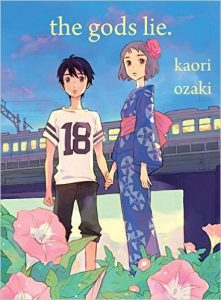
The Gods Lie by Kaori Ozaki

I waited a long time to read one of my favorite manga of the year. I bought The Gods Lie shortly after it came out, but it has been sitting on my to-read pile for months. This is a coming of age story showing the developing relationship between Natsuru, a soccer prodigy, and Rio, a girl who stands out at school for being overly tall and silent. When the story opens, it first seems like a slice of life manga, but soon the reader sees that death overshadows the lives of the characters. Natsuru lives alone with his quirky writer mom, because his father died recently. His grandfatherly soccer coach is in the hospital with cancer, and while the replacement coach actually knows how to play soccer, Natsuru doesn’t react well to his new coaching methods.

Natsuru and Rio develop a friendship when he rescues a kitten his mom is allergic to. She offers to take care of it if he’ll help pay for the cat. It is clear that Rio has a stronger sense of household budgeting than is normal for a 6th grader. Her younger brother Yuuta just sails through life cheerfully, seemingly unaffected by their run-down house and need to economize on everything. When Natsuru visits their home, Rio tells him that her father is fishing in Alaska, but will be back in time for the spring festival. Natsuru decides to secretly ditch soccer camp and stays with his new friend over the summer. As the story develops, it is clear that Rio is guarding a secret that she can’t share with her new friend.

There’s a sense of clarity and assurance in Ozaki’s art, it is expressive without being bogged down by too many details. She perfectly portrays the stuck-up and clueless attitude of the class princess, the disrepair of Rio’s house, and the freedom of unstructured summer days. It is a rare manga that is perfect in one volume but The Gods Lie has the feeling of a great short story, capturing a range of experience for the characters in just a few pages, and hinting at what they’ll become as they grow up.

Categories
Manga Reviews REVIEWS

Haikyu!! Vol 5 and Kuroko’s Basketball 3 and 4

Haikyu!! Volume 5 by Haruichi Furudate

I still feel like pinching myself a little bit to remind myself that it is actually real that so much great sports manga is coming out now! I’m trying to get caught up with my manga reading after a very hectic few months at work, and there’s something very relaxing about retreating to a world where everyone’s biggest concern is sports tournaments.

One of the reasons why I like Haikyu!! so much is that the focus shifts around with every volume, so while the odd rookie couple Hinata and Kageyama are certainly progressing with each volume, the emotional core of the story changes to focus on different team members. As Karasuno heads towards a tournament with the weight of their past reputation still following them around, it becomes an opportunity for redemption. Karasuno can be recognized as a legitimate opponent again. One important theme stressed in tournament play is the need to focus on one game at a time. While the bracket facing the team is challenging, they take on their first opponent with a serious sense of purpose. The experience of the boys’ team is contrasted with the girls volleyball team, who falls to their first opponent. Furudate takes a beat to acknowledge how athletes feel when they are knocked out of a season unexpectedly early, without the opportunity to play their sport anymore.

Karasuno faces the “Iron Wall” of Date Technical High school, and here we see how Hinata’s jumping abilities and athleticism have turned him into a great decoy on the court. With the opposing team distracted by his unexpected athletic brilliance, it slowly builds into an opening for Asahi. Some of the more striking panels in the manga show Hinata in the spotlight with Asahi in the background growing more and more intense, until he’s able to prove his abilities as an ace again. Karasuno has shown all the pieces of their team though, and they won’t be able to take advantage of the element of surprise again. Haikyu!! continues to be incredibly gripping and fun.

Kuroko’s Basketball Volumes 3 and 4 by Tadatoshi Fujimaki

In contrast, while Kuroko’s Basketball sometimes feels more like a traditional shonen battle manga transported to the basketball court, with a little less focus on the emotional story associated with sports and a bit more emphasis on defeating opponents who have honed their skills at basketball in order to develop sports superpowers.

Kuroko’s invisibility continues to be an asset to Seiren High, and no surprise they are in a tournament too! They have the tough draw of having to fight two opponents in the same day. First up is Seiho, who have an intimidating center, and a brash player who starts running off his mouth about Kagami being the only good player on the Seiren team. Seiho’s team is difficult to read and defend against, because all their movements are informed by martial arts practices instead of ordinary basketball. Gradually Seiren comes up with unexpected plays that wear the other team down.

The next team contains the best shooter of Kuroko’s old team, “the Miracle Generation”. Midorima’s superstitions are funny, but his insane ability to never miss with a basketball makes him seem more like an overpowered fighting manga villain than a high school basketball player. The shots he makes are so improbable, I was worried about Seiren’s ability to come up with a strategy to defeat him. Along the way Kuroko and Kagami have some interpersonal conflict yet again as Kagami decides that he has to win the game all by himself, which is in direct opposition to Kuroko’s team-driven approach. While there’s a little bit of character development, most of these two volumes was devoted to non-stop dynamic basketball action. I appreciate the omnibus release for this manga, since the story isn’t quite as gripping as Haikyu!! for me, I’d rather read it in larger chunks. This is still an enjoyable manga, even though I don’t think it will reach the iconic status of Slam Dunk.

Categories
Manga Reviews REVIEWS

Ten Count, Vols. 1 and 2

Ten Count Volumes 1 and 2 by Rihito Takarai

Ten Count is a yaoi series that caused me to wonder greatly about psychiatric ethics. Shirotani is an executive assistant who functions well in his job despite having an almost debilitating case of obsessive compulsive disorder. He has to wear gloves to hide his injuries from frequent hand washing and he has elaborate systems and rituals in place in order to make him feel safe. His condition also affects his relationships with other people, as he has an aversion to being touched.

One day Shirotani’s boss gets saved from an accident by a random bystander, who turns out to be Kurose, a therapist. Kurose recognizes Shirotani’s symptoms and goes out of his way to cultivate his acquaintance. Kurose’s mannerisms are brusque and not very emotional, but Shirotani seems to be drawn to him anyway. Kurose proposes that Shirotani gradually build up a tolerance to the situations that trigger his OCD by making a list of ten things he finds difficult or impossible to do, ranging from things like touching a door handle bare handed to eating with another person. Kurose says that this isn’t therapy, just two friends trading tips.

The relationship begins to grow, and Shirotani becomes increasingly dependant on Kurose, but Kurose abruptly cuts things off, only to leave Shirotani confused and upset. For someone who is supposed to be an expert in human behavior, Kurose seems a bit odd himself in how he conducts himself with this new friendship.

The first volume doesn’t need the explicit content warning on the front, but the second definitely does! I’m not terribly fond of relationships in yaoi manga where one person is entirely dominant and the other is set up in a more submissive role. In this case Kurose seemed to keep pushing Shirotani out of his comfort zone, and while it might end up that Shirotani becomes a more functional human being as a result of this, there were some dynamics to the relationship that I didn’t really enjoy reading. I think though that this is likely to be an enjoyable manga for most yaoi fans.

Categories
Manga Reviews REVIEWS

Platinum End Vol. 1

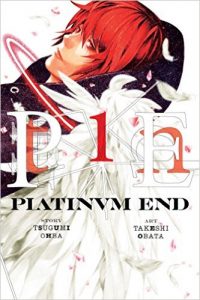
Platinum End Volume 1 by Tsugumi Ohba and Takeshi Obata

I approached reading Platinum End with mixed feelings, I was interested because this series is another work from the team that brought the world Death Note, and I greatly enjoyed Death Note. On the other hand, I wasn’t looking forward Death Note 2: Electric Boogaloo. I ended up putting down the first volume feeling like I was cautiously interested in seeing where Platinum End was going.

The volume opens with Mirai Kagehashi, a high school student who has decided to kill himself. He’s foiled in his attempt by the sudden appearance of an angel who rescues him. Mirai is stuck in despair because he was orphaned when he was young, and taken in by relatives who abused him. His new angel announces that she’s going to make him happy and gives him some new abilities – he can choose between having wings to fly anywhere or mystical red arrows that will cause anyone to fall in love with him. Mirai responds that he’ll ponder what he wants if he’s given both gifts and the angel agrees.

Mirai’s angel Nasse functions more like the devil on his shoulder than a good conscience, as she encourages him to use his powers for the most selfish of reasons. Mirai gets a sense of how deadly the ability to make anyone fall in love with him can be, when he returns to his aunt and uncle and learns the truth behind the death of his parents. In true shonen fashion it turns out that Mirai is caught up in a cosmic game, where God has decided that he’s going to elevate a human to become the next God. 13 angels have been assigned to 13 chosen humans, and the last one left gets to be in charge of the universe.

Mirai says that he would be just content with normal happiness, but Nasse keeps pushing him to use his angel-given superpowers to manipulate and murder his way to having money and happiness. In a way, Platinum End seems more like a horror title than anything else, as Mirai wakes up from nightmares with horrific visions. The other contestants for godhood aren’t using their powers for good either, as one of them decides to disguise himself as a superhero and pick off his opponents one by one, killing a comedian who decides to use the love arrows to assault a group of women.

Platinum End is rated mature and aside from that, one could develop a drinking game centered on the number of panels where Nasse’s disembodied butt is hanging in the air randomly in many panels. The art from Obata is good as always. Overall, this was an interesting manga to read, but not very pleasant. It seems like Platinum End is going to be even darker in tone than Death Note, and that series was pretty dark. At the same time, seeing if Mirai’s inherent sense of morality is going to hold up to the temptation of godlike power is an interesting story to explore, even though it is thematically a bit too close to Death Note. I put this volume down feeling a bit cautious about this series. I’ll be curious to see if in the next couple volumes Platinum End develops into a manga that I’m looking forward to reading. If not, there’s always Death Note!

pe1