Categories
Manga Reviews REVIEWS

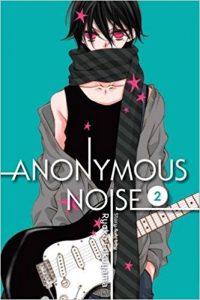
Anonymous Noise Vol. 2

I feel like Anonymous Noise is hobbled by its covers, because they are so consistently great the manga inside has a hard time living up to them. That being said, I found the contrived plot elements a little less annoying in the second volume, probably because the cliched character introductions are now out of the way.

The volume opens with Nino being challenged about her vocal ability. Miou, Yuzu’s former singer points out that while Nino’s voice has a compelling quality, her technique is a mess. Nino and Miou sing together and Miou is able to sustain her note much longer than Nino. Nino is determined to get better, and she starts reading tons of books on vocal technique. Nino spots Momo’s name on a flyer advertising music autions for a famous writer/producer, and she decides to try out in order to find out if the mysterious producer is her long-lost Momo. Of course the auditions are on the same day as the next TV appearance of In No Hurry to Shout, and Nino has to somehow pull off being at both at the same time.

The aspect of this manga that I found most interesting in the first volume was Nino as a destructive muse. She’s so single-minded, she is still utterly unaware that she’s hurting Yuzu’s feelings with her never-ending Momo obsession. Yuzu is inspired to compose by the idea of Nino as his Alice, but Momo is determined to avoid her because he’s turned away from his original childhood inspiration to compose pop hits. Yuzu even damaged his voice to sing with Nino when they were children, with the result that he’s no longer able to sing himself and Nino is now serving as his proxy. All this obsession in the service of creativity might not be a good thing, yet the joyful scenes of people lost in song carry the manga along.

I wish some of the plot elements were a little less contrived, because the coincidences piling on top of each other take me out of enjoying the story a little bit. I am still enjoying the stylish art, particularly a great panel where Yuzu hands Nino the wig of the lead singer for his band. I think this series might be one where I become a little better at engaging my suspension of disbelief with each volume. Anonymous Noise certainly delivers dramatic angst, so I’m still finding it interesting to read.
Categories
Manga Reviews REVIEWS

Anonymous Noise Vol. 1

Anonymous Noise Volume 1 by Ryoko Fukuyama

I read Anonymous Noise a few days ago, and I’ve had a hard time writing about it, I think because I ended up feeling very conflicted about whether or not I actually enjoyed reading it. It was stylish looking, which I appreciated. The author deployed a great deal of typical shoujo manga plot elements, which I was less than enthusiastic about. Finally, there was a level of angst involved in the relationships between the characters that I actually found intriguing, and will likely keep me hanging on to reading this series in the hopes that it gets a bit better in the second volume.

Childhood friends who are separated and meet again only to fall in love is such a shoujo staple plot element, that I get weary of it if it isn’t executed well. Nino Arisugawa has a habit of developing close childhood friendships with boys only for them to utterly disappear, which will make it very handy for her to have a love triangle as a teenager. Her first friend is Momo, a next door neighbor boy with a habit of making terrible puns. They’re in the habit of singing together. Momo abruptly moves away with his family and while Nino is visiting the sea to scream her agony into it, she stumbles across Yuzu, a kid composer who likes to write musical compositions in the sand. Yuzu is also a very familiar character type seen in manga, the short kid who drinks a ton of milk in hopes of triggering a growth spurt. Nino finds a bit of peace when singing Yuzu’s compositions, but she still longs for her lost friend Momo.

Switching gears to the future, Nino starts attending a school where Yuzu is a student. He’s very busy, because he also has the time to be in a rock band called In No Hurry, which performs wearing face masks and eyepatches. Nino and Yuzu reconnect, but it is clear that she’s still nurturing her feelings for Momo. The part of this manga that I found most interesting, and I’m not sure if it was intentional on the part of the author, is that Yuzu’s obsession with Nino as a muse is so clearly unhealthy. He has a girl singer in his band called Alice who is designed with his memories of Nino in mind, and he likens his feelings for Nino as being trapped under the spell of a canary. Yuzu ends up being the most compelling character in this manga, just because he wears his emotional agony on his sleeve. No surprise, Momo is attending the same high school, and shows up around Yuzu to make a few bad puns and then disappear in an enigmatic fashion.

The art is stylish, if a bit generic. I enjoyed the edgy costumes for Yuzu’s band. A couple moments in the manga that stood out to be as being particularly well-executed were a scene of Nino and Yuzu reconnecting through music in a practice room, and an encounter with Yuzu’s band mates that hints at a whole different story of unrequited love. I often feel like some manga series need at least two volumes before passing judgement on them, and I’m hoping that the second volume of Anonymous Noise has less shoujo cliches and more teen angst because the potential is there for an entertaining music infused teen soap opera, but I’m not quite seeing that yet.

Categories
Manga Reviews REVIEWS

The Water Dragon’s Bride, Vol. 1

The Water Dragon’s Bride Volume 1 by Rei Toma

I remember being delighted when I heard that another Rei Toma title was going to be released by Viz. Then many months passed between the announcement and actually getting the volume in my hand, I totally forgot about it and then was delighted all over again! I do enjoy fantasy manga and this volume was an excellent start to the series.

Asahi is a modern girl who has the misfortune of standing too close to a pond, where she is promptly whisked away to a village with no technology whose inhabitants don’t quite know what to make of her. A young boy named Subaru stumbles across Asahi and takes her home despite his sister’s protests. Unfortunately the village has a habit of offering up human sacrifices to the Water Dragon, and when Subaru brings home his new friend his mother decides that the odd girl will be a great way to ensure the prosperity of her family. Asahi is a bit stunned by being catapulted into another world and she doesn’t realize that she’s going to be a sacrifice until it is too late. Subaru tries to prevent the ritual but is unable to do anything to save his new friend.

Asahi finds herself in the Water Dragon’s realm. He’s a cold, stoic sort of god who says that he’ll wait to make Asahi his bride until she grows up. She asks him if he’s wearing cosplay and accuses him of being a pervert. The Water Dragon seems to find Asahi mildly entertaining, but he takes away her voice and then sits calmly while she starts to starve. Asahi finally realizes that the world she’s lost in is horrible. Other gods intervene to see some drama when Subaru and Asahi are reunited, but the humans in Subaru’s village prove to be even more terrible than the gods.

I think that Toma’s art, which was always good, has improved since Dawn of the Arcana. Her clear and simple style does a great job highlighting all the variants in facial expressions and reactions as the characters deal with the extraordinary. Subaru’s mother shows hints of evil in her smirk, and then devolves into full-out evil as she takes on the role of putting Asahi to trial for being rejected by the gods. Asahi’s personality is inherently bubbly and open, and it takes her a while to realize the truth of the world that she’s found herself in. Her body language completely changes after meeting the Water Dragon and the villagers. There aren’t a lot of detailed backgrounds in this manga, but the absence of setting is used to great effect when Asahi is in the Water Dragon’s world because the lack of detail in Asahi’s surroundings just makes everything seem even more surreal.

The inhumanity of the humans and the possibility that a god might change due to having to take care of a small girl are interesting themes for this manga to explore. This is a solid shoujo fantasy title and I strongly recommended it for fans of the genre.

Categories
Manga Reviews REVIEWS

A Springtime With Ninjas Vol. 1

A Springtime with Ninjas Volume 1 by Narumi Hasegaki

I had high hopes for this title because I greatly enjoy both ninjas and shoujo manga, but I was underwhelmed by A Springtime With Ninjas. I think part of my disappointment was because I was hoping that the heroine and hero of the manga were both ninjas, but it turned out to be a decently executed manga that had some funny moments with a very conventional clueless rich girl heroine who was unfortunately not a ninja at all.

Benio is a sheltered rich girl who lives with the a horrible curse – she has to marry the first man who kisses her. She’s trapped in her home, at the mercy of a procession of tutors and she longs to go to school and experience normal life as a high schooler. Her uncle announces that he’s found a friend for her, and produces Tamaki, a flirtatious ninja bodyguard. Benio immediately finds him offputting, cherishing the memory of a friendship she had as a child when a boy who came over to play with her. Surprising no one who has read a shoujo manga before, it is pretty clear that Tamaki is her long lost friend.

Benio and Tamaki eventually get clearance to go to school, and he fends off Benio’s would-be suitors with his elite ninja skills. There were some amusing lines of dialogue like “The sanctity of this princess’s lips bears more weight to me than your lives.” Also, it was fun to see random high school club presidents suddenly manifest ninja abilities. The art is attractive, and the action scenes are clear and easy to follow. But there isn’t really any distinct quality or style to the art that would help offset storylines that kept giving me a sense of deja vu. I ended up putting down this manga being reminded of all the other shoujo manga that I’ve read that cover some of the same story tropes but end up being a little bit more funny, or have a more interesting take on ninjas or sheltered heiresses.

Categories
Manga Reviews REVIEWS

Chihayafuru Vol. 1

Chihayafuru Volume 1 by Yuki Suetsugu

Around a month ago, there were a few things I knew about Chihayafuru. It was a josei title about a Japanese card game. It has had an anime adaptation. I was interested in reading this, but I was convinced it would never be licensed. I have also been living under a rock, or at least totally unaware of what Kodansha was doing because I didn’t realize until several days ago that Chihayafuru was being released in English albeit just in digital format. I clicked the preorder button so quickly!

Chihayafuru is a josei manga, but it also is a sports manga centered around karuta, a poetry matching game that requires literary knowledge, memorization, quick reflexes, and strategy. From the start, the reader gets a few panels of the middle of an exciting game. Then the manga catapults into the past, to six years earlier. The main character is Chihaya, a girl who has buried her ambitions in supporting her older sister’s dream of becoming a supermodel. While Chihaya doesn’t seem to have any goals for herself, it is clear that she’s kind and a bit of tomboy at school. When a new kid arrives in her classroom and is promptly bullied, Chihaya sticks up for him. Wataya might talk funny and be poor, but he is a master at the game karuta, which the class plays from time to time. Wataya’s first enemy is Taichi, a popular boy who is dedicated to his studies and comfortable always winning the school kuruta tournament.

Wataya is a genius level kuruta player, and when he gets put at a disadvantage in a challenge match because his glasses were stolen, Chihaya substitutes herself for him. She doesn’t have all the poems memorized, but she has an incredibly dynamic and aggressive playing style that when combined with her reflexes enables her to eke out a win. She becomes inspired to pursue kuruta as her own interest. Taichi, Wataya, and Chihaya end up forming an odd friend group centered around kuruta, even visiting a local club to play practice matches and learn from a local teacher. The personalities of the three main characters create an interesting dynamic and dramatic tension.

I’m assuming with the flashback opening to this volume, the characters will be shown at their current ages soon, but the reader is set up to being able to feel all nostalgic when the trio gets together again outside of middle school. Chihayafuru reminds me of Hikaru No Go in the best way, because it takes a topic that might seem overly cerebral and invests it with a great sense of pacing and action. Chihaya’s dynamic personality and habit of slapping down cards whenever she gets a sudden insight makes everything exciting. Suetsugu’s paneling using multiple perspectives as angles on the game action also creates plenty of visual interest. I also liked the way romanized Japanese was presented along with the translations for the poems, because it was easier to get a sense of the rythm of the game, and how the players greet matched poems as “old friends”. In a digital release I suppose one can’t expect too many extras, but if print volumes of this series ever come out, it would be fun to have some of the poems and cards featured in more depth in notes at the back of each volume.