Categories
Manga Reviews

Shoujo Quick Takes – Black Bird 8, Stepping on Roses 5, and Seiho Boys High School 5

Black Bird Volume 8

I read the first couple volumes of Black Bird and decided that the romance between a young girl and a dominating demon just wasn’t for me. I wasn’t all that thrilled with all the wound licking going on, and for whatever reason in my tawdry manga I prefer the flat out trashiness of something like Ai Ore to the more romanticized Black Bird although both titles display the same type of troubling and stereotypical gender roles in their main couples. At least Ai Ore is more open in its commitment to crazy plot elements, with all the rape threats, etc. right there on the page. In contrast, Black Bird tends to coyly hide elements of sexual coercion with all the accidental wounds and subsequent licking going on, along with a heroine who would happily sacrifice her existence for her demon boyfriend. This volume of Black Bird marks a bit of a turning point, as Misao and Kyo may finally have to get it on. Not because they mutually decide to take their relationship to the next level as an expression of their love, but because Kyo is afflicted by a horrible curse (which manifests in the form of exhaustion and tribal tattoos) and only Misao’s becoming his demonic bride can heal his affliction. I enjoyed this volume more than I expected but for a large section of the book I was really hoping that bad guy Raiko would prevail with his demon hunting mission and actually kill Kyo. I have a feeling I’m not supposed to be rooting for the death of the romantic lead in this manga.

Stepping on Roses Volume 5

I originally felt a little resentful towards this title because I thought it was more superficial than Ueda’s other series Tail of the Moon, which is one of my favorite historical shoujo manga. After reading a couple volumes I think the Perils of Pauline troubles that beset Sumi are starting to be more amusing than annoying, just because Ueda manages to pack so many problems into a single volume of manga. In the fifth volume Sumi is still in her marriage of convenience with wealthy businessman Soichiro. The evil Natsuki has succeeded in driving away Soichiro’s faithful butler and inserting a spying maid into Sumi’s household. Soichiro’s best friend Nozomu is still in love with Sumi but that didn’t stop him from marrying a random rich girl, who is not pleased that her husband is in love with someone else. So! Sumi and Soichiro are growing closer, but when he asks her if she loves him she replies no. He conveniently has forgotten that when they married he instructed her not to fall in love with him and he walks out in the rain. Sumi goes after him and gets soaked. Nozomo has moved out of his house, leaving his wife alone after she caused a scene at a party by attacking Sumi with a bouquet of flowers. Nozomo spends his time alone creepily working on an epic naked painting of Sumi, and when he finds her outside his house he decides to finagle her into posing for him. In the meantime Sumi’s hapless brother with a gambling addiction is trying to go straight by working at Soichiro’s company, and Soichiro’s long lost butler has moved in with Sumi’s poverty stricken family. Whew! I do wish that Sumi had a bit more of a personality, as her main function seems to be making futile attempts to ward off the attentions of almost every man who stumbles across her.

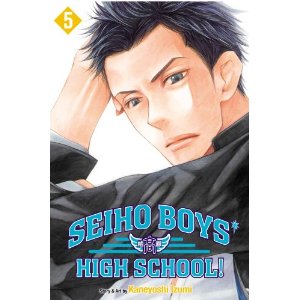
Seiho Boys High School! Volume 5

This volume was my favorite in this mini-batch of manga. I enjoy the self-contained short stories in each volume, but since the series uses the same rotating cast of characters, the reader still gets plenty of character development. Having the stories written more from a male point of view also provides a nice contrast to more conventional shoujo titles. The first couple stories explore Maki’s situation as he remembers his dead girlfriend and struggles on a first date with his new girlfriend. A ghostly image starts appearing to many of the guys at the dorm, and Maki wonders if his girlfriend Erika is trying to signal something to him. The ghost ends up being a hermit-like male student, but Maki has an unexpectedly touching dream triggered by the episode that may be a signal that he’s truly ready to let go and move on with his life. Unfortunately moving on can be difficult, as he attempts to go on a date with his current love interest and starts tensing up and making the situation even more awkward. Stories about relationships are balanced out by more comedic episodes, as Hanai accidentally finds his photographic ambitions recognized when he starts getting besieged by girls from other schools who want pictures of his classmates. The ongoing storyline about ordinary girl Miyaji and extraordinary male specimen Kamiki gets a little bit of progression as well. This manga strikes me as a good series to have around to reread. The episodic nature of Seiho Boys High School makes it easy to pick up a random volume to read, and the short stories provide plenty of humor and emotion.

Review copies provided by the publisher.

Categories
Manga Reviews

Manga Moveable Feast: Rumic World Trilogy Volumes 2 and 3

Rumiko Takahashi is one of those manga artists whose influence it is impossible to overstate, but the prolific nature of her manga series might make her works seem a bit daunting to the average reader who might not feel like picking up 56 volumes of Inuyasha or 36 volumes of Ranma 1/2. Many manga bloggers are choosing to focus on shorter series and her short stories this week, and I’m no exception as I decided to finally read a couple volumes of the Rumic World Trilogy that I’ve been hoarding for just such an occasion. Somewhere in a closet I have stashed a few single issues of Uresei Yatsura and one of my favorite Takahashi stories, Firetripper, which appears in collected format in the Rumic World Trilogy Volume 1. Firetripper is probably a contributing factor to why I like Shinobi Life so much, as it features a time traveling romance about a girl from modern times who ends up meeting a warrior from the past.

The second volume of the Rumic World Trilogy is almost a self-contained volume, as it features five stories with the same characters bookended by two short stories, “The Golden Gods of Poverty” about an unfortunate boy who is used by his rapacious parents to summon the lucky gods who don’t seem to be very lucky anymore, and “The Entrepreneurial Spirit” about fundraising seances in high school.

“Wasted Minds” are the five linked stories in this volume, which are a comedic adventure story about two spies with special powers. Yura Enjoji functions as the team’s strongman, and she is fiercely protective of her long hair. Tamuro Gomi’s last name (trash in Japanese) is a reflection of his skills because he is a teleporter who can only teleport from trash heap to trash heap. They start investigating a rival spy agency along with their hapless handler. They run into pigs that transform machines into trash, sea monsters, and a school for teen juvenile delinquents. As they flit from garbage dump to trashcan, there’s plenty of adventures and a little bit of romance. Whenever I pick up a Takahashi title, I’m struck by the simplicity of her illustrations and clear action sequences of her art. It seems like many manga titles today rely on an abundance of screen tone and occasionally confusing panel composition, so it is a relief to my eyes to pick up a title like this that is so easy to read.

The third volume of this series features a nice selection of short stories. I enjoyed the first one, “Wedded Bliss” about a new couple who happily fights all the time to the detriment of their neighbors. “War Council” was an amusing take on the “evil student council” type story that so often pops up in manga, as an ordinary boy who agrees to serve as student council president because he has a crush on the vice president is caught between the warring factions of the jock student organization and the nerd student organization. “When my Eyes Got Wings” shows more of a horror influence as a sick boy with a scary pet bird develops a crush on a high school girl, and strange things begin happening around her boyfriend. “Sleep and Forget” is a dramatic romance that resembled “Firetripper” in plot and tone. A girl and boy with a connection to dogs relive and reenact events from their past lives, as they struggle with the vicious spirits of a dog and the old woman that was its master. “The Face Pack” is a goofy story about a group of students dedicated to the art of disguise. Also included is an autobiographical sketch of what happened to Takahashi when she suddenly found herself cat-sitting. Out of all of the stories in this volume, I found “Sleep and Forget” the most memorable, just because tend to enjoy Takahashi when she turns her hand to more serious stories that blend action and romance.

If you’re a little intimidated by the thought of tackling Takahashi, I think that these Rumic World Trilogy volumes are a worthwhile investment. While they might be out of print, they are still easy to acquire. Sometimes when reading anthology manga volumes, I put them down thinking that most of the stories were auditions for longer series that didn’t quite make the grade. I didn’t get that feeling when reading the Rumic World stories, as everything seemed nicely resolved and self-contained.


Check out the Manga Moveable Feast for more bloggers talking about Rumiko Takahashi
.

Categories
Manga Reviews

Ai Ore Volume 1

Ai Ore Volume 1 by Mayu Shinjo

I don’t think I’ve ever blogged much about Mayu Shinjo’s series Sensual Phrase, mostly because I wrote about it for Library Journal’s Xpress Reviews online a long long time ago. If you scroll down this page you can see my review of the final volume. Sensual Phrase was pure trashy soapy fun, as you might expect from a series about a virginal (but not for long) girl who inexplicably becomes recruited to be the lyricist of a popular rock band. Shinju’s series fill a niche that isn’t often explored here for translated manga – more mature shoujo. We’ve got some other examples like Butterflies, Flowers (which I consider to be josei masquerading as shoujo) but not much else.

Ai Ore deals with superficially swapping traditional gender roles and romance in a teen rock band saga format. An androgynous band named Blaue Rosen is faced with the loss of their lead singer. All the pretty boys in the band are actually girls who attend the same all female high school. A cute girl named Akira asks to audition for the part, but the stoic lead guitarist Mizuki doesn’t want anyone else singing her songs. Of course Akira turns out to be a boy, and a romance between the tall and rangy Mizuki and the short and cute Akira begins. Mizuki’s handsomeness cause her to be treated as a major crush object by all the girls at her school, and Akira’s feminine charms have given him the title of his school’s “princess”. When Mizuki and Akira are together, misunderstandings abound as Mizuki’s classmates don’t understand why she is favoring a single girl with her attention and the boys at Akira’s school are disappointed that a handsome boy is monopolizing the attention of their princess. Shenanigans!

Unfortunately the switch in outward appearances doesn’t mean that Shinjo’s characters personalities are switched as well. For all his girlish features, Akira is a fairly typical alpha male, relentlessly pursuing his goal of dating Mizuki and joining her band despite her not very convincing protestations. While Mizuki professes to hate men, and is committed to maintaining her princely outward appearance, her inexplicable feelings for Akira turn her timorous. She doesn’t project the self-confidence and cool that she’s able to maintain as part of her stage performance. Shinjo’s romantic plot devices have a striking similarity to many of the tropes that pop up in old school romance novels. Threats of rape and sexual assault are common, and I was a little bummed out yet unsurprised that the end of this volume focused on several scenarios of this type. I am generally a big fan of cross dressing manga but Ai Ore didn’t totally win me over, despite plenty of over the top pronouncements like Akira saying “Instead of singing about love, drown yourself in me!” It was a little hard for me to believe that Akira is more physically dominating than Mizuki when he’s drawn to be around a foot shorter than her.

Existing Mayu Shinjo fans will find a lot to like about Ai Ore. It is an oversized edition of 300 pages, with color pages in the front and a character gallery in the back. Even though I’m not finding this manga as immediately addicting as Sensual Phrase, I’ll want to check out the second volume.

Review copy provided by the publisher

Categories
Manga Reviews

Viz Signature Quick Takes – Used Books, Charisma, and Leaves

Kingyo Used Books Volume 3

Reading this series can sometimes be a little bit painful. All the loving descriptions of classic manga that will never be released in English make me pine for what I’m unable to read. This volume might be a little more fun for American manga fans because much of the manga profiled in this volume will be familiar. The third volume starts off when a scardey cat meets a beautiful woman who is obsessed with Umezu horror manga. He tries to read the manga as a superficial way of connecting with his pick-up target, and ends up appreciating the horror genre much more than he thought he would because “Every one of his characters goes full-throttle at everything.” In “Makeup” a woman struggling with her career finds the strength to continue when she revisits her childhood love of Sailor Moon. Sailor Moon serves as a cultural touchstone for all the women she randomly encounters during her day. They share memories, with one of them asking “Don’t you think dressing up feels like going into battle mode?”

The other stories in Kingyo Used Books feature stories about cooking manga, romance between employees, and the lengths someone will go to in order to track down an unreturned book. The notes in the back provide some interesting historical context about the status of manga lending libraries in Japan. It occurs to me that between Kingyo Used Books, with its overview of classic series and focus on the connections that readers make with manga and Bakuman’s feverish statistic-laced overview of the act of manga creation, it is possible to build up a good if idiosyncratic portrait of the manga industry in Japan.

Afterschool Charisma Volume 2

I’m not always great about remembering to go over to check the Sigikki site for online chapters (although I am very thankful the site exists), so I’m making a mental note to go over there this week and get caught up on Afterschool Charisma. I was familiar with most of the chapters in this volume due to one of my infrequent Sigikki binges, but it was nice to sit down with the print edition and revisit this series about a normal high school boy trapped in a school filled with the clones of famous historic figures. The clones are getting ready for their annual talent day. Glimmerings of a new religion begin to manifest when small groups of clones start carrying around tiny sheep and referring to the “Almighty Dolly”. Shiro has to deal with a couple stressful situations – he’s tasked with babysitting a suicidal Mozart, and the school’s feckless director swoops in along with an ominously familiar looking little girl named Pandora. The school director latches on to Shiro and forces him to play tennis and other sports while all the clones are studying. Shiro starts getting caught up in the clones new religion, along with his new companion Hitler. I continue to be an unabashed Freud fangirl, because it is just hilarious seeing teenage Freud skulk around with his pageboy haircut uncovering evil secret organizations, and then acting incredibly neurotic the minute anyone asks him what he’s doing. This volume ends with a big surprise, so I’ve got to get over to the online chapters and find out what is going to happen!

House of Five Leaves Volume 3

Every time I pick up a volume of this manga, I’m struck by the unique atmosphere that Ono creates. The blend of Edo period slice of life pacing and the underworld setting creates an undercurrent of tension. I’m always on edge thinking that the moment is going to come when hapless ronin Masa is going to get caught up in violence but he always manages to drift along on the edges of life, surviving despite himself. In this volume the spy/thief of the House of Five Leaves gets caught stealing, and Masa takes advantage of his new charismatic acquaintance Yagi to gain a side job at the house where his companion is being held captive. Yaichi is suspicious of Masa’s new friendship with Yagi, but is he anxious not to see someone else take on his pet ronin or is something else going on? Masa’s sister abruptly visits Masa in order to get some help extracting herself from a marriage offer, and it is funny seeing how the gang of hardened criminals acts around her. Everybody remarks that she eats just like Masa, and seeing Masa take on the role of scolding older brother shows a different aspect of his personality. For all of Masa’s supposed ineffectiveness, he does manage to aid his comrades but in doing so he gives the outsider Yagi more information than what might be prudent. It’ll be interesting to see what happens next between the odd triangle of Masa, Yaichi, and Yagi.

Review copies of Kingyo Used books and House of Five leaves provided by the publisher.

Categories
Manga Reviews

Gatcha Gacha Volumes 7 and 8

I’ve procrastinated writing about the last couple volumes of Gatcha Gacha because I didn’t really want this series to end. In a world filled with cookie cutter shoujo, this series is genuinely weird, somewhat endearing, and occasionally disturbing. I’m assuming that based on the long stretches of time between the series debut and the translation of the final volume that this series didn’t do so well in the sales arena, so kudos for Tokyopop for finishing it. While I’m unhappy about so many series being unfinished with Tokyopop shutting down, I’m trying to comfort myself with the idea that at least Gatcha Gacha was finished. There are plenty of spoilers ahead, so be warned.

Gatcha Gacha Volume 7 by Yutaka Tachibana

The seventh volume was the first one where I felt like Tachibana was stalling for time before the end of the series. Instead of focusing on the relationships between the main characters, we get an extended flashback of what happened between Motoko and a girl from her past named Sae. Motoko gets involved in Sae’s life, and while Sae thinks that she’s using Motoko, it is clear that everyone’s favorite tough girl has her own motivations for intervening. The next story arc in this Motokocentric volume touches on the possibility that she has a different family background than everybody previously assumed. It is interesting to see the agony Yuri goes through when confronted with the idea that Motoko might be disappearing from her life. Motoko ends up solving the issue with her customary directness, and it reminded me how much I enjoy reading a manga that features a character that just says whatever she wants without fear. In another series, the situation probably wouldn’t have been taken care of in half a volume, because everyone would sill be sneaking around without saying anything.

Gatcha Gacha Volume 8 by Yutaka Tachibana

The final volume confirms that the great love affair in this manga wasn’t between Yuri and Yabe or Yuri and Hirao, but Yuri and Motoko. Someone with a better background in gender studies than I would probably have a field day with Gatcha Gacha. It certainly shows a quirky yet positive proto-lesbian relationship between Yuri and Motoko, but it also uses gay characters and situations as fodder for soap opera sleaze of the highest order, as the cute girl who has been stalking Hirao is revealed to be a guy with an overprotective brother/gang leader who makes his displeasure known when the male objects of his cross dressing brothers affection reject his advances. The image of Yuri being menaced by a gang member in full gimp costume is one of the most incongruous things I’ve seen in mainstream shoujo, and one of the reasons why I love Gatcha Gacha is that it can be both surprising and weird.

The ending is one of those open-ended conclusions that often seem to plague manga. The characters are all a little different thanks to knowing each other, but all of the ongoing relationship issues are hinted at instead of given a clear resolution. Hirao is still enamored of Yuri, but even as she tries to give their relationship a chance and acts jealous if other girls give him attention, she’s probably slotted him into a non-romantic category in her mind. His emotional sensitivity and generosity has her thinking of him as princess she wants to protect. In contrast, when Yuri needs someone to rescue her, the person she calls for is Motoko. Motoko sweeps in, ready to fight for Yuri. When I first put the volume down I felt a little cheated because the end of the manga didn’t totally feel like a static conclusion. After reflecting a bit, I realized that even though there might not be major changes, the personalities of all of the characters have shifted a little bit just from their interaction over time. Motoko really views friendship with Yuri as something precious. Yuri is able to stand up for herself a little bit. Hirao is still going after Yuri, but he’s aware that it may already be too late. One of the funniest bits in this volume came with the omake at the back where the characters react to the lack of an ending, and Hirao is complaining that everything’s come back to where it started, only to be answered with the comment that “the girls have all grown into strong, sensitive men.” Gatcha Gacha has been one of the quirkiest shoujo manga that I’ve read, and I’ll horde these precious volumes until I die since they’ll be going out of print. I’m already looking forward to rereading the series next year.

Thanks so much to Sean Gaffney for sending me his extra copy of Volume 8!