Categories
Manga Reviews

A Bride's Story Volume 1

I think it is nice that Kaoru Mori’s manga inspires special treatment. The editions of Emma from CMX featured matte paper stock that gave the volumes an old timey feel. A Bride’s Story gets the deluxe treatment from Yen Press, with the first volume arriving as an over sized hardback with a lovely wraparound illustration on the dust jacket. The painstaking research, sympathetic characters, and lovely detailed illustrations that readers enjoyed in Emma are in full effect in A Bride’s Story, with the bonus of a heroine who enjoys hunting rabbits from horseback with a bow.

The story takes place along the Silk Road in the 19th century. Amir is twenty years old, and she’s sent to marry a twelve year old boy named Karluk. Amir comes from a more nomadic tribe than Karluk’s family, with the result that she brings with her some skills that her new family hasn’t possessed in awhile. Amir seems anxious to fit into her new place, trying to be helpful whenever possible and she seems to be waiting for her new husband to grow up. Evidently twenty years is an unforgivably old age for a bride, and the backstory behind the marriage isn’t shown. Karluk is an uncommonly calm twelve year old, who seems to take his responsibilities very seriously. He jumps at the chance to try to locate his uncle’s clan of shepherds, wanting to be reintroduced to his relatives as a married man.

I’d always thought that Mori’s slice of life stories are particularly good at portraying children and how they negotiate the world. Rostam, the youngest member of the household, becomes fascinated with the local woodcarver and he neglects his chores to observe him. This gives Mori the excuse to showcase some dazzling panels of woodcarving patters, as well as showing the reactions of Rostam’s family. His mother sends him to bed without dinner, then tasks Amir with sneaking him food later. When it is clear that this is a general pattern of Rostam getting punishments that his mother immediately regrets, Amir declines to participate. She’s nervous and wants to please her new family, but when they start discussing rabbit stew she seizes the opportunity to grab her bow (part of her dowry) and race off on her horse to hunt.

A Bride’s Story would be plenty entertaining if it just showcased Mori’s research and charming illustrations, but she decides to introduce a note of suspense when it seems like Amir’s family has started to regret sending her off to marry Karluck. Amir gets an unexpected ally when the matriarch of the family (an enjoyable example of the kick-ass grandma character that often appears in manga) decides to defend the new bride. Karluck’s grandmother received a bow with her dowry too! With publishers going out of business and series going out of print or left unfinished, I’ve been feeling a little less enthused about manga lately. Reading A Bride’s Story has reminded me about the possibilities for storytelling unique to manga, and I’m happy to find a great new series to read.

Categories
Manga Reviews

Genkaku Picasso Volumes 1-3

Genkaku Picasso Volumes 1-3 by Usamaru Furuya

Genkaku Picasso is an interesting series, because the author Usumaru Furuya came out of the alternative manga scene in Japan with his earlier work featured in Garo. Genkaku Picasso is a series about a misanthropic young artist who gains the power to change the people around him when he is possessed by the artistic inspiration to draw their inner souls. This series had incredibly interesting and surreal art, but it felt to me like it wasn’t ambitious enough. I’m probably being overly critical because Furuya is so clearly talented, but I thought the story aspects of Genkaku Picasso let down the art a little bit. The series is still very much worth reading for the visual elements alone.

The first volume shows the lonely life of Hikari Hamura, nicknamed “Picasso” by his classmates at school due to his relentless drawing habit. He doesn’t really have any friends, but a girl in his class named Chiaki who finds him interesting and makes an effort to hang out with him. As they sit by a riverbank while Hikari is sketching, a horrible helicopter crash takes place. Chiaki is killed, but Hikari survives. Chiaki is transformed into a mini-angel who lives in Hikari’s pocket and his talent at sketching takes on a mystical turn. Chiaki informs him that his arm is starting to rot and the only way that he can save himself is to start helping other people. Hikari can now sense when a classmate is troubled. A dark aura manifests itself around Hikari’s next subject and he becomes possessed by a strange muse, compulsively drawing a depiction of his classmate’s inner heart. Hikari then can leap into his own drawing and experience the surreal scene he created, and his actions inside the drawing can cause the tormented soul to change for the better.

Hikari’s first subject is Sugiura, whose inner landscape is dominated by a crumbling cliff, amusement park, and an angry giant clutching a bag of money. While Sugiura is outwardly popular, his family life is less than ideal. As Hikari learns more about his classmate, the surreal pictures shift and change until Hikari is able to arrive at the truth of what is tormenting Sugiura. One of the things I liked very much about this manga was the way the illustration style would change depending on the world Hikari inhabits. The real world has all the polish and screentone of a standard manga, but when Hikari is transported into one of his illustrations it becomes more unfinished, with crosshatching used for shading and a slightly grainy quality that evokes the idea of a pencil or charcoal sketch.

Hikari continues to help his classmates, but his erratic behavior (he looks like he’s talking to himself when he’s talking to Chiaki) and his habit of abruptly passing out (which happens when he disappears into a drawing) still causes most of his classmates to shun him. He does manage to inspire feelings of affection in the people he helps, and he’s soon surrounded by a circle of acquaintances who are now taking more of an active interest in him.

One of the things that bothered me about this manga throughout the first couple volumes was the fact that Chiaki doesn’t seem to mind at all her transformation into Hikari’s nagging Tinkerbell. Even though while she was alive she inexplicably supported Hikari, I thought it was odd that she didn’t have more of a reaction to her fate. Genkaku Picasso is fairly episodic, but I did like some of the stories where there would be a shift towards Hikari exploring the inner life of a character that appeared briefly before. Hikari helps a boy in his class named Mamba finally work through his feelings towards a girl named Ogura. Mamba’s images evoke a sinister tree binding the girl he likes. Later Hikari visits Ogura’s subconsciousness and sees that her inner life is filled with mecha and yaoi imagery.

Some of Hikari’s solutions sometimes seem a bit simplistic, and this was particularly the case when Hikari helped one of his classmates who happened to have gender identity issues. The story ends very happily, which is nicely affirming if unfortunately not very realistic. One of the rewarding things about Genkaku Picasso is seeing the differences in the inner lives of Hikari’s targets. Joan of Arc, a Disney take-off, pop idols, childhood toys, and surreal gardens form the mind landscapes of Hikari’s classmates.

The third volume moves away from the more episodic storytelling of the first two volumes, finally providing some answers to questions readers may be forming about Hikari’s strange behavior, and if he’s ever going to turn his powers of artistic observation on himself. In his final journey, Hikari delves into his own psyche but he finds himself absolutely alone, without Chiaki. Hikari’s classmates begin to get worried about where he might be and they decide to go on their own rescue mission. We finally see some of the back story of the accident where Chiaki was killed, and there are some incredibly arresting images of Hikari trying to peer out of his own eyeball as though he were separating out the slats of a window shade that are going to stay in my memory for a long time.

The ending is heartwarming, with a dash of fake-out. While the story was concluded in an emotionally affecting manner, it seemed a bit too easy for me somehow. This goes along with my earlier reaction of the basic premise of the book. I think that there are some problems that just can’t be solved nicely with some surreal sketching and psychological intervention from a socially maladjusted teenager. I’m glad I read Genkaku Picasso, because it is so visually innovative and serves as a great contrast to the usual type of shonen series that get translated here. My frustration with the series remains because I think Furuya’s artistic talent is so great that he’s clearly capable of producing a classic work, but Genkaku Picasso isn’t it. Maybe I’d be better off reading some of his manga where he’s adapting another writer’s work. I still enjoyed Genkaku Picasso and would recommend it to anyone wanting to read visually striking manga.

Review copies of volumes 2 and 3 provided by the publisher.

Categories
Manga Reviews

Harelequin Manga Series: The Stanbury Crown: Royally Wed

One of the fun things about romance novels in general is the way they are often arranged in linked series, where the relationships of different couples are introduced but you still get a chance to peek in on the previous couples when they show up as supporting characters in subsequent books. Often these series will be linked by siblings, so there just happen to be three unmarried sisters or brothers who all find connubial bliss by the time the trilogy is over. The Stanbury Crown series focuses on an imaginary country called Edenbourg, and here’s a look at the first two volumes in this four volume series.

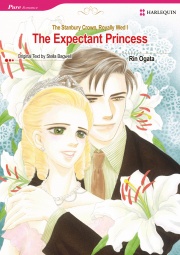
The Expectant Princess by Rin Ogata and Stella Bagwell

Princess Dominique has a hopeless crush on the lawyer for her family, Marcus Kent. She confessed her love for him and was rejected so she decided to throw herself into her studies by moving abroad. Dominique hides her identity while she’s in America. She returns to her family for a royal gathering. There’s plenty of drama in the first few pages of this manga. Dominique’s father the King goes missing under suspicious circumstances. His car crashes but his body isn’t found. Dominique is confused and anxious because she had an affair with a married man while she was in school, and she’s pregnant. Marcus is newly divorced. When Dominique and Marcus come together to investigate her father’s death, he makes it clear that he still sees Dominique as a child and any relationship between them would be in appropriate. Dominique tells Marcus about her condition and he promptly proposes in order to protect the royal family. Dominique rejects him because she doesn’t want a loveless marriage but Marcus begins to realize that he’s been lying to himself about his true feelings. The art and adaptation for this volume were fine, nothing spectacular but perfectly fine for a Harlequin manga.

The Blacksheep Prince’s Bride by Miho Tomoi and Martha Shields

The mystery of the King’s disappearance continues on in the next volume as Rowena goes undercover as a nanny in the royal household. Jake is forth in line for the throne and in need of domestic help because he’s divorced with a toddler son. Jake is the son of the King’s estranged and possibly evil brother, and thus a prime suspect for the kidnapping of the king. While Rowena struggles with an unearned reputation as a fast woman and Jake is trying to clear his name they grow closer. There were a few awkward poses and a little stiffness in the art, but this was offset by some cute character interactions. When Jake finds out that Rowena is a spy he’s annoyed not because she lied to him, but because he’s worried about how she views her own safety – what if he’d turned out to be an evil kidnapper and she went into his house unprotected? Everyone comments that while Jake may be a suspect he couldn’t possibly be guilty because he likes children and puppies. So, if you might find yourself suspected of kidnapping obscure European royalty, be sure to accessorize yourself with an adorable moppet and some wee doggies. Overall, I thought this volume was pretty much right in the average in terms of Harlequin manga quality. I’m still amused by the idea of finishing up this series by different authors and illustrators and I have to admit that my hopes are higher for the next book in the series, Codename: Prince because that title just seems intrinsically entertaining.

Access to electronic copies provided by the publisher.

Categories
Manga Reviews

Gente Volume Three

Gente Volume Three by Natsume Ono

More than anyone else, Natsume Ono’s manga excel in creating an atmosphere and sense of place. While I love reading manga set in many different places, there are few that I’d actually want to visit in real life. If it was possible to visit Natusme Ono’s Italy, I’d love to go there. With Gente‘s emphasis on good food, friendship, complicated relationships, and quirky bespectacled gentlemen, it easily inspires the reader to start packing for an imaginary vacation. The final volume of Gente continues in the slice of life trajectory established in the previous volumes. There aren’t any resounding conclusions, just the chance to visit the people of Casetta dell’Orso once again and see that their lives continue as always.

The first story in the volume focuses on a politician and restaurant customer who has an unusual way of ordering his day. He listens to fortunes told by his little granddaughter because they always seem to come true. He comes to a crossroads in his life and makes a decision, helped along by a prediction and a good meal. A darker side of love is explored in “Singore Rizzo’s Fancy,” where the womanizing half of an estranged couple finds himself hopelessly attracted to a woman who is uninterested in him. Rizzo decides to try to arrange for the happiness of the woman who has inspired his affection, even as he continues his relationship with his wife where passionate love has changed into a combination of hostility and familial feelings. The closing image is of Rizzo and his wife sitting in different chairs, smoking and looking off in different directions. Nicoletta observes all these relationships play out at the restaurant while still nursing her love for the waiter Claudio. In some ways, this volume does feel like a closing volume for Nicoletta’s story that began in Ristorante Paradisio. She talks with her stepfather Lorenzo about the ways he serves as a father for her and for the family of workers at the restaurant. He’s starting to grow older, and might be turning into a bespectacled older gentleman himself. The mysterious Gigi supports Nicoletta and then goes off to make an unexpected acquaintance. While the ending might not be a Hollywood style conclusion where Nicoletta takes her relationship with Claudio to the next level, it is nice to see her in such an emotionally supportive environment (perhaps because her mother is absent). The bonus story at the end shows the staff getting together to celebrate young Franc’s birthday, which provides a nice festive way to conclude the series.

As always, I enjoyed Ono’s loose and unfinished drawing style. Just as the subject matter of her manga provides place where I’d want to visit to relax, her illustrations manage to be both lively and restful, with just the essential details portrayed.

]]

Review copy provided by the publisher

Categories
Manga Reviews

Ai Ore: Clever Satire or Anti-Female Trash?

I wasn’t going to write about Ai Ore again so soon after posting my initial review, but I got into a conversation on twitter the other night that is causing me to rethink my initial reaction.

Jason Thomson posted: Dear Internet: Ai Ore is a comedy. I think it’s meant to be more like DMC than an actual romance. You can still find it offensive of course.

I was a little disappointed that Ai Ore didn’t completely follow through with the promise of its gender switching premise. I didn’t really react to the threat of rape at the end of the volume, other than to note that it was a disappointing way for the manga to end. I honestly am not surprised to see rape threats or coercive sex in a Mayu Shinjo series, I was actually a little bummed out that there was no bondage, amnesia, or evil hypnosis on display the way it was in Sensual Phrase. Other manga bloggers reacted more strongly to the rape scenes and cliched plot elements, and I can certainly understand why. When Jason compared Ai Ore to DMC I started thinking about this manga some more to see if I could find more evidence of parody. All the rape references in DMC are much funnier and easier to take, because they tend to involve inanimate objects like the Tokyo Tower or extremely improbable targets like sweet elderly grandparents. Nancy Thistlethwaite, who edits Ai Ore, said “…if Shinjo is subverting anything, it is how women are portrayed in ero manga. & she’s having fun with it.

Is Shinjo ever really trying to be taken seriously? I don’t have most of my issues of Sensual Phrase, but I did pick up volume 3 where rock star hero Sakuya has been shot up with drugs and chained to a wall while his brother tells the heroine Aine that she has to have sex with him or Sakuya will be killed. Later Sakuya shows up after surviving withdrawl through sheer willpower. He splits up his band in order to become an incredibly successful businessman in three months so he can bargain for Aine. He gets her and his band back, and then tells her that he’s going to withhold sex from her because she’s so happy she isn’t writing good song lyrics anymore. Does someone who writes a manga where events like that take place in the first 3 chapters turn around and write another manga without their tongue firmly in cheek?

But If Ai Ore is satirical, it doesn’t do a fabulous job of signaling this in the first volume. Perhaps it would have been easier to take if the masculine female lead Mizuki was a national landmark like Tokyo Tower or Nagoya Castle. If Ai Ore is more like DMC than a more straightforward gender switching shojo manga like Hana Kimi, how can we look at the characters and situations it portrays?

Is it commenting on stereotypical characters portrayed in Yaoi and ero manga? I’ve never been entirely comfortable with some of the rigid roles and forced sex in yaoi manga. The roles of seme and uke are taken on by Mizuki and Akira, with their appearances and gender serving as a start contrast to their roles. Mizuki’s masculine swagger is a mask for an insecure girl, and Akira’s feminine exterior is at odds with his alpha male/stalker/macho personality. The way the characters are drawn, it was impossible for me to read any scenes of Akira physically dominating Mizuki without thinking that something was seriously off. It might be a reflection of her confidence in her physical prowess, but I thought it was more than a little odd that a girl with Mizuki’s build was constantly getting into situations where she didn’t seem to be capable of using her advantages of strength and height to escape. But if Mizuki is a stand in for a uke who happens to be trapped in the body that resembles a male supermodel when she’s dressed up, maybe Shinjo is setting up these situations to make the reader uncomfortable deliberately. If some readers may accept these roles without question in other genres, perhaps the squicky elements that are introduced in Ai Ore when Shinjo plays out her gender-flipped scenario are a deliberate statement. If these roles are acceptable to some readers when presented in a yaoi context and unacceptable when presented in a heterosexual relationship, maybe Shinjo is being deliberately satirical. Ai Ore does seem like it could be read multiple ways. I’ve seen comments from readers that refer to it as being enjoyably trashy, a deliberate parody, and deeply offensive to feminists. Maybe it is all three things. In any case, I’m willing to sick around for the next few volumes of the series to try and figure it out.