Categories
Manga Reviews

Rereading Saiyuki Volumes 1-3

The manga moveable feast for this month is Wild Adapter. I’m not able to participate fully, because I only read the first two volumes of that series a long time ago. I didn’t follow through with collecting Wild Adapter because I was much more taken by Minekura’s other series, Saiyuki. I’ve read most of the first series and have collected a decent chunk of Saiyuki: Reload, but I haven’t read Reload yet. This Manga Moveable Feast is a good excuse to go back and remind myself why I liked Saiyuki so much in the first place. Hopefully I’ll be able to make a second pass through this series over the summer and finally read most of Reload.

Minekura’s Saiyuki is very loosely based on the classic Chinese tale Journey to the West. Saiyuki’s quartet of womanizing and drinking heroes set off on a journey to prevent the escape of a great and destructive Yokai who was sealed away centuries ago. The land they journey through is Shangri-La, an uneasy mixture of Heaven and Earth, populated by both humans and yokai. Many of the yokai have started to turn on humans and the great priest Genjo Sanzo is charged with preserving Shangri-La. With him are yokai companions, the powerful and irrepressible Monkey Kin Son Goku, the womanizing half-breed Sha Gojyo, and the enigmatic Cho Hakkai. The bickering relationship between the characters makes their quest sometimes seem like a very strange episode from one of the National Lampoon Vacation movies, if it was cast with a boy band who makes frequent stops to murder insane demons.

When rereading the first few volumes of this series I was struck by how well Minekura paces her story. It starts out quickly with the quartet heading out on their quest and quickly getting into trouble. In between the fights are stories that showcase the individual characters and giving the reader insights as to why their combative friendship works. They see how distrusting humans are of yokai. Sha Gojyo shows an uncommon degree of gentleness to a woman who is pining for her lost yokai lover. Son Goku seems to spend most of his time getting into trouble and obsessing over food, but he’s devoted to Sanzo and is likely to be the most powerful of the group if he was ever unleashed. Cho Hakkai’s smiling and calm exterior hides a tragic past. Sanzo resolutely maintains his cynical exterior.

As the character’s personalities become more defined, it is also fun to see the world they navigate through on their quest. Minekura blends fantasy elements with modern anachronisms. Cho Hakkai’s dragon transforms into a Jeep that the characters drive through the landscape of Shangri-La. The heroes are chain-smoking beer drinkers who love gambling. When other monks encounter Sanzo they are horrified by his dissolute habits, but he’s able to put down rogue yokai with his awesome sutra chanting or his gun. With a cast of bickering cuties with tortured casts and Minekura’s growing habit of drawing her men in random pin-up poses, it is easy to see why Saiyuki developed a huge female following. I’m not even sure if this manga ever actually ended, because it seems to spawn any number of sequel and prequel series. But the point of Saiyuki is the journey, not the destination. I think I liked it just as much when rereading these volumes that I last read several years ago.

Categories
Manga Reviews

Tenjo Tenge: Full Contact Edition

Tenjo Tenge is infamous as the manga that caused anguished otakus to rage at CMX for the censored edition that was put out during the earlier days of its publishing history. I’m wondering what the economic impact would be if everybody that complained about the CMX editions were to pick up this new Viz edition of the series. I generally am not a big fan of fighting manga where female nakedness is as much of a story element as the battles, but I have an inexplicable fondness for Oh!great. He did pick as a pen name a moniker that wouldn’t be out of place in the discussions of pseudonyms in Even a Monkey Can Draw Manga. It takes a certain kind of moxie to design a pen name for yourself that incorporates an exclamation point in it. I read and enjoyed the first few volumes of Air Gear. Air Gear had plenty of great action scenes, and I enjoyed the visuals and over the top idea of rival gangs fighting it out on flying roller blades. I hadn’t read the CMX version of Tenjo Tenge, so I was curious to see what this earlier Oh!great series would be like in the uncensored edition.

Complaining about misogyny in an Oh!Great series is a bit like protesting all the skulls used to decorate female private parts in Tarot: Witch of the Black Rose or the spinelessness exhibited by Miki Aihara heroines. Certain things just go with the territory for series like this, and there are plenty of illustrations of large bosomed girls busting out of their clothes in fights, a bizarre rape, and a weird habit of staging scenes in women’s bathrooms. Todo High appears to be a school that exists mainly as a staging ground for fights, because there are never any scenes of students actually attending class. New kids Bob and Soichiro arrive and announce that they’re going to be number one, but the members of the Juken fight club think differently. Maya Natsume spends most of her time in the form of a small child, but she transforms into a robust teenage girl when she wants to take down an opponent. Aya Natsume has untapped hidden power and an unfortunate habit of falling madly in love with the first boy (Soichiro) to fall on top of her when she’s taking a shower. Masataka Takayanagi is a skilled martial artist who spends most of his time mooning over Aya. Bob and Soichiro join the Juken Club, and the Juken club has to fight the evil Executive Council. So the fighting begins!

It is probably unfair to compare a later series with an earlier work from the artist, but I did like what little I read of Air Gear more than the first couple volumes of Tenjo Tenge. In the first few volumes at least, Air Gear had less frequent nudity, better proportioned female character drawings, and much more innovative action scenes. I hadn’t read far enough into Air Gear to encounter the time one of the characters is basically dressed in string while wearing a paper bag over her head, so I understand plenty of that stuff happens in that series but it seemed to be toned down a bit at first. One of the things that annoyed me a little bit about Tenjo Tenge is that the female characters often are drawn as if they have shrunken heads on much larger bodies. I understand a certain amount of exaggeration is going to happen in a title like this, but it gets a little ridiculous if one person’s boob is three times the size of their head. I did find Tenjo Tenge’s absolute commitment to endless fighting in school to be somewhat amusing. There are a few interruptions like when someone watches porn, a minor character explains how her rape wasn’t a rape using incredibly bizarre logic, or a bowling trip goes wrong, but mostly there’s an endless parade of fights or people training to get better at fighting. For people who like plenty of action scenes in their fighting manga, Tenjo Tenge certainly delivers. The girls fight just as much as the boys, with Maya being particularly deadly.

It wasn’t until the end of this volume that I started having a bit more fun reading Tenjo Tenje. I always enjoy it when martial arts techniques like “Linking Heavenly Iron Blossom Strike!!” are incorporated into the action, but this happened far too infrequently. The endless parade of panty shots seems to be there more to distract from the lack of compelling storyline or more stylish fights. There seemed to be more exuberance on display in Air Gear, so I’m sure that as this series goes along the art improves. While I read Tenjo Tenge and concluded that it isn’t for me, I do think that the Tenjo Tenge fans who were put off by the CMX editions will like this edition. The series get the full Viz Signature treatment with an oversized edition and color pages.

Review copy provided by the publisher.

Categories
Manga Reviews

Dengeki Daisy Volumes 4 and 5

Only in shoujo manga would you find yourself rooting for the romance between a peppy orphaned high school girl and an emotionally damaged ex-hacker turned school custodian. When this series first started I was hoping that the industrial espionage aspects would be more fully explored. As this series settles down for the long haul, it is clear that the mystery behind the death of Teru’s brother and the secret he left behind is really going to be used as more of a background element to either bring Teru and Kurosaki closer together or further complicate their relationship. I don’t mind the lack of industrial espionage at the forefront of the series, because I’ve come to care about the characters. Plus, wishy washy industrial espionage is a little more compelling than school club activities, evil student councils, sudden sibling scenarios or any of the other slightly shopworn plots used in much shoujo manga nowadays.

Dengeki Daisy Volume 4

The third volume ended with a plot development that had the potential to move things along nicely. Teru discovered that Kurosaki has been acting as her mysterious guardian and best friend via cell phone Daisy. As the fourth volume opens, she’s struggling with the fact that she knows Kurosaki’s secret but isn’t sure if she should admit it to him. She’s afraid of how their relationship might change if everything is out in the open. Teru is acting uncharacteristically awkward around Kurosaki and struggles to keep her usual tone when texting Daisy. Eventually they work through their issues, helped out by the memory of Teru’s brother and the revelation of the violent reason behind Daisy’s nickname. The comedic relief in this volume comes in the introduction of the school director. Ando was also linked to Teru’s brother, and he seems to spend most of his time skulking in odd corners, so the students start thinking that the school is haunted. It is interesting that at least three positions at the school are populated by people with a connection to Teru’s brother. Someone starts posing as Daisy in a cell phone hacking attempt, and Teru’s school life grows even more complicated.

Dengeki Daisy Volume 5

The shadowy menace gets emphasized in this volume as Kurosaki gets injured protecting Teru. Her other protectors kick into high gear. It is clear that Kurosaki knows that Teru knows that he’s Daisy, but she doesn’t know that he knows that she knows. So complicated! Kurosaki’s guilt may prevent him from ever having a relationship with Teru, and she seems to want things to remain as they are so she can just enjoy spending whatever time she can with him. Events from previous volumes are brought up again as Arai, the former student council advisor is investigated for possibly being the source of the fake Daisy scheme and the attacks on Teru. Teru struggles with what to do to help solve the situation and Kurosaki has one of his scary but cool moments when he targets the manipulative Miss Mori. Kurosaki’s glares and evil demeanor brought some extra energy to this volume, I always enjoy it when he starts acting as menacing as he was in the initial volumes.

I’m still enjoying this series very much. The slightly unconventional relationship, the mystery of Teru’s brother, and the slow revelations about Kurosaki’s past are all very satisfying. I realize that popular series like this will probably get spun out over several volumes but I’m still enjoying the slowly developing relationship in Dengeki Daisy.


Volume 5 provided by the publisher

Categories
Manga Reviews

Demon Sacred #4, Shinobi Life #7, and Karakuri Odette #6

Ah, the last volumes of series published by Tokyopop. I can’t help but feel wistful when I think about not being able to read the end of these series. And since a decent number of volumes for both of these were published, I can’t imagine another company would pick up the licenses. Fortunately after feeling mournful about Demon Sacred and Shinobi Life, I was able to read the concluding volume of the ever delightful Karakuri Odette.

Demon Sacred #4

After the first few volumes of non-stop insanity with all the demons manifesting on earth as pop idol duplicates and reverse aging syndrome, the fourth volume is a little bit more settled. It felt to me like Itsuki was digging in a bit with her typical slow world building. One revelation I found interesting was that the immortal demons are attracted to humans due to their mortality. If a human ever truely loves a demon, the demon may finally receive the gift of a revered type of death. Shinobu’s evil sister Zophie manages to coax her way into his apartment by bribing K2 with pastries, and as soon as she gets a glimpse of the demon she decides to use her cougar wiles on him. Mona is less than thrilled about her demon running off with an older woman. Rina is dealing with the emotional effects of her reverse aging. Shinobu’s family and the government are introducing an anti-demon military and propaganda campaign and they’ve decided to approach Keito to act as their celebrity spokesperson. I love the way Itsuki manages to construct a story out of the most improbably elements but still manage to make everything happening seem believable and natural. With so many volumes left in this series, I’m really curious about where the story would have gone.

Shinobi Life #7

It seems like with every volume of this series there’s a surprising character revelation. Beni is trapped in the past with a younger version of Kegetora, while Kagetora travels to a time in Beni’s past when she is a little girl and her mother is alive. Beni is navigating through all the treachery and suspicion that surrounds Kagetora’s ninja clan, struggling with her feelings for a teenage Kagetora who hasn’t turned into the man she loves yet. Kagetora gets to observe a young Beni’s interactions with her mother, and he makes the discovery that Beni’s father is a time traveler as well. Beni’s mother describes what happens when travelers meet themselves, and Kagetora is determined to keep jumping through time until he finds her again. This was another great volume of Shinobi Life, and I’m sorry that I won’t be able to read the rest of the series.

Karakuri Odette #6

The final volume of this series has one of those open-ended conclusions that I sometimes find annoying, but Karakuri Odette has always been so episodic it didn’t bother me that no big plots were wrapped up at the end. Odette’s robot girl uniqueness is explored further when the sibling robots of rival creator Dr Owen cause further complications in her life. Travis has decided that Odette should be his robot bride. Even though Grace has a lower level of artificial intelligence, she’s jealous of Odette. Owen sees that Odette is superior to his own creations and is determined to grab her so he can find out how she became so advanced. Owen’s strategies to capture Odette result in horrible failure. He underestimates the capabilities of his own robots to decide on their own actions. He approaches Odette himself with a “Hey little girl” type line that she immediately sees through. Finally, he tries to get Odette’s human best friend Asao to deliver Odette to him, with disastrous results. Odette is working through the idea that she might not have a companion for life. Asao is moving on and graduating, and as much has he professes not to care for the robot girl, he still appears to help her whenever she’s in trouble. Chris just lurks in the background being silently supportive and Travis isn’t suitable for a number of reasons. Odette’s final lesson in her journey to becoming human is understanding the nature of change. As the school year ends, all the characters seem to be capable of moving on in their own ways.

Categories
Manga Reviews

Afterschool Charisma Volume 3

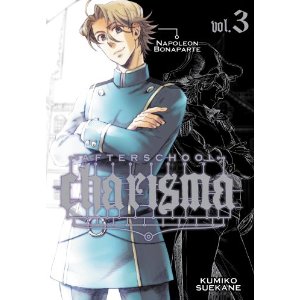
I’m always happy to read a new volume of Afterschool Charisma. This series about teenage clones of historic figures, their vaguely menacing high school, and the seemingly normal boy trapped with them just has a certain kind of pulpy appeal that I find enjoyable. The cover model for this volume is the uncharacteristically tall teenage Napoleon Bonaparte. At the end of the previous volume non-clone Shiro got a nasty shock when an older version of himself showed up with a pint-sized resurrected Marie Curie, nicknamed Pandora. Mozart yells “Welcome to the clone world, Shiro!” Freud points out that other than the fact that there’s someone that looks a lot like Shiro, they don’t have any confirmation that Shiro actually is a clone. Shiro wants to find his dad so he can ask him about what’s going on. Mozart goes around acting unhinged, and Joan of Arc is preparing to reenact her predecessor’s fiery death.

School director Rockwell reveals a maniacal side underneath his seemingly breezy personality. The shadowy group of people orchestrating the Dolly the Sheep religion finally make themselves known as the school festival draws a variety of visitors who wish to observe the clone’s special talents. One disappointing thing about this volume for me was that we didn’t see much of Clone Freud being awesome. He’s mostly just taking in everything about Shiro, wondering who he actually is, and observing the reactions of those around him. I’m expecting something dramatic from Clone Freud in the future. The pacing for this manga is very good if sometimes a little frustrating. There’s always a dramatic cliffhanger at the end of each volume which leaves me wondering what will happen next.

Review copy provided by the publisher.