Categories
Manga Reviews

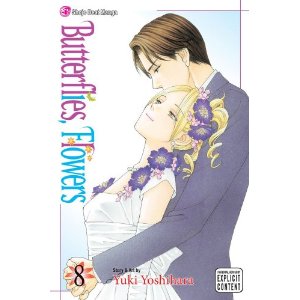
Butterflies, Flowers Volume 8

Butterflies, Flowers Volume 8 by Yuki Yoshihara

This is the final volume! I’ve enjoyed this series, which I tend to think of as “stealth josei” because even though it was released under the Shojo Beat imprint it skews a lot older. This series about a rich woman working in an office under the direction of a former servant to her family who she winds up dating might seem incredibly frivolous, but it ends up being enlivened by Yoshihara’s offbeat sense of humor and the caring exhibited in the relationship between Choko and Masayuki.

After dating for some time, Choko and Masayuki face the ultimate test when Choko goes on an arranged marriage meeting and Masayuki appears to be doing nothing to stop it. Of course he reveals his objections in a dramatic and hilariously crude manner, but will this odd couple be able to take the next step in their relationship? Choko resorts to hiding marriage registration papers around the office, trying to get Masayuki to sign the documents in a moment of distraction. When Masayuki finally comes around and asks her to marry him, he’s unable to call her by her first name because he’s so fully internalized their master/servant relationship. Choko wants a relationship of equals, and wants to move forward but Masayuki seems pathologically unable to see her as his equal. There isn’t really any doubt that the couple will get together, but despite all the weird master servant jokes, otaku Gundam references, and random crossdressers, there’s a certain level of sweetness present when Choko and Masayuki are able to move on from their roles as lady and servant.

I wish more series like Butterflies, Flowers would be published over here. I don’t mind plenty of high school romance shojo, but it is nice to have a little bit of variety in the settings of romance manga. I hope Viz licenses more Yoshihara manga because her quirky sensibility makes this series unique and weirdly endearing.

Review copy provided by the publisher

Categories
Manga Reviews

Dengeki Daisy Volume 6

Dengeki Daisy Volume 6 by Kyousuke Motomi

I have to admit after six volumes, the storylines in Dengeki Daisy are getting a bit predictable. Fortunately Motomi is such a skilled author that I don’t really care! The slowly developing relationship between plucky orphan high school student Teru and grumpy janitor/hacker Kurosaki is still moving forward at a glacial pace. Teru and Kurosaki are both pretending that she hasn’t discovered that he’s her mysterious guardian known as Daisy. I think one of the reasons why I tolerate the slower plot developments in Dengeki Daisy is that Teru and Kurosaki’s inaction about their relationship is tied in to their emotional states. In more predicatable shoujo manga, there would be plenty of outside forces popping up to prevent a couple getting together such as the sudden appearance of a long-lost fiance or an evil male model. Teru and Kurosaki both aren’t in an emotional place to deal with being honest with their feelings, so everything goes unsaid even as they face danger yet again.

I have learned now through this manga that school nurses are even more dangerous than male models. Teru investigates the possible guilt of Arai in a stabbing incident centered around the ex-school nurse Ms. Mori. It turns out that while Arai is guilty of some things, he’s really being set up as a patsy. Teru places herself in danger yet again, but she trusts that Daisy will be able to save her. While this scenario might make it seem like Teru’s a typical captive heroine, she does actually fight back and continues to use her cell phone strategically in summoning help. When I was reading this I was struck again by how well Motomi conveys the vastly different moods of the characters. There’s cynicism, playfulness, repressed emotion, and gloom. Teru and Kurosaki seem to go through so much in this volume, but their relationship is summed up in a scene where she’s perched on the monkey bars at school and he coaxes her to jump down in to his arms. Kurosaki thinks about the guilt he bears over her brother’s death and how much better off his life is with Teru in it. She thinks he’s acting strangely and wonders if he’s drunk, and he makes a crude joke about her youthfulness. So in just a few panels we go from reflection and intimacy to reinforcement of the teasing that keeps a safe distance between the couple. Scenes like this, with so much packed into a few panels are why I continue to enjoy reading Dengeki Daisy.

Review copy provided by the publisher.

Categories
Manga Reviews

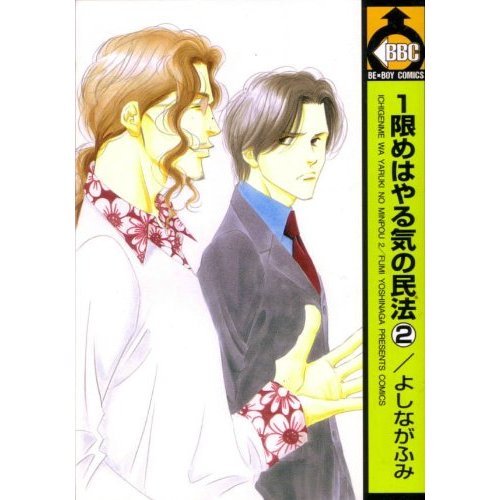
Ichigenme: The First Class is Civil Law

Ichigenme: The First Class is Civil Law Volumes 1 and 2 by Fumi Yoshinaga

For the Manga Moveable Feast I wanted to read something I hadn’t read before by Yoshinaga, and since I’ve read most of her other series already, the only thing left was some of her yaoi titles. I decided to go with Ichigenme: The First Class is Civil Law.

Tamiya joins a new zemi (seminar group) for law school. Although he’s a hard-working student, he’s ended up in a peer group full of rich kids who devote their time to goofing off. As part of a hazing ritual for third year students Toudou, a long-haired spoiled son of a politician performs an elaborate striptease for his fellow classmates. He winds up by giving Tamiya a kiss in order to distract everyone from making Tamiya strip too. Tamiya’s classmates make casual plans to go to Hokkaido to ski for the weekend. When they invite him along and offer to pay for him, he says that he’ll go along with them if it is something he can pay for but “I don’t want anyone paying for something I can’t pay them back for.” Tamiya’s seriousness and integrity provide a stark contrast to the attitudes of his classmates, and Toudou decides that Tamiya is “pretty cool.”

The first volume centers on the growing friendship between Tamiya and Toudou. When his father is caught up in a political scandal, Toudou is ostracized by all of his classmates except Tamiya. While Toudou is comfortable with his sexuality, Tamiya isn’t quite willing to admit that he’s gay even though he’s never been attracted to women. This manga is one of Yoshinaga’s earlier works, but her facility for creating compelling slice of life stories is in full effect. The students get drunk, avoid studying, have unfortunate run-ins with faculty, and in some cases slowly grow up. Toudou and Tamiya’s relationship progresses slowly, and while they do get physical Toudou is left wondering if Tamiya only wants him to stay over due to the elaborate breakfasts he prepares the next morning. When Tamiya turns down a classmate’s advances saying that he doesn’t think he could ever be with a woman. She says “I’ll…have to tell people, okay?” Tamiya replies that he doesn’t care, and his expression switches from blank to peaceful. He says to himself “Somehow…I feel much better.”

The second volume shows Tamiya and Toudou in a more established relationship. Toudou is breaking away from his family’s expectations and working at a games development company and Tamiya has become a teacher. They struggle with having enough time to spend with each other. Toudou’s younger brother is also the focus of some of the stories in this volume, as he takes up with a professor. The first volume of Ichigenme had a few sex scenes, but was more focused on character interaction. The second volume flips the formula, with sex scenes punctuated by occasional glimpses of the characters going out to dinner, struggling with pressure from work, or dealing with the aftermath of a new haircut.

As a whole, I liked Ichigenme more than most of the yaoi I’ve tried. It doesn’t have some of the problematic genre elements that tend to annoy me in many yaoi titles, like a reliance on rape scenarios or the insistence that the men in the story aren’t really gay, they’re just “truly in love.” Instead Yoshinaga creates stories about believable people who fall in love with each other.

Categories
Manga News Manga Reviews

Kicking the Tires at Jmanga.com

Jmanga.com launched today, an online site that promises to deliver digital content from a variety of publishers. When I saw the site I was delighted to see that they were making some more obscure manga available, but as I investigated further I found myself a little disappointed by their payment model and pricing.

The site is organized by genre, making it easy to browse shonen, shoujo, seinen, and josei manga. The titles available range from manga already available in English (I spotted titles from Viz, Dark Horse, and CMX) to material that hasn’t been translated before. One of the things I was hoping for from Jmanga before it launched was that it would be a good source of josei manga titles. Unfortunately the josei selection is tilted heavily towards the boys love end of the spectrum, without featuring the office lady or paranormal romances I was wishing to read. The seinen section of the site seemed to have the most interesting possibilities for me as a reader. I was absolutely delighted to see that Jmanga had a translation of Ekiben Hitoritabi available. I’d heard about this manga featuring people riding trains and eating bento before, but I’d never expected to be able to read it. It was this title more than anything else that prompted me to sign up as a Jmanga user.

The pricing is one of the most problematic aspects of the site. Jmanga requires you to sign up for a $10 subscription, giving you 1000 points to buy manga with. Initial subscribers get a bonus of 500 points, but 1500 points doesn’t go very far on the site. As a monthly subscriber, you can purchase additional points when you’ve used up what you have. Individual chapters are as much as 290 points and single volumes are 899 points. This is problematic and I think not very sustainable pricing for digital comics. Emanga has single volumes for around $5, and so does the Viz iPad app. I tend to go for bargains when buying digital content. I’m perfectly happy to watch my k-dramas on streaming sites with commercials, without paying for a premium subscription. I tend to buy ebooks for the kindle when there’s a special sale. I buy digital comics through Comixology when they have items on sale. I buy manga on the Viz iPad app when it is discounted, but I do pay full digital price when I’m missing a volume. I would much rather have a “pay as you go” system on Jmanga.com. Being forced into a subscriber model annoys me. I also just do not enjoy reading manga on a web browser all that much, and view the iPad as an ideal method of reading digital comics. I hope an iPad version of Jmanga is going to be developed soon.

I ran through most of my 1500 points in an evening. This is what I read:

Ekiben Hitoritabi

This seinen manga will appeal to anyone who wants to feel like they’re taking a leisurely trip around Japan. Daisuke’s wife sends him on a slow train tour of Japan for an anniversary present. He loves the unique train station bentos he can get at each station that reflect the unique food culture of the area he’s traveling through. Daisuke is a genial guide to this aspect of Japan. He’s a large bearded man with a perpetual smile on his face. He meets a travel companion named Nana. She’s a journalist who is working on an article, and she enjoys eating almost as much as Daisuke does. There’s no real romance here, although Daisuke enjoys spending time exploring bento with Nana. Like many foodie manga, Ekiben Hitoritabi will make you want to eat. Each regional bento is lavishly illustrated, with diagrams pointing out all the different types of food packed into a small rectangular container.

Ekiben Hitoritabi is an exercise in notalgia as a slower, more rural Japan is showcased. Daisuke is riding in sleeper cars and slow trains, making stops along the way to visit hot springs or to buy the best locally made bento. No shinkansens here! Along the way we also get stories Daisuke tells of the unique models of trains he’s riding, local stories about how the railway was constructed, and illustrations of different types of engines. I have to admit, the bento descriptions appealed to me much more than the train history aspects of the manga.
The translation quality for the manga was fine, I didn’t notice any major typos or glitches other than the occasional odd turn of phrase. As with most foodie manga, the art excels in depicting food but Daisuke and Nana had much more fluid facial expressions than I was expecting, with Oishinbo as the main foodie manga I’ve read before. After reading this manga I know that one image will stick in my mind – Daisuke almost in tears hugging a prized bento to his face and Nana laughing at him. Ekiben Hitoritabi is the best type of foodie/travel manga because after reading it I really wanted to duplicate the type of trip Daisuke was on for myself. If you can endure the inevitable craving for bento and longing for Japanese scenery that Ekiben Hitoritabi will inspire, it is well worth the read.

My Sadistic Boyfriend

Switching to one of the few shoujo titles that looked interesting that hasn’t already come out in English, I decided to try out My Sadistic Boyfriend. This is a pretty typical shoujo title with attractive art that I think would appeal to fans of Miki Aihara. Chiaki enrolls in a prestigious school only to be told on the first day that she’s won a lottery and is going to be roommates with the “Prince” of the school, Katsuho. Does he immediatly start putting the moves on Chiaki? Does he have a Jeckyll and Hyde type personality? Is she bewildered yet strangely excited by his unwanted attentions? If you have to ask questions like these, you haven’t read a shoujo manga before! So there is not much new in My Sadistic Boyfriend, but it seems fine for what it is. I just liked the title.

The Larceny Log of Zampei the Cloud Snatcher

If you are a fan of Golgo 13’s Takao Saito, Jmanga is the site for you because it hosts a ton of his titles. The Larceny Log of Zampei the Cloud Snatcher is exactly what you’d expect from a Saito title set in historic Japan about the greatest womanizing thief ever. Zampei meets with a female client who wants him to steal a sword in a hot springs. Being a Saito hero, the details about the job and an incredible amount of exposition are spread over several pages while Zampei abruptly has sex with his client. I was truly amazed at the amount of backstory and details about the sword she wanted Zampei to steal the woman was able to convey considering the variety of positions she was contorted into. Even though Zampei is an awesome thief, he does have a fear of snakes which causes some complications when he goes out on the job. This title had by far the worst translation of the three titles I sampled. There were misspellings and word transpositions (faminine for feminine) that were really obvious.

The flash-based manga reader functioned ok, but sometimes lagged a bit when loading pages. I enjoyed the way I could toggle between English and Japanese in the reader. This seems like a potentially useful tool for Japanese language students.

After trying Jmanga out these are my hopes for the future:

  • More variety available for shoujo and josei titles. I would also like to see authorized translations for some of the many orphan series we have that were left untranslated in the US. I would like to pay to read many of the unfinished series that were previously licensed by CMX.
  • A better, more reasonable pricing scheme and subscription model. I signed up, but I’m not going to continue to subscribe for many months unless my points go further. They need to either lower prices or have some crazy sales for additional points in order to match what other manga companies are currently offering.
  • Development of an iPad app
  • As a first try, there are aspects of Jmanga that are very promising. Being able to get series online from so many different publishers is certainly something to be excited about. I hope that in the next few months they work on some of the issues they had at the launch.

Categories
Manga Reviews

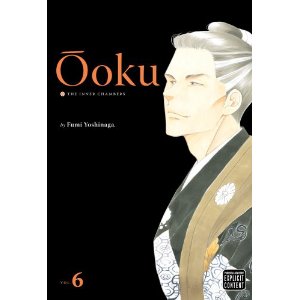
Ooku Volume 6

Fumi Yoshinaga is the topic of the Manga Moveable Feast for August. Ooku is by far her most artistically ambitious work, and while I enjoy and appreciate it very much, it doesn’t conjure up in me the same feelings of fondness as some of her other series like Antique Bakery and Flower of Life. Ooku’s more complex alternate history framework ensures that the series moves around telling different stories, without the leisurely time devoted to the slice of life character-based interaction that Yoshinaga excels at.

The sixth volume of Ooku focuses on the Shogun Tsunayoshi. Her unrealistic edicts of compassion for animals make her unpopular with her subjects, and she struggles with naming a successor. Even though she’s caught up in the machinery of government, it is the small human considerations that drive her decisions. Though her father is senile, she doesn’t want to name an heir who he opposes. After an assassination attempt, Tsunayoshi is strangely unmoved, not wanting to make an effort to live anymore. She finds brief comfort in the arms of Senior Chamberlin Emonnosuke. The tension between the official history of the shogunate and the events that actually happened is always present, as the third person narration hints at rumors the reader is shown to be true.

The second story in this volume introduces Sayko, a man so desperate to get away from his abusive mother that he clutches at the possibility of entering the service of the next Shogun Ienobu. He regards the Valet of the Chamber Akifusa as his savior, falling in love with her. One of the underlying themes of Ooku is the way power twists and changes normal human relationships. Akifusa has Sayko trained in all the gentlemanly arts of the samurai, and then tells him that she’s been grooming him for the role of the Shogun’s concubine. When Sakyo sees Ienobu sitting with her official consort, he thinks “These two people should have grown older in happy harmony, with nothing to come between them. Instead, because as Shogun she must produce an heir, her highness must lie with the likes of me…’Tis a wretched thing…”

The constraints posed on the characters by the structure of society and the office of the Shogun ensure that the best anyone can hope for is a moment of fleeting happiness. I put this volume down wondering if the most recent shogun Yoshimune will be able to enact some reforms after spending so much time learning about her predecessors.

Review copy provided by the publisher