Categories
Manga Reviews Reread Reviews

Hana Kimi 3 in 1 Edition Volume 2

One of the fun things about these new omnibus editions is being able to go back and revisit some of my favorite series like Hana Kimi. This volume covers books 4-6 of the original manga, and by the end of this volume the love triangle between Mizuki, Sano, and Nakatsu is firmly established. Hana Kimi is a silly series, and the characters go through the typical events in a shojo manga such as school festivals and class trips. But there’s always an elements of humor and the dramatic that make the story enjoyable even when the reader is facing yet another volume of manga focused on school festival hijinks. One of the things that makes this series amusing is the absolutely ridiculous situations and supporting cast. The school festival ends up being a competition between dorms, so Mizuki’s sporty group is pitted against gangs of drama students and menacing karate practitioners. The tension is heightened due to the intense rivalry between the dorm leaders, so all the cultural exhibits and sporting events that take place at the school festival are filled with tension. Of course, this being an all boys school in Japan portrayed in a shoujo manga, there is a cross dressing event where Mizuki’s dorm hosts a cafe and she has to pretend to be a boy pretending to be a girl and almost gets too much attention because her feminine disguise is too good.

Even though Mizuki is in some ways a typical peppy shoujo heroine, it is nice to see that her track and field skills still come in handy. She’s targeted and bullied by other teams who see her as a strong competitor for her dorm, and that ends up bringing her and Sano closer when he starts to worry about what might happen to her. While the school festival took up a bunch of story space, Mizuki also has to deal with a reporter trying to ferret out the reasons behind Sano’s return to track and Nakatsu’s sudden public confession of love.

Hana Kimi is helped a bunch by Nakajo’s very confident art. She’s able to render all the action sequences of high jumping and the menacing dangers of random flowerpots with ease, but she does a great job at making all of her characters visually and emotionally appealing. With such a large cast it is only to be expected that a lot of effort goes into dramatizing the subtle moments between Sano and Mizuki that drive their romance forward, but there’s still plenty to enjoy in seeing Nanba’s facial expressions as he works through being confronted with a romance from his past and struggles with his RA leadership duties.

One thing that might be frustrating is that Hana Kimi is a manga that stretches out the volume count simply by characters not telling each other their feelings. Sano’s acting a bit like Mizuki is his girlfriend, but he doesn’t tell her that he knows her secret. Mizuki is happy to be platonic friends with Sano, because she thinks that’s the best she can hope for. The only person who is ridiculously honest is Nakatsu, and he’s always around to serve as the hyperactive comic relief. But this is a series that I generally reread every two years or so, and even though I’m probably on my third go around with these volumes, I’m still finding Hana Kimi plenty entertaining.
Categories
Manga Reviews

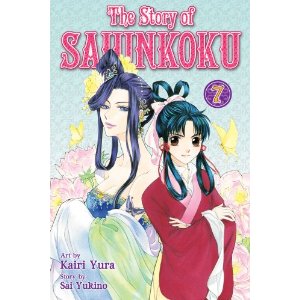
Story of Saiunkoku Volume 7

Story of Saiunkoku Volume 7 by Sai Yukino and Kairi Yura

One of the things that struck me while reading this latest volume of Story of Saiunkoku is how skilled the creators of this manga are at ratcheting up the dramatic tension. A long storyline centered on the travails and hazing of new bureaucrats in a historic fantasy country resembling China doesn’t seem like it would be a great setting for swashbuckling action and extremes of emotion, but that’s one of the things that Story of Saiunkoku does so well. Shurei and Eigetsu continue to suffer a workload that goes way beyond the norm for new civil servants in their positions, as they are singled out for being female and young respectively. Their uncomplaining attitude towards their unfair situation is beginning to win them allies, as some of their colleagues admit that having female civil servants around might be a good thing, and one of their fellow rookies even takes time out of his own schedule to help them out. I knew that something crazy was going to happen by the end of the volume when I saw that Shurei’s surrogate mother/brothel owner/crimeboss Kocho acting docile and subservient to an official that had targeted Shurei. I knew that Kocho was going to act in Shurei’s best interests and force a confrontation, and that’s what ended up happening.

One of the nice things about Story of Saiunkoku is that each volume seems to be able to cram in an incredible amount of intrigue and personal development in each volume. With such a large cast, it is impossible for every character to be featured in each volume, but the manga does take the time to focus on character development. I was happy to see that uptight directionally challenged Koyu got his chance in the spotlight in this volume, as he wonders exactly what his place is in his adopted family of the Hong clan. He struggles a bit to understand the attitude of his adopted father (Shurei’s uncle) but then realizes exactly how much he is valued and cared for.

There were plenty of great moments in this volume. Kocho was heroic as only a crime boss/madam can be. Eigetsu’s drunken violent alter ego Yogetsu came out to smack down his and Shurei’s enemies. Shurei and the Emperor Ryuki had a great scene towards the end of the volume where she commented to him that he used her as bait to draw out some hidden plots and said “Thank you for treating me as an official in your government.” Sometimes after a series gets past the five volume mark, I start to experience a bit of fatigue if the story isn’t truly engaging. That’s never a problem with Story of Saiunkoku, which always seems to balance just the right amounts of humor, excitement, and character growth in each volume.

Review copy provided by the publisher.

Categories
Manga Reviews

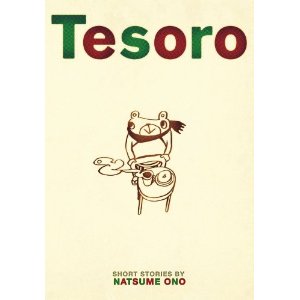
Tesoro by Natsume Ono

For the Manga Moveable Feast, the one title I had sitting on my to-read stack from the Signature line was Natsume Ono’s Tesoro. I enjoyed this volume of short stories and doujinshi, but it might be mainly for Natsume Ono completists. I enjoyed this volume very much, but I tend to be an Ono fan. I think that the only work of hers translated in English that I haven’t read is Not Simple, and the art style in these stories seems to echo the cover of that volume. The facial expressions and thin linework are recognizably Ono’s work, but instead of the more elongated character designs seen in House of Five Leaves and Gente, the proportions of the people in this manga are much more short and childlike. This cartoony style suits the slice of life nature of the stories, as Ono quickly dashes off observations about family relationships and food. This volume will appeal more to fans of Gente and Ristorante Paradiso than House of Five Leaves.

I tended to enjoy the stories in the first half of the volume more than the ones in the back. Standouts to me were the story “Moyashi Couple,” about an aging husband and wife that worry how they are perceived by their neighbors and “Three Short Stories About Bento” in which the traditional Japanese lunch is a main character in the lives of different people. Ono is at her best when capturing quick illuminating moments that portray the relationships between people and their surroundings. Fans of Gente will enjoy the middle part of this volume, with many stories set in Italy. The story I couldn’t really get into was Senza Titolo #4, about a man getting out of prison who needs to deal with the expectations of all the people who are waiting for him. For some reason that story seemed like it was cobbled together from sources instead of having the more authentic feel of the other works in this manga, which feel very observational and true to life. Tesoro is essentially a collection of Natsume Ono B-sides, and if you’re already a fan of her work you will most likely enjoy it in order to get a glimpse of her earlier art and storytelling style.

Categories
Manga Reviews

Working Kentauros by Est Em

Working Kentauros is available on Jmanga.com

As someone who reads a lot of manga every month, it is easy for me to get a little jaded. I do enjoy the commercial manga that comes out from mainstream publishers, but it is nice to experiment a bit and try something different now and then. Working Kentauros is exactly the type of title I was hoping for when Jmanga launched. I was hoping that the online format would result in some quirky titles being translated, and my wishes were fulfilled to some degree when Jmanga translated a manga that I’d heard about but never hoped to read, Ekiben Hitoritabi. Working Kentauros is about the work lives of centaurs who have entered modern society and it is without a doubt one of the most surprising and well-executed manga that I’ve read recently. I knew I was in for a treat when I saw that the first page featured a businessman in full gallop, clutching a briefcase and stuffing a carrot in his mouth. The next page features a diagram of the contents of a Kentaur’s briefcase, starting with his company cellphone and ending up with a protective charm against traffic accidents. There was more humor and charm packed into the first couple pages of illustrations of Working Kentauros than I see in many full chapters of manga.

So, centaur businessmen is a great gimmick for a manga story, but part of what makes this book so great is the way Est Em integrated what might seem like a goofy concept into her manga. Kentaurs have much longer lifespans than humans, and anti-discrimination laws have only recently been passed that allow them to work in human office environments. The first few chapters deal with the daily life of Kentaro, a Kentaur who has recently been hired by a harness making company. He has to run up flights of stairs to get to work, arriving at the office so sweaty that his senpai has to groom him before they go to a business meeting. Kentaro’s senpai has a certain amount of grudging respect for him. Even when he yells in disbelief “How dare you carry a cordovan leather briefcase!” he says that Kentaro is a good worker. Then he straps boxes to Kentaro to help in an office move, leaving Kentaro to wonder if he’s experiencing workplace bullying. When Kentaro finally is able to ride the larger elevator at his new office building, he finds himself the target of an anonymous molester. Kentaro’s senpai helps him track down the pervert, and it ends up being a horse-crazy lady he has a crush on! Throughout the next few chapters Kentaro and his senpai get to know each other better, and Est Em slips in interesting details about Kentaur society. They add on names based on their work with humans over the years and since they are so long lived, the oldest Kentaurs have names that are so long it is difficult to introduce themselves in one breath. While Kentaro seems like a man who has just graduated college, he’s around fifty years old.

Est Em’s art has simple but mobile line work, and she’s great at portraying Kentaro’s thrilled excitement about an elevator he can fit in as well as his habits of galloping off on sales calls. The character designs are attractive and in proportion, which ends up highlighting some of the difficulties the Kentaurs face when they are navigating through a world that wasn’t originally designed for people with half-horse bodies. The second half of this series focuses on Kentaurs with dreams of other jobs like opening up a noodle stand or becoming a messenger. There’s a chapter that focuses on a successful male model Kentaur who is only able to get work with a stand-in serving as his Photoshopped human legs. As goofy as the concept of Working Kentauros might seem, it is very clear that Est Em has spent plenty of time thinking about her characters and their relationships with each other. There’s a great page towards the end of the book that shows the difference in lifespans of the characters for a Kentaur and human who have gone into business together as partners in a shoe company. A quick succession of images shows the human aging while the Kentaur stays the same age, working at his job the entire time. Working Kentaurous blends plenty of whimsy and humor with the more serious topic of showing people who are just trying to make their way in the world even though they might have hooves instead of feet.

This book was carefully designed too, and sadly one thing that gets lost in the transformation from print to digital are the tiny Kentaur animated flipbook illustrations that are placed at the bottom of each page. This was the first manga by Est Em that I’ve read, but it definitely won’t be the last. If you’re a Jamanga subscriber already, reading this book is a no-brainer. If you haven’t signed up for the site yet, this is a great first title to try.

Access to electronic copy provided by Jmanga.

Categories
Manga Reviews Reread Reviews

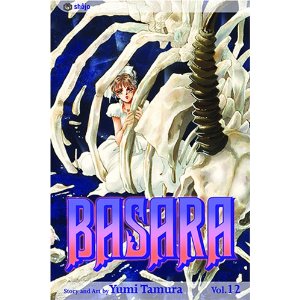
Basara Volumes 11 and 12 by Yumi Tamura

Getting back into my great reread of Basara, I’m going to tackle Volumes 11 and 12, where Sarasa finds herself in a very unpleasant prison in Hokkaido. When she discovers Hayato’s ship abandoned with curse markings that include splashed blood and voodoo dolls, she’s dismayed that he’s gone missing. Her concern for Hayato is taken over with her excitement when she discovers that the Red King is still alive “So I can kill him…with my own two hands!” Sarasa promptly decides to visit the Kazuno people who kidnapped her friend, hoping to get him back and recruit more allies she can use in her battle against the Red King. The Kazuno have an elaborate set of traps which Sarasa wins through with her usual resilience and personal integrity, but it isn’t enough to prevent her from being thrown into a horrible prison with Ageha and Asagi. One of the prison guards looks suspiciously like Shuri, and it turns out that the self proclaimed “King of the Northern Seas” aka “Wind Owl” is Shuri’s cousin.

When Ageha is away from Sarasa being secretive and snarky it is easy to forget just how much he cares for Sarasa and his role as Tatara. As soon as they wind up in prison he makes protecting Sarasa’s secret his first priority, offering up his body as a distraction so no one will suspect that Tatara is a girl. Sarasa is overcome with emotion at Ageha’s sacrifice and wonders if there’s anything she can do to make things better. Ageha tells her that he knew she was the child of destiny the first time he saw her in the desert, and if she can focus on rebuilding their country he’ll be happy. Even Asagi is now on watch to protect Sarasa in prison, but when she’s used as a canary in a prison mine, she’s taken away by the “King of the Northern Seas.” Seeing Sarasa and Ageha endure a horrible situation together after being parted for so long showed the strength of their relationship, and as horrible as Asagi would like to think he is, he’s gradually being changed just by being exposed to Tatara as well.

It is PRISON BREAK TIME in Volume 12! One of the ways that Tamura is such a pro in the way she presents this sprawling adventure with a large cast is that each character gets a moment that provides some insight into their personality, motivations, or relationships. When Shuri’s cousin discovers that Tatara is a woman, he immediately starts groping her, leading her to reflect that the terror she’s experiencing “reminds me of all the terror that women go through…reminds me that I’m a woman…even while I’m trying to live as a man!” Ageha rescues her, but not before they’re doused with icy water, and Sarasa takes care of him tenderly. Sarasa is beginning to wonder if Shuri is the Red King after her encounter with Wind Owl, but the ever sneaky Asagi assures her that they look nothing alike. Sarasa manages to find Hayato, and he undergoes his own trial as he fights against the drugs he’s been dosed with to warn Sarasa about the dangers that lie ahead in the prison. Asagi spends most of his time in prison commenting about how much he dislikes the events he’s experienced. One of my favorite moments occurred when Sarasa was distracted after learning the histories of the prison guards. She’s distracted and lost in her own thoughts, so Ageha promptly sweeps her off her feet and gives her a dramatic kiss before asking her what she needs as a leader. As always it is a combination of Sarasa’s confidence and insight and the help of her friends that lead her out of the prison. Old Kaku turns out to have been the only successful escapee from the prison, and he, Nakajin, and Asagi’s spy Muratake work to help as well. After the political intrigue and tropical idyll everyone experienced in Okinawa, the prison in the North provides a great contrast to the earlier story arc. This volume ends on a cliffhanger (literally) and I haven’t read these middle volumes of Basara recently at all, so I’m eagerly looking forward to the next volume!