Categories
Manga Reviews

Twelve Hour Ruler Volumes 1 and 2 from Jmanga.com

I’m always on the lookout for fun fantasy series, so I decided to give The Twelve Hour Ruler a try when I saw it appear on Jmanga.com. The series blends attractive art, a large cast of characters, and some intricate geopolitics when building a story about identical twin princes and the fate that awaits them.

Twelve Hour Ruler Volume 1 by Wasa Sagiri

The first volume opens with a popular gambit – the old introductory crazy barfight! An attractive young barmaid named Koyuki suffers the loutish attentions of a local government official when an arrogant young man decides to step in and save her. His name is Twelve, and it turns out that he’s the prince of Orchis, a vaguely Middle-Eastern Empire with a complicated creation myth involving twins. Twelve’s older brother Eleven is treated not as a prince and heir, but as a disposable commodity while the younger prince is viewed as the source of goodness and light. One of the things I enjoyed about this manga was the difference in personality between the brothers. Twelve basically acts like an arrogant rich boy, yet he has a streak of kindness that he tries to disguise. He bomes to Koyuki’s aid quite often, even though they fall into the habit of bickering with each other. Eleven is watchful and more cynical. He genuinely cares for his brother, but he tends to observe rather than participate due to his many years of being pushed aside for his twin.

The characters in The Twelve Hour Ruler are all attractive. Eleven distinguishes himself from his brother by having shorter hair and earrings, but he puts on a wig if he suddenly has to act as a decoy for the heir to the Empire. Twelve gradually gets to know Koyuki better, and he seems to almost enjoy having someone to call him out on acting like a spoiled brat occasionally. My one quibble with this manga is the pace of new character introductions. In short order, the reader encounters a large portion of the extended royal family, all of whom have names and number designations. While the characters all look distinct, it is a little dizzying reading about people who just seem to pop up for a chapter or two and then disappear from the rest of the narrative. Twelve’s piratical uncle Four and his daughter Lulu are some of the more consistent supporting cast members. When a large dark-skinned man with amnesia drops through the roof of Koyuki’s bar, Lulu decides that he’s Skazy, the hero of her favorite story and she promptly decides to adopt him. The twin princes move forward through a complicated progression of court ritual, as the day approaches when Twelve will be crowned as ruler and Eleven will be cast aside.


Twelve Hour Ruler Volume 2 by Wasa Sagiri

In addition to a plethora of characters, The Twelve Hour Ruler also deals with various forms of fantasy nation desert geopolitics. It turns out that Twelve has to be married before becoming Emperor, and while the court elders are aware that Twelve has a preference for Koyuki, they won’t allow him to pick his own wife. The main candidates for Empress are Sakura, a girl with the power of foresight and a Pirate Princess named Yuan Fang Long. Koyuki seems oddly philosophical about the women circling Twelve. This volume slows down the pace of character introductions a little bit, showing the reader some flashbacks of Twelve and Elven as young children. I’m somewhat mystified as to what is going on with Skazy, as he’s referred to as a “Monster” by observers, and I’m not entirely sure if this is based only on his strength and appearance or if he is actually a non-human creature. Skazy and Lulu provide a bit of comic relief as he deals with her marathon shopping sessions. Twelve moves forward towards his succession, but it turns out that the desert tribes have a competing myth that favors the rule of the older twin, and representatives descend on the city to check out Eleven to see if he is suitable. The combination of unconventional setting, attractive art, humor, and action offsets the extremely crowded cast and plot. Twelve Hour Ruler would be a clear winning manga for me if I felt like as a reader I had a bit more room to breathe. As it is, after reading two volumes I am still invested in seeing what will become of Twelve and Eleven even though I hope that the next couple volumes slow down a bit with introducing new characters.

Categories
Manga Reviews

Lady Lady Volume 1 from Jmanga.com

Lady, Lady by Nanao Hidaka

I think I should just plan to read all Ohzora Publishing titles when they pop up on Jmanga, because I generally have found everything that I’ve sampled from the publisher to be at least somewhat entertaining and sometimes great (Walkin’ Butterfly). Lady, Lady is one of those titles I would recommend as being absolutely great, with one big caveat. If you are the type of person who reads manga mainly for the art, this is not a good manga for you. The illustrations in Lady Lady look fairly dated and stiff, sort of like a rushed adaptation of a Harlequin manga that came out in the 1980s. Many of characters when drawn full-length suffer from proportion issues and often the characters only cycle between a selected set of facial expressions. Fortunately the personalities and situations in this manga were so delightful, I was able to ignore the execution issues with the art and enjoy the story. A woman detective named Reiko Kujou gets transferred to the Asakasa Police Department. She pulls up to her new office in a Lamborgini and emerges from the car wearing heels and a short mini-dress. Young policeman Sanada greets her, and when they head into the building he learns that he’s been assigned as her new partner. They race off to investigate a hostage situation. Sanada tries to warn her about the speed limit and Reiko calmly informs him that she’s driving a police vehicle. Her unique method of hostage negotiation is immediately on display as she walks into the room, distracts the hostage taker with her bosom, then quickly brings him to his knees by stomping on his foot with a stiletto heel and elbowing him in the stomach.

Basically, Reiko is totally stoic, and the master of any situation she finds herself in. If Golgo 13 was a woman who was obsessed with fast cars and designer fashion, he would be Reiko Kujou. She is a bit more loquacious than Duke Togo, as she is capable of uttering more sentences than just an occasional “….” Reiko manages to solve high-level crisis situations because her clothing causes her opponents to assume that she’s a ditzy secretary and she sails through danger absolutely unscathed. She quickly collects a trio of male admirers including a yakuza boss, feckless rich boy, and the hapless Sanada. All three come in handy in her work at one point or another, but mostly Reiko just sails through her day registering an expression of mild disgust if she happens to get set up on a horrible blind date or shot at by Chinese mobsters on a yacht. Lady Lady ended up being a funny police procedural with an entertaining heroine, perfect manga for reading if you want to turn your brain off for a little bit. Three volumes of this series are available from Jmanga.com.

Electronic access provided by the publisher.

Categories
Manga Reviews

Library Wars: Love and War Volume 8

Library Wars: Love and War Volume 8 by Kiiro Yumi

I knew that this volume was going to be dangerously adorable when I saw Iku and Dojo in an over-the-top romantic pose, complete with a ribbon in a heart shape proclaiming “Prince and Princess.” I’m always in favor of shoujo manga featuring prominent ribbons. Iku’s administrative woes are revealed to be caused by the machinations of Tezuka’s big brother – the evil library futurist. He asks for a meeting with Iku, hoping to win her to his side and use her to influence Tezuka. This meeting is where Iku’s so-called simplemindedness comes in handy, because she just flatly rejects him and his evil plans even when she has the opportunity to save herself from an administrative witch hunt. She says “If Tezuka learned that his big brother did something so shameful, he would be hurt. I mean how could I be so selfish? Tezuka is my friend.” Dojo shows up in a dress uniform halfway through the meeting and drags Iku away. What then follows is a totally cute scene where Dojo forces Iku to sit on a park bench because he can’t pat her head to praise her when she’s standing due to her high heels. Iku begins to ponder Dojo’s prince-like behavior, but when she gets a letter from Tezuka the Elder pointing making insinuations about Dojo and Iku’s princely ideals, she finally realizes that Dojo was the library officer who helped her save her favorite book from censorship when she was in school.

Iku spends the rest of the volume in full freakout mode as she attempts to process her own emotions and understand Dojo’s current feelings for her. There is a nice sideplot that shows Tezuka saving Shibazaki from unwanted male attention. It took eight volumes for Iku to finally realize her feelings for Dojo, but I have to say that as a fan of the series, it was worth the wait. There was much more focus on the emotions of the characters and their shifting relationships in this volume, as opposed to the usual library crime of the week. While I do enjoy all the paramilitary exercises about library books, I found this volume much more gripping than the past few volumes of Library Wars. It looks like this series is up to ten volumes in Japan, and I’m guessing it will get wrapped up in a little bit now that the central romance is finally starting to move forward. I’m looking forward to Dojo’s reaction once he knows that Iku knows he’s her prince.

Review copy provided by the publisher.

Categories
Manga Reviews

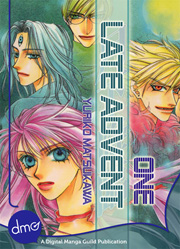
Late Advent Volumes 1 and 2 by Yuriko Matsukawa from emanga

I was excited to see that some shoujo titles are starting to pop up on emanga.com, because it seems as though most of the titles released through the DMG program are yaoi, and a little yaoi generally goes a long way with me. I often enjoy two volume series like Late Advent. Sometimes manga that’s complete in one volume doesn’t really follow through on character and plot development, but two volumes is often enough space to experience a short series without feeling rushed. I think this manga originally came out in Japan in 2000, but I thought it had a bit of an older 90s shoujo fantasy vibe.

Late Advent Volume 1

Reira Bandou is going through her normal everyday life, going to her college classes and learning about eight classic statues that depict Buddhist deities. Reira is exausted because she’s been having strange dreams, and as she’s sitting in class a strange blobby demon starts crawling up her desk. Reira starts having encounters with odd people who claim that they knew her in a past life, and that she’s descended from Ashura, the Buddhist god of War. She meets Kubanda, a feral-looking hipster who introduces himself as her lover in a past life. She also meets the gentle Kinnara, a boy with a visible third eye, a talking myna bird who is Karua, and Shagara, whose human form is that of a cynical professor. As Reira starts to adjust to her changed circumstances and struggles to control her new supernatural powers, she’s aided by the deity Gobujo, who only seems to appear as a voice or spirt but hasn’t yet manifested in human form. With the eight deities gathered together, they have to face down the new invasion of demons that might have been triggered by their presence.

Late Advent Volume 2

Matsukawa’s art is smooth and assured, with her deities shown as garbed in fantasy armor with fangs when they channel their godly powers. The adaptation here seemed smooth. I spotted one obvious error, but overall Late Advent was very readable. I found myself having a bit of difficulty following the sequence and reasoning behind all the demonic battles, and Reira seemed to gain new confidence with her powers between volumes. I was also a bit sleepy when I was reading Late Advent, so
some of my difficulties in following the plot were probably due to fatigue. One of the aspects of the series I enjoyed was the contrast between Reira’s occasional flashbacks or dreams and the current incarnations of the various deities. Elements of the past inform the present, and in some cases the current lives the characters are living provide a way for them to work through the trauma of their past lives. I did enjoy Late Advent overall. The Buddhist deities with super-powers but was a nice change of pace from some of the other fantasy series that I’ve read, and I enjoyed the old-school feeling of the art. This is a good series for shoujo fantasy fans to check out. As a shoujo fan, I want to see a good variety of publishers coming out with new titles, so I’m happy to see new shoujo on the emanga platform and hope that this series is a sign of more shoujo to come from emanga.

Electronic access provided by the publisher.

Categories
Manga Reviews

Shojo Beat Quick Takes – Oresama Teacher #10 and A Devil and Her Love Song #4

Oresama Teacher #10 by Izumi Tsubaki

Oresama Teacher has settled into a bit of a predictable formula, but Tsubaki’s particular brand of ridiculous idiocy never fails to cheer me up. This volume focuses on Yui, the ninja and erstwhile spy on the Public Morals Club for the fiendish school council. He decides that Mafuyu and Hayasaka have to endure his particular brand of ninja training, with hilarious results as his modern substitutes for traditional ninja training apparatus never seem to quite work out. Mafuyu has to struggle to get certification for the Public Morals Club, which involves tangling with Hojo, a student council lackey with a major crush on Yui. It is amusing, because while Mafuyu is incredibly dense when it comes to her own feelings, she quickly figures out the undercurrents between Hojo and Yui while Yui remains absolutely oblivious. Deranged ninja antics are always good for a laugh, and while it was nice to have the focus of this volume on a different character, I’m hoping that the next volume swings back to feature more scenes with Hayasaka and Takaomi. I’d also like to see some more scenes that show Mafuyu’s emotional development as she works through her issues with juvenile delinquency. Also, I feel like there was less face-punching in this volume than I’ve come to expect from Oresama Teacher.

A Devil and Her Love Song #4 by Miyoshi Tomori

Ordinarily I would start to get a little frustrated with a series where characters spend a large chunk of time discussing their feelings and interactions, but in A Devil and Her Love Song Maria’s forthright pronouncements and abrasive personality put her into some interesting situations. I might not feel as much of an emotional connection to this story as compared to some of my other favorite shoujo manga, but I do enjoy seeing how Maria’s presence seems to force the people around her to change and grow. In this volume, we are still dealing with the Machiavellian shenanigans around a school concert that the media is about to film. Maria’s evil teacher is planning on using her alleged “reformation” as a way of bringing favorable publicity to the school, and Hana is going along with the plan so she can show herself as a saintly angel of forgiveness. The only problem is that Maria is totally aware of the plan and decides to participate willingly just due to her desire to sing with her classmates. Maria encourages her previous bully Ayu to express her true feelings, with the result that the entire set-up gets derailed when Ayu can’t stand the blatant hypocrisy and lies around her. Maria faces even more obstacles, but she ends up putting “a lovely spin” on the whole situation, managing to salvage the concert. It’ll be interesting to see the fallout resulting from this volume, since various classmates have had emotional breakthroughs and learned more about themselves. I’m predicting that Maria will never be popular, but I’m guessing that her circle of friends will grow a bit and she’s going to treasure the loyalty of the people who actually appreciate her forthright yet slightly odd personality. Overall, this was yet another strong volume for this series.

Review copies provided by the publisher.