Categories
Manga Reviews

Two from Yuriko Matsukawa: Not for a Student and Hush A Bye Baby

I previously reviewed Matsukawa’s two volume series Late Advent, so I was interested in checking out some of her one-shot works that are now available on emanga.com. Not for a Student and Hush a Bye Baby are both collections of stories, with one long anchor story for each volume followed by a few shorter stories.

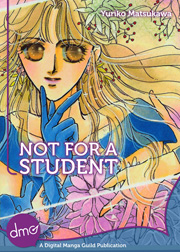
Not For A Studentavailable on emanga.com

Miki is a photographer who abruptly decides to become a teacher when losing a competition scuttles her chances of a professional career. Before her student teaching stint she has an odd encounter with a waiter at a nightclub who is so compelling that she has to photograph him. Imagine her surprise when she finds out that he’s Takase Misaki, one of the worst students in the class she’s been assigned to student teach. Takase is constantly skipping school, only showing up when he feels like it, and the rest of the students in the class seem to be in a bit of a conspiracy to help him get away with whatever he wants to do. Miki has the desire to prove what a great teacher she can be by trying to help him, but her efforts are met with a surprising degree of intimidation and blackmail from Takase. As she discovers the secret he’s protecting, she begins to act in a very un-teacher-like manner.

This volume was an enjoyable collection of shojo short stories. In addition to Not for a Teacher, it included a story “Aim for Acclaim My Beautiful Hostess!” about the trials and tribulations of a traditional inn owner in Tokyo and her unexpected romance and another story, “Put Your Right Foot Forward” about a girl pursuing her passion for dance only to get caught up in a rivalry between to potential partners. Matsukawa’s art still has that old-school style that I enjoy, and this collection was a pleasant diversion. Not For A Student‘s more dramatic story was balanced out by the slice-of-life stories in the rest of the volume.

Hush A Bye Babyavailable on emanga.com

I found Hush A Bye Baby: Midnight’s Rebel Army a bit more entertaining than Not For A Student, just because the premise for the main story was more crazy, as convenience store worker Sakaya finds herself accidentally handcuffed to cute, yet tragically haunted biker Reiji (just like the 39 Steps, but not!) who has a mysterious past. Don’t all tragically haunted bikers have mysterious pasts!? Sakaya ends up helping Reiji investigate the truth of an accident he was framed for, and they grow closer in the process even though they have to endure being shackled together for a couple days. My only complaint with the art for this story is that the chain connecting the handcuffs seemed to randomly expand and contract at various points of the story, but on the whole it was still very entertaining. I always enjoy linked short stories and restaurant settings, so the other half of the volume was a treat. “No Saint of Soupe” deals with a French Restaurant in Japan, and a romance between the owner’s daughter and a gifted chef named Rene who only specializes in soups much to his brother’s dismay. “Professional Passion” turns the focus on Rene’s older brother as he deals with an inexperienced reporter who is assigned to cover him for her first big professional story.

If I had to pick between these volumes and only recommend one, I’d go with “Hush A Bye Baby” since the combination of manacled bikers and foodie manga is pretty irresistible. Both volumes were entertaining though and would provide a quick entertaining read for any shojo fans looking for single volumes of manga.

Categories
Manga Reviews

Shojo Beat quick takes: Kimi Ni Todoke, Oresama Teacher, and We were There

Kimi Ni Todoke #15

One of the reasons why Kimi Ni Todoke doesn’t seem to be getting stale even at volume 15 is that there are so many rich and emotionally charged stories that center on the supporting cast. If the manga only focused on the lead couple, I could see myself getting a little weary, but being able to stop every now and then and see a relationship explored that has a totally different dynamic keeps everything interesting. As one would expect from the cover to the volume, the relationship between Chizuru and Ryu is given the spotlight here, and this resulted in one of the most gripping shoujo manga that I’ve read recently.

Ryu has confessed his feelings for Chizu, and she isn’t sure what to do. She’d been nursing an unrequited love for his older brother for a long time, and always thought of Ryu as her brother. Now, she doesn’t want to face him and the fact that their friendship won’t be the same. Ryu’s relieved that he’s finally no longer hiding how he feels and he’s actually feels calm even if Chizu is avoiding him. She’s sad, but still drops off rice balls at Ryu’s house and he reveals to Kazehaya that she’s been bringing him food since the winter of third grade. One of the things that I enjoyed most about this volume was the way it delved into the reasons behind the character’s feelings. Kazahaya ends up serving as a sounding board for both of his friends, and he attempts to find out why Chizu is so upset. With the revelation of Ryu’s feelings, Chizu thinks that their sibling-type relationship was a lie, and everything that she valued “never existed.” Kazehaya asks if knowing that Ryu loves her makes her a little bit happy and she thinks that it never occurred to her. She’s crying because she can’t hang out doing goofy stuff like playing video games and eating ramen anymore because he’s not her brother. Chizu thinks back to the beginning of their friendship when they were little kids and constant companions. When Ryu’s mother died, their friendship developed a deep bond when Chizu vowed to be Ryu’s sister.

Kimi Ni Todoke delves into some pretty serious issues as Chizu works through her feelings, but everything is explored in a very natural and unaffected way. While there are plenty of scenes of the characters working through their feelings, much more is expressed through the portrayal of everyday actions like bundling up before a walk to school in the winter, or the neighborly way Chizu and Ryu’s families trade food back and forth. The act of eating home cooked food takes on a ritual significance when Ryu’s life changes so we see why Chizu’s act of dropping of snacks and Ryu’s habit of preparing lunch for her means so much more than just making sure that a friend has something to eat. Kimi Ni Todoke is such a standout shoujo series, and I become more and more fond of it with each volume.

Oresama Teacher #11

I can always count on this manga to make me smile, and I was particularly delighted that this volume featured the always entertaining plot line of Mafuyu trying to defeat a new enemy. But first, the reader is treated to what might be one of the most ridiculous Christmas dates ever to be portrayed in a shoujo manga, as Hayasaka goes on a date with his hero Super Bun. Mafuyu trying to negotiate the date while still wearing her Super Bun ceramic mask was quite a sight, and it was fun to see a comedic twist on this shojo plot staple. A new enemy appears in the form of the rather sickly student council stooge Ayabe, who goes everywhere with a guitar case on his back. He decides that he’s going to take Mafuyu down, but his methods are a bit odd as they involve actions like shutting himself in a locker and sending out death vibes when she walks by. Ayabe challenges Mafuyu and he actually manages to defeat her, leaving her to decide that she’s going to figure out everything about him in order to beat him next time. Her resolute stalking of him throughout the school makes some bystandars assume that she has a crush on him, but she’s really trying to know her enemy the best she can.

Oresama Teacher‘s formula of exaggerated behavior and ridiculous situations might be a bit predictable, but Tsubaki’s storylines always seem to have a bit of a weird and unexpected twist that maintains my interest. The source of Ayabe’s delinquent fighting powers was incredibly goofy, but I would expect nothing less from this series. I hope the next volume swings back to feature a bit more Takaomi and Bancho, because I’ve missed them. They make brief appearances in this volume, but not quite enough to satisfy me.

We Were There #15

This is the next to last volume of We Were There, and as much as I admire this series I think I am ready for it to be over. I could see how things were starting to wind down in the last volume, and that continues in this volume as Yano begins to realize the continuing depth of Nanami’s feelings for him. One of the things that We Were There really excels at as it shows the characters age from high school to young adulthood is portraying the burden of their shared history. Yano’s relationship and sense of obligation to the Yamamoto family finally reaches a stage where he may begin to move forward with his life, but I’m still wondering if Yano and Nanami really should end up together just due to the weight of their pasts. If Yano actually gets past all the guilt he’s been carrying around, he might actually be a whole human being once again, and it is clear that there is no other person that Nanami can be with. I’ve said before that this series reminded me a bit of Sand Chronicles, in the way both of them go for absolute melodrama in the way the plots unfolded. This isn’t a bad thing, but I think the emotional trauma has me looking forward to the final volume of this series while at the same time I’m very happy that Kimi Ni Todoke is up to 17 volumes and still going strong.

Review copies provided by the publisher

Categories
Manga Reviews

Record of a Fallen Vampire Volumes 1-3

When I picked up the first volume of this series, I was a little worried because the first chapter mainly seemed to be concerned with characters talking to each other in long paragraphs of exposition. After reading the first three volumes, I found myself enjoying the series a bit more, but in a “I’d pick it up from the library” if I had nothing else to read type of way. Part of my lukewarm reaction is the way Record of a Fallen Vampire reminded me of other series that I enjoyed much more, and part of it is undoubtably due to the fact that I have better things to read in my stack of unread manga. But I do think that inexhaustible vampire manga fans could find something to enjoy in this series.

The manga starts out with an appropriately emo backstory about a Vampire King whose Queen was about to destroy the world with her magic. Shut away and disguised by hundreds of decoy magical seals, her King has to roam the world destroying the seals until he finds the true one that has entrapped his queen. He’s hunted by both dhampires (human vampire hybrids), and a powerful mystical force known as the Black Swan who keeps being reborn generation after generation as a human girl. Akabara Strauss is the Vampire King. He’s joined in his quest by Laetitia, a dhampire who is trapped in a childlike form. Anyone who has been around for hundreds of years builds up quite a past, and Strauss’ main dhampire enemy is Bridget, a powerful warrior who at one point led his army and was treated by him as an adoptive daughter. The incarnation of the black swan retains the memories of her predecessors, who were all killed by battling Strauss. A dhampire named Renka was in love with the 49th Black Swan, and his determination for revenge causes him to be reckless in battle.

Strauss and his enemies battle each other in safe zones in cities, hidden from humans. This reminded me a bit of X/1999, but the art in Record of a Fallen Vampire isn’t nearly as good. The character designs are all somewhat feminine but generic, and the battle scenes are sometimes a little difficult to follow. There’s no extra visual flair in this manga to make it more interesting. Most of the three volumes contrast reality with the semi-fable of the King searching for his lost Queen. It is revealed that love might not be Strauss’ main motivation. Renka is destroyed when he sees that the latest Black Swan Koyuki is a dead ringer for his long-lost love. Bridget continues her efforts to hunt down her former mentor, and Strauss can’t get rid of Laeti even if he tries. The pace of the revelations at the end of each volume does serve to keep the story moving forward after a fashion, but there are still a bit too many scenes of the characters telling the story instead of showing it – as plot developments are often revealed through various discussions as opposed to action.

I did enjoy the new Black Swan Koyuki, as she acts in unpredictable ways and thus totally confuses the dhampires. She temporarily allies herself with Strauss even though they’ve been enemies for hundreds of years. She’s pragmatic and a little cynical, and she might be the most powerful Black Swan yet. She’s smart to wait and see what might be going on instead of throwing herself into battle and dying almost immediately like many of her predecessors. Koyuki is one of the few people in the manga that have a more distinct personality. Most characters with the exception of Laeti are either tormented, sad, wistful, or filled with a burning desire for vengeance. There’s not very much to lighten the mood in Record of a Fallen Vampire, but it isn’t quite gothically over-the-top for me to enjoy all the angst for the sake of angst.

SPOILER SPACE!!!!

The third volume ends with a revelation that in a manga I was enjoying more would have filled me with delight – aliens are headed towards Earth and the humans, dhampires, and vampires must join together to fight an extraterrestrial menace. Believe me when I say that I would normally read anything featuring vampires fighting aliens quite happily. But Record of a Fallen Vampire just seems so serious, I don’t have much faith that the fun aspect of vampire/alien conflict will be explored at all. If any of the characters in Record of a Fallen Vampire had more of a sense of humor, I’d be sticking with the series past the first three volumes.

If you’ve read the series and think that it gets better, please let me know. I’m a little intrigued by the arrival of aliens, but I have so much higher quality manga to read that I’m not going to invest the time in this series unless someone tells me that it is worth it.

Categories
Manga Reviews

Jiu Jiu Volume 2

I’ve been meaning to write about the second volume of Jiu Jiu and decided to finally sit down and do a post this week because it is during the Vampire Manga Moveable Feast and there is a new vampire character in this manga! Here’s my review of the first volume. I found the art in the first volume a little bit hard to decode, but for whatever reason I thought the second volume was much clearer. Either I was more used to the drawing style, or the layouts got a bit easier to follow. In any case, I had a much easier time reading this volume. For those people who enjoyed the first volume of the series, the second is much the same as Takamichi and her Jiu Jiu Snow and Night spend a fair amount of time exploring their feelings for each other in between episodes of demon-hunting shenanigans.

Things get shaken up a bit with the sudden arrival of an imperious vampire pig bat, who initially looks like an elementary school student when he switches to humanoid form. Takamachi thinks that it is adorable but Snow and Night are sensibly suspicious of any new addition to the menagerie. Meru has fixated on Takamichi for a ritual involving his first time taking blood from a human. He reveals that he’s actually 17, but can only reach maturity with the addition of blood. The contrast between Meru’s various forms was quite amusing, with the ungainly pig-bat being quite the caricature. Jiu Jiu flashes back and forth from scenes exploring emotional abandonment to more typical shojo manga staples like trips to the beach. Themes of maturity and growing up are explored, as the contrast between Snow and Night’s actual ages and their appearance sometimes gets the quasi-family group into trouble. Meru serves as a contrast to this dynamic since he switches between younger and older forms.

Jiu Jiu is still very episodic in nature. While the two volumes released so far explore the same themes, it doesn’t have the narrative urgency that would come from a more involved storyline. Still, I found myself enjoying Tobina’s unique art style more in the second volume just because it was more comprehensible, and there are elements in Jiu Jiu that are really quite odd, with all the cages and the characters’ tendencies to sleep together like a pile of puppies. I’d likely recommend this series to any fan of supernatural shojo who was looking for something a little offbeat.

Review copy provided by the publisher.

Categories
Manga Reviews

New Shojo From Vertical – Limit and Paradise Kiss

Limit by Keiko Suenobu volume 1

After reading Limit, I could totally see why Vertical chose to publish this series about high school girls reenacting Lord of the Flies, because the combination of social commentary and horror totally fits into Vertical’s tendency to go for artistic and edgy manga to add to their catalog. Mizuki Konno is a popular girl. Not the most popular girl in her class, but just popular enough to enjoy a social life in high school as one of the anointed ones. Mizuki is part of the inner circle headed up by Sakura, the most popular girl in school. Mizuki’s calculated goal is to just float along on the surface, never doing anything that might stand out and attract undesirable attention. Mizuki’s foil is one of the unpopular girls named Kamiya who seems to possess more than average intelligence and self-awareness for a high school girl. More importantly, Kamiya is actually willing to speak up against the injustices perpetuated by high school cliques. Mizuki’s orderly world abruptly changes when a bus crash during a class trip kills most of her classmates and strands her in the wilderness. Suddenly the scapegoat of the class, Morishige has the upper hand because she scavenged a scythe. She’s also become seriously unhinged, drawing pentagrams and consulting tarot cards to determine the likelihood of rescue. Kamiya goes along with Morishige but Mizuki seems unwilling or unable to adjust to her suddenly changed circumstances. Food is running out, and Morishige’s memory of past wrongs makes her all too willing to get back at her past tormentors.

Limit is like a refreshing sorbet of violence and societal critique for people who might be weary of too much romance in their shojo. Limit would also be an excellent crossover title for people who don’t tend to read much manga targeted at girls. Suenobu does a great job showing Mizuki’s inner life and contrasting her thoughts with the growing horror and tension of the hopeless situation she’s found herself in. The dynamics of high school friendships when they become stressed beyond endurance are explored, and so much drama was packed into this first volume that I’m very intrigued about what might happen next. This manga is published at the same size as Japanese manga and I must say it is awfully cute even though my inner cheapskate quails a bit at a $10.95 sticker price on a 4.5 by 7 inch volume. Character designs are a strength in this title, as it is very easy to distinguish between the cast members. Suenobu’s art is very clear and doesn’t suffer from being printed at a smaller size from what I’m used to seeing in North American manga editions.

Paradise Kiss Part 1 by Ai Yazawa

Paradise Kiss is a manga that is so good, I don’t mind buying it twice. While I’ve read the entire series and collected all but one volume of the Tokyopop edition, I was very excited to see that Vertical is releasing the series in an omnibus, large-size format. Paradise Kiss is the story of an ordinary girl named Yukari whose life revolves around school, cram school, and the occasional chance to muse upon her crush Tokumori. She doesn’t have much purpose in life, but her psyche is shaken up when she has a random encounter with a group of art-school students headed by the enigmatic George. He’s looking for a muse and model for his capstone collection from art school and while Yukari at first thinks that the punk Arashi, cross-dressing Isabella, perpetually cute Miwako, and maddeningly attractive George are all crazy, she begins to be drawn into their world due to their commitment and shared sense of purpose. Yukari has just been working to get into a good college because that’s what’s expected of her, but when she sees the group of teens her same age working with a true passion for fashion, she decides she will join them as a model.

Yukari quickly starts leading a double life, ditching cram school to learn how to sew beads on a dress. She develops a growing attraction to George, and it is fascinating to see her personality start to shift. She’s no longer able to maintain her cool exterior at school and Tokumori starts to notice her more as she displays occasional moments of goofiness. The art in Paradise Kiss is fabulous. The series originally ran in a fashion magazine and the characters all look like walking, talking fashion illustrations. Even better than the style displayed in the art is the way the fashion in the manga is so perfectly set up to showcase the differences in personality between the characters. I could easily look at outfits designed for Arashi, Isabella, and Miwako and know who was going to end up wearing them. George’s more malleable style signals his changing nature as he shifts from suits to glam cowboy to mod with almost too much ease. I enjoyed revisiting this series in this updated, more deluxe edition. Manga Bookshelf covered some of the differences in translation between the old and new editions. I’m going to buy this new edition from Vertical because I love this series, but I’m probably going to keep the old Tokyopop edition as well. I hope that this does well enough for Vertical that we could see some other work by Ai Yazawa translated, like Gokinjo Monogatari. In any case, Paradise Kiss is a series that I think deserves to be in print, and I am happy that Vertical is reissuing it.