Categories
Manga Reviews REVIEWS

Shojo Beat Quick Takes – Midnight Secretary Vol 6 and Dengeki Daisy Vol 14

Midnight Secretary Vol 6 by Tomu Ohmi

This volume of Midnight Secretary shows the relationship between Kaya and her vampire boss Kyohei on firmer footing, but the manipulations of the vampire clan start to interfere with the couple. Kyohei takes Kaya to a party as his date, and there’s a bit of unexpected fallout from the action. Kyohei’s vampire mother shows up to warn Kaya off of becoming involved in a human/vampire relationship. Kaya has a bit of a pregnancy scare, and she’s worried about what would happen if she had a vampire baby, because the vampire clan would swoop in and claim any vampire child as one of their own. It turns out that Kaya’s not pregnant and Kyohei tells her that he has no intention of marrying her or having children with her, simply because of the way their relationship would be stressed with outside interference as soon as it takes on the appearance of being serious. While he doesn’t want Kaya to be manipulated by the vampire clan, she’s soon deluged with marriage offers as the clan takes steps to separate her from Kyohei. Vampire politics soon becomes even more of a focus of the volume, as the head of the clan shows up, looking less evil than one would suppose! Throughout the trials and tribulations in this volume Kaya and Kyohei’s relationship remains strong, but we’ll have to see in future volumes if they can withstand the forces that are seeking to drive them apart. This series continues to be very entertaining. I’m always amused by the combination of heartfelt romance, the paranormal elements, and boardroom politics.


Dengeki Daisy Vol 14 by Kyousuke Motomi

Dengeki Daisy is still going strong in its 14th volume. I have to say, I don’t really care about the latest hacker drama that is occupying all the characters, it is really the way that they interact with each other when dealing with the high stakes world of computer viruses and conspiracy theories. In their search for “M’s Last Testament”, the group has finally found out more information about the mysterious hacker Akira, and learned how exactly he became so twisted. One of the reasons why I like this series so much is that the reactions of the characters seem so much more authentic and less reliant on what I’d expect to see in a shoujo romance. When Teru learns the truth about Akira she can see why her other friends feel an obligation to help him, but her own suffering at his hands has left her wondering if he’s a person without any hope of redemption. In a more typical series, the disclosure of a character’s tragic past would prompt people to immediately move towards forgiveness, but Teru isn’t able to get over the past and she’s very forthright about her feelings. This drives a bit of a wedge between her and Kurosaki, as he moves on with the rest of the team even though he understands Teru’s reasons for not wanting to participate. In true Dengeki Daisy fashion, this first crisis of their relationship is solved with text messaging, in a nice bit of circular plotting that echoes back to the beginning of the series. Motomi could really just call each new hacker MacGuffin 1 or MacGuffin 2 and I’d still love reading this series just because it is so well executed and the characters are very memorable.

Categories
Manga Reviews REVIEWS

Devils and Realist, Vol 1

Devils and Realist Vol 1 by Madoka Takadono and Utako Yukihiro

Devils and Realist is an amusing fish out of water supernatural tale about a young scientific aristocrat and the devils who torment him. The realist of the title is William Twining, an elite member of the English aristocracy who prides himself on his elite status and his logical mind. He makes an uncomfortable discovery when he goes home for a school holiday. His uncle, who was in charge of his fortune has rendered him penniless. William discovers that his house is almost entirely empty and he only has one lone servant left in Kevin Cecil, who is staying on without being paid and learning how to garden for vegetables in the absence of any other food.

William is determined to come up with the money to pay for his tuition, because it would never do for someone of his standing to apply for a scholarship. As he and Kevin scour the house trying to find something valuable, they happen across a hidden room, with a door that is unlocked by William’s blood when he suffers an accident trying to break it down. A mystical spell is invoked and the demon Dantalion appears in grand fashion, only to tell William that he’s now a central figure in the electoral politics of Hell, because William possesses “the Blood of Solomon”. William isn’t ready to believe that he has a mystical connection with a bunch of demons, and invents a series of comically rational explanations for all the supernatural phenomena he’s starting to encounter. Dantalion is joined by other demons, all of who want to win William to their side. William remains stubbornly focused on finishing up his schooling in the human world, leading to additional wacky complications.

There are some parallel themes here with Black Butler, but I found that series to be a bit mean spirited and creepy.
Devils and Realist is more of a gently comedic take on the genre, with William’s stubbornness manifesting in various ways. There are hints that William’s ancestors might not be all that innocent and Dantalion has some hidden motivations that might serve to illuminate his character in later volumes. The art for Devils and Realist is attractive, with particular attention paid to the character designs of the parade of demons which makes it much easier to distinguish them. I enjoyed this volume, and I’ll try volume 2 before deciding to go all in on following this series. I could see William’s realism being used for jokes getting a bit tiring after multiple volumes when he’s surrounded by an army of demons, so I’m interested to see if the author comes up with some other plot devices to keep things fresh.

Categories
Manga Reviews REVIEWS

Gangsta Vols 1 and 2

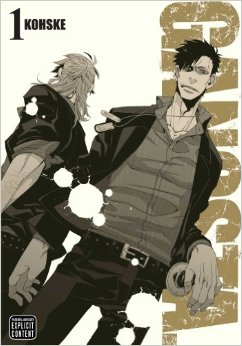
Gangsta Volumes 1 and 2 by Kohske

I was pretty intrigued by Gangsta when I first heard that Viz was going to be translating this title. I always am interested in series that get the deluxe treatment of the Viz Signature line. The art looked very stylish, and I generally enjoy the few examples of seinen written by women authors that we get translated over here, so I was already intrigued for a few months before finally getting my hands on a couple volumes.

First of all, to totally judge a manga by its cover, I was immediately captivated by the cover designs! The front and back covers of both volumes show the same scene from different perspectives, showcasing the personalities of the main characters Nic and Worick. The first volume shows Nic glaring out at the reader, with Worick turned away. On the back Worick has his finger raised over his lips to prevent someone from telling a secret. Worick and Nic are handymen, mercenaries, couriers, and assassins taking on jobs no one else will. Their day opens in a way that conveys the gritty and corrupt nature of the city of Ergastulum, as a hooker gets beat up and the police chief asks the handymen to deal with recent gang activity, promising them “all their goods” as payment.

As the day unfolds, more gets revealed about Nic and Worick. Nic is a “Tag” or “Twilight,” who appears to be an ex-soldier who was the subject of some sort of enhancement experiments that have turned him into a deadly warrior. Nic is deaf, and Kohske has come up with some clever ways of portraying this, by representing his sign language with a different style of word balloons and carefully drawing them as emanating from his hands as he gestures. Nic is incredibly deadly, but he is viewed as subhuman by almost everybody but Worick. The duo quickly becomes a platonic (so far) threesome, as the handymen decide to liberate Ally, the hooker who was being beat up by her john before. When the police chief objects, Nic yells that the handymen will take whatever they want.

What follows is a mix between slice of life communal living issues, drug deals, and over the top action scenes as Ally putters around the handymen’s apartment, reading sign language dictionaries and answering their phone. She gradually learns a little more about Worick and Nic, including the fact that Worick occasionally hires himself out as a gigalo and that his past might be very far from the circles where he runs in now.

There are a few elements of Gangsta that reminded me of other series, but not in a bad way. The intense friendship of Nic and Worick set against a gritty background with mysterious drugs enhancing human abilities gave me some slight Wild Adapter flashbacks, although Gangsta isn’t very shonen-ai (yet). I’m sure there’s some Gangsta doujinshi out there that is though! Worick’s mysterious and privileged past made me remember Antique Bakery a bit. And the 3 rules for Twilight behavior are basically Asimov’s 3 Laws of Robotics. But Kohske hints at so many different plots to be explored in future volumes, I’m wanting to see the shared past of the handymen explored, wondering if Ally is better off with them than without them, and curious to see how Nic manages to deal with the latest in a procession of super human enemies.

Kohske’s art is gritty and stylish, showcasing the dynamic nature of the fights the handymen find themselves embroiled in as well as the run down area of the city where they live. The illustrations in this book are for sure not style over substance, as there are nuanced and varying character designs for all the members of the expanding cast. Nic’s growling antagonism and Worick’s intelligently constructed careless facade are both nimbly portrayed, as are the wordless exchanges and day to day moments that say volumes about the friendship they share. After enjoying the first two volumes, I’m certainly going to see about reading the rest of this series.

Categories
Manga Reviews REVIEWS

Vinland Saga, Vol 2

Vinland Saga Volume 2 by Makoto Yukimura

It says a lot about the quality of writing in Vinland Saga that the most memorable moments in the manga for me aren’t the Viking battle scenes but instead quiet moments that reveal more about the characters in the story. The clash of wills between determined young warrior Thorfinn and the conniving Askeladd becomes even more intriguing with the plot development in this volume. The story opens with a bit of a flashback to Thorfinn’s early adventures in infiltration for Askeladd, when he is taken in by an English family who he ends up having to betray. Thorfinn attempts to tell them to run before the Viking invasion is about to crush their village, and his concern turns to resignation as he sees the destruction coming at the hands of the Vikings.

Thorfinn has an encounter with a crazed Viking commander named Thorkell. Thorkell’s glee in battle contrasts with Askeladd’s more cerebral and cynical approach. Thorfinn is defeated, but Thorkell cheerfully waves goodbye with the stumps of the fingers that Thorfinn sliced off, saying of the fight “I enjoyed our battle! We should do it again!” The name of Thorfinn’s father still functions as an element of protection, because Thors was such a legendary warrior that Thorfinn’s Viking opponents are immediately curious about his capabilities.

Askeladd has his own agenda to execute as his band begins to march across the English countryside. They encounter the timid Prince Canute, and Askeladd strikes an unusual bargain with the Welsh. There’s an element of impending doom referenced multiple times, as Askeladd references a prophesied end of the world. The clash of religions between Christianity and paganism is also explored, as is the absolute brutality of the Vikings as they plunder a village in the winter. Yukimura’s art is always strong, and I appreciate the clarity of the battle scenes, as well as the attention to detail with the characters’ emotions as they react to the events on their journey.

While Thorfinn fits in with the traditional model of a hero, I’m finding myself more intrigued by Askeladd, simply because he’s such an unreliable narrator. I’m not sure if his stated reasons for acting are the truth, which creates quite a bit of dramatic tension in the story. The deluxe production for these volumes is always a treat, and I’m looking forward to the next volume of this saga continuing.

Categories
Manga Reviews REVIEWS

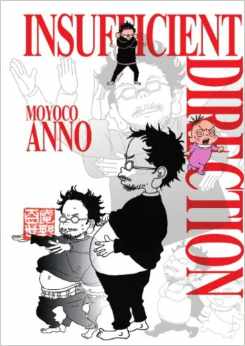
Insufficient Direction by Moyoco Anno

Vertical is such a great publisher. I’m turning into even more of a fangirl because Gundam: The Origin, What Did You Eat Yesterday?, and Insufficient Direction all make me very happy. Some of the online reviews I’ve skimmed about this manga tend to focus more on the opportunity to find out what Hideaki Anno is like, but I always found myself more intrigued by getting a bit of an autobiographical glimpse into Moyoco Anno’s home life. She’s obviously fiercely intelligent, with a cynical edge to her manga like Happy Mania and Sakuran.

Insufficient Direction
is an affectionate and humorous look at what it is like to be married to the Ultimate Otaku. Anno portrays herself as a toddler wearing a one piece suit named Rompers and her husband looks like a bearded five-year-old with a beer belly, who is referred to as Director-kun. The manga details the hazards of geekdom, including how to shop for wedding outfits when one part of the couple wants to cosplay as Ultraman, anime song earworms, large collections of action figures and dvds, and superhero posing contests. Rompers gradually finds her personality slowly adjusting to Director-kun’s as she accidentally binge watches Gundam and finds herself making random geeky cultural references.

Anno’s style in Insufficient Direction is basically a cartoonish chibi way of drawing both her and her husband, but I was amused by the panels here and there where her normal manga style peeked through, when she was sitting around talking to her assistants or portraying a goofy story made up by her husband. Overall, this manga is an affectionate portrayal of a marriage, with give and take on both sides as Rompers tries to get Director-kun to be more healthy and Director-kun tries to get his wife to become the ultimate otaku bride.

There’s an essay by Hideaki Anno in the back of the book, and it is clear how much he respects his wife’s talent. I also appreciated the copious notes included in this volume, which are necessary for anyone who doesn’t have a ton of knowledge about Japanese tv shows and anime from the 60s and 70s. I enjoyed the episodic nature of this manga, which made it easy to pick up and put down if I was just in the mood to read a chapter or two. This is a must read if you enjoy slice of life manga, or if you are a fan of either Hideaki or Moyoco Anno.