Categories
Manga Reviews

Harlequin Manga Quick Takes – To Marry a Stranger and To Woo a Wife

To Marry a Stranger by Renee Roszel and Takako Hashimoto

I decided to read this title mainly because the hero of the story has an eye patch. Eye patches are a feature of romantic heroes that seem to be sorely neglected recently, although I think for some reason they were more prevalent in the 80s. Helen wants to know who her destined man is, so she decides to visit the conveniently located Love Mansion, a haunted house that is located near the bed and breakfast she’s opening with her sisters. She runs into the current habitat of the Love Mansion, Damien Lord. He happens to be horribly scarred due to accidents he suffered as a reporter in Afghanistan, but he’s taken up residence in the country to recuperate. Damien is cranky and Helen decides to tame him by feeding him plenty of home-cooked meals. To Marry a Stranger follows the typical Harlequin formula of a woman’s beauty and domestic talents winning over a tortured yet handsome man. It is enlivened by Hashimoto’s art which is relaxed, with a feminine cartoony style. I do believe that more romance heroes need eye patches.

To Woo A Wife by Carol Mortimer and Yoko Hanabusa

This was an entertaining title, simply because Hanabusa’s art has an old fashioned look to it. The characters have long noses and limpid eyes that wouldn’t look out of place in a 1980s manga. When you combine the old school art with a socially maladjusted hero given to making random women hating comments hilarity ensues. Jarrett Hunter is a millionaire bachelor who is trying to buy a hotel from a “Black Widow,” a woman who conveniently married a very elderly rich man who died a couple years into the marriage. Jarrett has managed to avoid the snares of women, because he’s been severely messed up by his mother running out on his father. So when he meets Addie, he assumes that she is a very high-priced hooker, because he thinks she’s visiting a hotel alone. Unfortunately Addie is the widow he’s been sent to woo for the purposes of acquiring her real estate. He has golden eyes! She has violet eyes! Will their bickering lead to love? Will he be charmed by her relationship with her young daughter? Will he relentlessly pursue her? Does he have two unmarried brothers so the author will be able to write a trilogy? The answers to all these questions is of course a resounding yes. Even though there were a few rough spots in the adaptation for this manga, I found it entertaining simply because of Jarrett’s horrible social ineptness, which would have probably caused him to get beaten up if he wasn’t a handsome billionaire.

Access to electronic copies provided by the publisher

Categories
Manga Reviews

Black Gate Volumes 1-3

Black Gate Volumes 1-3 by Yukiko Sumiyoshi

Usually I love omnibus editions because they give me a good excuse to devour two or more volumes of manga in an afternoon. I found it hard to get excited about Black Gate, an omnibus of a complete 3 volume series that features attractive art that is hampered by a lack of compelling storytelling. In Black Gate, there are light and dark gates that exert a powerful influence on human spirits. When someone is ready to die, they naturally go through a gate into the next world. Black gates are malign forces that try to take human souls too soon. Mitedamashi have the power to seal gates. Senju is a guardian to Hijiri, a rather bratty boy with a powerful mystical heritage. The fate of humankind may hang in the balance as Hijiri finds out the secret of his past, but will he be mature enough to harness his natural power?

One of the more unfortunate aspects of Black Gate is the lack of real character development. Hijiri’s main mode of expression is irresponsible brat, and while he exhibits a little bit of character growth he mostly remains static. Senju is haunted by the death of Hijiri’s parents, but he keeps plugging away at his part-time job (being a gatekeeper pays very little) and raising Hijiri as best he can. I found Senju a more compelling protagonist than Hijiri, so I was disappointed when he abruptly disappears for a long stretch of the book. Senju is replaced in Hijiri’s life by the sudden appearance of the Sugawara cousins, a pair of teen boys who also serve as guardians. Hijiri struggles to become a gate keeper himself and he tries to partner up with with Michizane, the half brother of one of the guardian cousins. The second and third volume become weighted down with a bit of plot mish mash involving a gate keeper serial killer, spirit possession, inadvertent immortality, and a struggle between the human and spirit worlds.

I usually tend to enjoy manga with themes like Black Gate, but I found it hard to get interested in this manga because Sumiyoshi tends to gloss over character development. None of her characters have terribly unique personalities, and the protagonist Hijiri isn’t very nuanced. I found myself not really caring what was going to happen to Hijiri, and that made it difficult to work up much enthusiasm for this manga. Sumiyoshi’s art is slick and competent, and she has a knack for creating attractive character designs. I really wish she’d been partnered with a different author because I think the work would have been so much better if the art was created in service to a more interesting story. I tend to place a little more importance on story than art when reading manga, but the art has to be absolutely gorgeous for me to overlook dull storytelling. Biomega might be incoherent, but it has the advantages of lovely art and a gimmicky supporting character that I adore. Bride of the Water God is gorgeous, and relies more on mood and extra pretty characters than story. Unfortunately there wasn’t enough in Black Gate to compensate for its narrative shortcomings. I read all three volumes of Black Gate, hoping the story would get better and I ended up disappointed. Someone who reads manga primarily for the art might find Black Gate much more fun than I did.

Review copy provided by the publisher.

Categories
Manga Reviews

Kurozakuro Volume 1

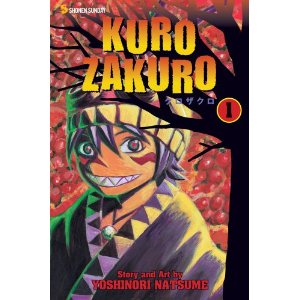
Kurozakuro Volume 1 by Yoshinori Natsume

This manga about a bullied schoolboy who makes a pact with evil forces to gain strength wasn’t really to my taste, but Kurozakuro offers a glimpse of something a little different as it incorporates the horror genre into an otherwise conventional shonen tale. Kurozakuro starts out by introducing an overly familiar shonen hero. Mikito is mild and meek, and thus the target of bullies at school. His humiliation is doubled when the girl he has a crush on attempts to come to his rescue. A strange creature comes to Mikito in a dream. Mikito crawls across a desolate landscape towards a barren tree where an impish child with sharp teeth commands him to name his desire. Mikito says that he wants to be stronger so “no one will push me around anymore.” The child says he’ll give Mikito power and in return he has to make the tree bloom. Mikito wakes up the next day with heightened senses, a quick temper, and super strength.

Mikito starts finding joy in violence, and his crush Saki is disgusted by him. He starts dealing with odd compulsions, and finds out that there are demon hunters out to get him. Mikito is slowly turning into an ogre and starts craving human flesh. To make matters worse, a teen demon hunter girl has just transferred into his class. Trying to hide from demon hunters, eating raw meat, and struggling with the compulsion to kill people can make it tough to function effectively in high school. Other than his new habit of thinking of people as meat, there isn’t much to distinguish Mikito from every other bullied shonen manga hero who wants to get stronger. Natsume’s art is a little stiff. The lack of fluidity works fine when he’s referencing the visual language of horror manga, with weird lighting and shading on Mikito’s face as his ogre personality starts to take over, but isn’t as effective during the action scenes when the ogre hunters start to take out their prey.

I enjoyed a couple things about Kurozakuro. The shonen/horror mash-up was interesting and the dark tone set it apart from the more typical fighting manga I tend to expect. But none of the characters were particularly compelling, and I didn’t put the manga down feeling all that invested in the story. I wouldn’t hesitate to recommend this title to someone who enjoys horror manga. For me, the stock plot elements and lackluster art overwhelmed the more interesting way Natsume was playing with genre. If the art had been a bit more surreal or the characters more unique I’d probably like this title a lot more.

Categories
Manga Reviews

Papillon Volume 5/6

Papillon Volume 5/6 by Miwa Ueda

I was happy to see signs of life in Kodansha’s North American arm with the recent summer lineup, but I was a little disappointed that the only ongoing Kodansha title that I actively purchase was left off the list. I’ve slacked off on getting Tsubasa and xxxHolic just because they seem to have gotten so weighed down by continuity. Wallflower is so episodic that I don’t feel like I’m missing much if I skip volumes, and while I enjoyed the first few volumes of Nodame Cantible, I haven’t gotten back into collecting that series. Papillon is pure trashy fun.

As I was reading this omnibus volume I was struck with how addicting Ueda makes this series despite the fact that none of her characters are sympathetic. Nice girl Ageha may be the heroine, but she’s essentially spineless and prone to collapsing under the weight of her own drama. Ageha’s twin Hana has a myriad of psychological issues that lead her to dress up as her sister to see if her boyfriends will fall for her twin, and she’s now trying to steal Ageha’s boyfriend away. Ageha’s boyfriend Ichijiku is a guidance counselor in training who somehow finds it appropriate to date a high schooler even though he might be trying to help build up her self-confidence. If the ending of Papillon involved the main characters dying in a fiery bus crash, I would not be all that disappointed. Yet Ueda’s soap opera makes me want to keep reading.

Ageha starts a part-time summer job at a restaurant where Hana’s ex-boyfriend Shinobu Shindo happens to be working. Shinobu used to have a crush on Ageha too, but when he told her about his feelings she thought he was teasing her. Hana confesses her feelings to Ichijiku and he rejects her. Then Ageha talks to Ichikiku in guidance counselor mode, telling him all about Shinobu without realizing that her new co-worker might inspire feelings of jealousy in her boyfriend. Angst and misunderstandings abound, and Hana start to act even more reprehensible than before when she disguises herself as Ageha and attempts to seduce Ichijiku. Meanwhile, a woman from Ichijiku’s past makes a sudden return, bringing yet another set of psychological problems for him and Ageha to deal with.

Ageha begins to show vague signs of self-awareness as she begins to analyze her own behavior. She actually helps Ichijiku with some of his problems, instead of being her usual flailing and helpless self. Hana keeps acting out so much, I am really hoping that she gets hit by a meteorite and dies. I hope that Kodansha decides to wrap up this series because even though I doubt my hopes of fiery death will be satisfied, I do want to see what happens next.

Categories
Manga Reviews

Kamisama Kiss Volume 1

Kamisama Kiss Volume 1 by Julietta Suzuki

Karakuri Odette was such a pleasant surprise when I first started reading it, I have been eagerly waiting for another Suzuki series to be translated. I was excited to see that the Shojo Beat line was adding her series about yokai, Kamisama Kiss. Much like Karakuri Odette, Kamisama Kiss takes a premise that might initially seem to be a bit worn out and makes it absolutely charming.

Nanami is a fairly typical heroine. She’s bright and enthusiastic but she’s dealing with a horrible home life. Her father is a hopeless gambler, and in the first few pages of the manga he announces that they’re broke again and vanishes while leaving a terse note behind. The eviction people are knocking on the door and Nanami soon finds herself homeless, railing at her situation in a park. She’s distracted from her own grumbling when she sees that a dog has treed a strange man. Nanami chases off the dog and finds herself talking to a man who admits that he’s a runaway too. He says something about how she’ll be a better master for his house, kisses her on the forehead and hands her a map.

Nanami checks out her new home, which turns out to be a seemingly deserted shrine. She’s attacked by Tomoe, a fox spirit who initially mistakes her aura for his missing master. Nanami is now the god of the shrine, and she has to deal with two tiny spirit servants as well as figuring out how to make Tomoe help her with her new duties. Nanami soon finds out that being in charge of a shrine involves a backbreaking amount of work, and her human nature means that she isn’t very good at using her new mystical powers. Tomoe and Nanami quickly develop the “they are bickering because they are secretly attracted to each other” type of relationship that is fairly typical in shoujo manga. But as I expected from Suzuki, there are many quirky touches that make Kamisama Kiss interesting.

While drawing a human doesn’t necessarily give Suzuki the free range in expressing slightly strange body language that she exercises in Karakuri Odette, I’m still drawn in by the facial expressions of the characters. Suzuki seems to be able to create incredibly lively people with ease. None of her characters seem stiff or have dead eyes, which is quite an achievement when you consider that Nanami’s Onibi-warashi servant duo only appear with masks on their faces. Tomoe spends most of his time looking fiendish with occasional lapses into sympathy as he finds himself liking Nanami despite his professed intentions of not accepting her as his new master. Kamisama Kiss isn’t as purely episodic as Karakuri Odette, but it manages to cover plenty of ground for a first volume as Nanami settles in to her new life, attempts to practice magic, visits the spirit world, and attempts to help another local deity with her love life.

I enjoyed Suzuki’s character designs for her yokai, as she managed to make everyone look both creepy and cute. When a swamp goddess visits Nanami she’s drawn to look like a heavily-made up lizard with saucer eyes and tiny webbed structures taking the place of her ears. While plenty of manga show girls disappearing into a fantasy world, towards the end of the volume Nanami goes back to town and she’s struck by the contrast of the modern town with her new life. This was a detail I appreciated, since usually heroines of this type of manga don’t seem to be able to move between both worlds with ease. I also liked the way Nanami was able to stand up to Tomoe. While he kept declining to help her in order to prove a point, she managed to work around him due to the strength of her stubborn personality. I’m happy that as many of the series I’ve been following are winding down or stalled, there are some fun fantasy series like Kamisama Kiss starting up.

Review copy provided by the publisher.