Categories
Manga Reviews

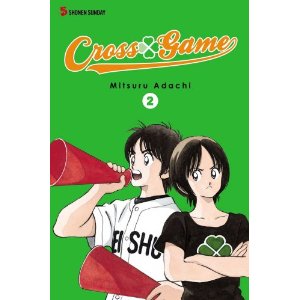
Cross Game Volume 2

Cross Game Volume 2 by Mitsuru Adachi

The first volume of Cross Game was my favorite new shonen manga of 2010, so when I got a new box of Viz goodies, this was the first manga I grabbed. I was happy to see that the second volume delivers on all the character development that was built up in the first volume. This omnibus edition contains volumes 4 and 5 of the manga. At the end of the first volume Ko and his “farm team” companions are gearing up to play against the elite varsity team at their high school.

The second volume opens with one of those deceptively simple scenes that serve to illuminate the relationships between the characters. Ko shows up at the Tsukishima household, asking to see Aoba. Mr. Tsukishima is slightly perplexed, but tells him to go into the house. Aoba’s oldest sister pops up suddenly into the panel with her hand on her forehead in disbelief, “Ko..? Here for Aoba?” Ko tells Aoba to follow him, and she goes with him, striking a fighting pose when he turns to throw her a baseball glove. It turns out that Aoba is the only person Ko can trust to give him a realistic assessment of his pitching abilities. His teammates haven’t said much to him, but they wouldn’t say anything to disrupt his confidence. Ko starts throwing the ball to Aoba and the sound effects start to kick in. Boom! Couples strolling in the park turn and stare. Boom! The sounds of Ko’s pitch echo in the night. Aoba catches every ball and when asked for her assessment, she says “You’re okay…I guess.” Ko is psyched and pumped up for the game, because Aoba’s “okay” is the best compliment she could give him. He challenges her to a bet, if he only lets the opposing team score 10 times, she’ll buy him a treat. Aoba changes the terms of the bet by yelling “Five runs!” Ko says “No fair.” and walks off into the night. Aoba nurses her battered catching hand and thinks “No fair for who?”

The game begins, and the corrupt coach and principal of the high school are unprepared for the farm team that they previously dismissed. The better players on the varsity team are aware of Ko’s talent, even while the coach tries to pretend that Ko’s pitching ability isn’t extraordinary. Even though the baseball game stretches over a good portion of the book, I was kept entertained by the skillful ways Adachi manages his cast of characters. Azuma, the ace batter on the opposing team begins to view Ko as a true rival. Aoba sits in the stands and provides a running commentary on all the players, which demonstrate that since she isn’t able to play with the boys on the field she might be better employed as an additional coach. The ancient but tricky coach of the farm team demonstrates some underhanded but effective ways of managing players, as he tells a false but inspiring story to his selfish third year players, and secretly arranges a different type of bat for a player who swings too hard but won’t work to change his approach.

One of the many things I appreciate about Cross Game is that the more poignant moments aren’t milked for melodrama. Ko’s still dealing with the tragedy that struck in the first volume, and the reader sees this in a couple scenes. He works himself tirelessly in the secret summer training camp of the farm team, saying that summer is a time he doesn’t want to think too much. He willingly humiliates himself just to get an item on Wakaba’s birthday list. These scenes are presented in the same slice-of-life manner as the rest of the manga, but I can’t help but think that in the hands of a less skilled creator, something like that would be presented with extra tears or emphasis. Cross Game just shows events unfolding with a natural rhythm that is deceptively effortless.

Review copy provided by the publisher.

Categories
Manga Reviews

Mizuki

Mizuki Episode 1 by Nao Yazawa

I’m happy to see that Digital Manga Publishing is bringing out more shoujo manga, but I’m a little disappointed that Mizuki is going to be available only in electronic format for the foreseeable future. It seems like magical girl shojo has fallen out of favor a little bit in recent years, but I’m hoping that the reprinting of Cardcaptor Sakura and series like Mizuki might signal a return to more magical girls manga being available. I am a sucker for transformation sequences, and the general frivolous tone of much magical girl manga makes it a perfect thing to read when I want to relax. I haven’t read Nao Yazawa’s other series Wedding Peach, but I do admire it from a distance just because I think magical girl transformations involving wedding dresses are hilarious.

Let’s sit back and bask in the bridal glow of Wedding Peach for a moment:

Mizuki has an interesting twist on the magical girl conventions, because instead of transforming into something sparkly with ribbons, her transformation option is limited to turning into a half-demon, complete with horned head. Mizuki’s family is descended from traditional Japaneses demons (oni) and as a result Mizuki is extremely uninterested in using her mystical powers. She doesn’t want to turn into a demon and have her classmates think that she’s scary or gross. The boy next door Seikito just thinks she should stop whining and get to work fighting mystical disturbances. Seikito’s family and Mizuki’s family have teamed up for generations to fight ghosts, and now he thinks that it is his turn to be Mizuki’s partner. Mizuki has a crush on popular baseball player Yamaguchi, so she just wants to be a normal girl.

Of course, there is some haunting near the school and Mizuki has to go into Oni-battle mode despite her reluctance. Yazawa’s character designs are attractive in a very retro sort of way. Her art style reminds me a bit of a slightly less skilled 1980s Rumiko Takahashi, which isn’t a slam on Yazawa at all because 1980s Takahashi was pretty awesome. Sekito has long hair that he keeps tied back, as befitting a ghost hunter who embraces his family tradition. Mizuki’s hair is short and sassy, which fits with her personality. Even though Mizuki looks plenty cute in her half oni form, I thought her reluctance to transform and the lack of traditional magical girl accessories and ribbons made this series interesting. I’m guessing Mizuki will have to deal with both a love triangle and her growing demonic powers in the future. Horrible ghosts do seem to have a habit of taking up residence near Japanese schools inhabited by teen ghost hunters. I’m looking forward to future episodes of this manga, it looks like a big first chapter is currently available on emanga now.

Access to electronic copy provided by the publisher

Categories
Manga Reviews

Silver Diamond Volumes 6 and 7

Silver Diamond is one of those series I think of as being a bit under the radar. I don’t see many posts about it on manga blogs, and this shonen ai manga itself is a bit odd, since it focuses on the adventures of a boy who can magically grow plants as he journeys to another world and all the cute men who enjoy hugging him. Sometimes I’m not sure if I can hang on for another 13+ volumes, but then I pick up a volume of this manga and I’m reminded again how much I like Sugiura’s creative world building and cozy atmosphere.

Silver Diamond Volume 6 by Shiho Sugiura

The sixth volume of this manga shows the demonic ayame prince (who looks suspiciously like green-thumbed hero Rakan) issuing a new prophecy: a god of death will bring new calamities on the desert world, but the people will persevere as long as they continue supporting him. The prophecy is issued as a response to the presence of Rakan, whose sanome powers to make plants grow have the potential to make the world green again. Rakan and his companions are journeying with a group of lost boys who were cast off from their families. Rakan is furious at the implied threat from the prince, and his anger manifests itself as a field of glowing flowers. Cut off from their new followers, Rakan, Senroh, Narushige, and Tohno continue to march towards the capital.

Silver Diamond Volume 7 by Shiho Sugiura

I liked the seventh volume a little more just because there was more wacky plant action and hugging, which are the main features I have come to expect from Silver Diamond. Rakan wakes up to find Narushige holding his hand, telling him to “get out of there.” The “there” in question is Senroh’s arms, who calmly announces that he decided to be Rakan’s pillow. The group is taking shelter in a storehouse with some unique seeds. Rakan is able to create plant-fences and plant-spiral-staircases with some of the preserved seeds. The domestic idyll ends quickly when an assassin from the prince sends in lizard-dogs made of stone and controlled by mystical garnets to kill Rakan.

Senroh takes care of things, aided by a plant rifle that Rakan grows quickly. One of the nice things about Silver Diamond is the cool action scenes. It was fun to see Senroh spring into action as a sniper with his dark glasses and vine entwined rifle. The stone lizard-dogs look appropriately mindless and creepy. The assassin confronts the group, and we see that there is at least one person Rakan can fail to charm. Finally, we get a female to join Rakan’s revolution as a giant stone-eating wolf decides to take up with the group after she dines on the assassin’s lizard dogs. Rakan welcomes her with the same openness that has won over his other companions in the past. Cute animal sidekicks is a plot element that Sugiura seems to specialize with. I wonder how the cynical snake Koh will get along with Kuro, who just seems to have a crush on every human boy she meets.

Even though Rakan and his companions are launching a rebellion against a prince and his cronies who have mystical powers of their own, Silver Diamond has a certain lack of urgency that I find relaxing as opposed to boring. The constant affirmation of friendship and the unique details of Sugiura’s fantasy world remain interesting, even if the general plot might be a little less drawn-out if this manga was being produced by a different author.

Categories
Manga Reviews

Ooku Volume 5

Ooku Volume 5 by Fumi Yoshinaga

I like this series, but I am feeling a little impatient about all the flashbacks establishing the world of Yoshinaga’s gender-flipped Edo period. When the first couple volumes introduced Yoshitsune, we saw a female shogun who was pragmatic, practical and horrified by the excess of court life. Yoshinaga shows how the court gradually grows more excessive and corrupt, as well as the desperation of the previous shogun to conceive a child. Even though Japan now functions as a matriarchal society, it isn’t necessarily any better with women in charge. The scarce men are valued only for their sperm, and the Shogun’s harem of men is a demonstration of of her wealth.

The fifth volume details the rise to power of Emonnsuke, as he manipulates the other men around him in the Inner Chambers. He has special palaces designed for the Shogun’s chosen men, ostensibly to honor them but they serve to keep her support system at a distance. The Shogun’s close female confident the Baron of Dewa confronts Emonnsuke, and while both acknowledge each other’s power nothing much gets changed. It is hilarious when Emonnsuke starts calling for salt to purify himself after talking with the Baron, thinking to himself “Is she the love-child of a demon and a human, perhaps!?” When the shogun’s daughter and heir Matsu dies the pressure on her to produce a new heir is immense, and the resulting antics in the Inner Chamber grow more and more corrupt. While some of the non-chosen men in the Inner Chamber view it as a respite from their previous duties servicing women for money to support their families, the Shogun is forced to sleep with a succession of lovers and isn’t allowed to fully mourn the child she lost. She’s lost in despair when she confesses to Emmonnsuke, “I’ll tell thee what a shogun is — ’tis a base sordid woman, lower by far than those men who sell themselves in the cheapest bawdy houses.”

There’s a huge contrast between the rituals of the Ooku and the inner lives of of the people who are caught in its rituals. The Shogun starts making foolish laws. A shocking act of violence is committed by one of the last Samurai families controlled by men, and the Shogun’s reaction is to create a new law placing even more power in the hands of women. There’s a glimmer of something new towards the end of the volume, as the Shogun meets her young relative O-Nobu. O-Nobu’s freedom in speaking exactly what’s on her mind and her confession that since she’s not pretty she doesn’t value pretty men delight the elderly Shogun. O-Nobu will grow up to become the Shogun Yoshitsune, and I’m hoping that the next volume will tell more of her story. The strength of Ooku is the world building and the careful and measured way Yoshinaga presents the rituals and history of the Inner Chamber. But at the end of this volume, I have the feeling that most of this story is just prologue, leading to the possibility of Yoshitsune doing something to change the static matriarchal society of Yoshinaga’s alternate history.

Review copy provided by the publisher

Categories
Manga Reviews

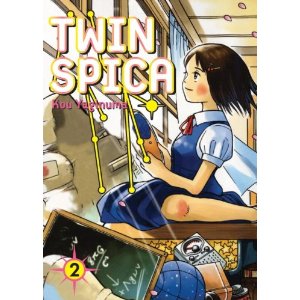
Twin Spica Volume 2


Twin Spica Volume 2 by Kou Yaginuma

I am woefully behind on this series, but I guess that can be a good thing as I can look forward to reading plenty of volumes to get caught up. One of the things I was struck with in this volume is Yaginuma’s economy when packing the story full of emotional beats. He manages to create many genuinely affecting scenes in only a few pages. Twin Spica might be a little sentimental, but the sentiment is earned. Asumi has been admitted to space school and prepares to follow her dream of becoming an astronaut. The second volume starts out with a melancholy note as Asumi has to say goodbye to her spiritual companion Mr. Lion. He runs along her train yelling at her not to cry and to do her best. Asumi promptly gets her skirt stuck in the train door.

When she arrives at space school, she’s reunited with her fellow recruits. They have to face grueling physical training and hard science classes. Even though Asumi is one of the smallest in her class, she’s one of the quickest due to some of the training exercises Mr. Lion has put her through. Asumi’s natural tenacity might not be enough to overcome her being singled out by a teacher who doesn’t approve of her father and her need for an expensive custom flight suit. The flashback episodes in Twin Spica are the most affecting. While the first volume dealt with Asumi’s trauma over losing her mother, the second volume focuses on a friend from Asumi’s childhood who was also affected by the spaceship crash that overshadows Asumi’s current life and dreams. Asumi’s relentless pursuit of friendship and her refusal to give up even when facing rejection will hopefully carry over into a triumph over her issues at space school.

There’s a contrast in Twin Spica between Asumi’s natural innocence and optimism and the cynical approach of many of her teachers at space school. Asumi’s persistence despite her obstacles makes her a heroine you want to root for. While she may be starry-eyed in her quest for space, the administrators at space school aren’t willing to make sacrifices for a promising student that doesn’t fit the exact physical profile for an astronaut. Asumi stands out, and that can be a bad thing as she learns more about her father’s involvement in the crash. This was a good second volume, but I have a feeling that the series really starts to get going in the next couple volumes. I need to get caught up soon!