Categories
Manga Reviews

Manga Moveable Feast: Barefoot Gen and Manga! Manga!

I thought for the Manga Moveable Feast, I write a little bit about where I first encountered Barefoot Gen, in the back of the classic Frederik L. Schodt book Manga! Manga! The World of Japanese Comics. This might be a thinly disguised way of attempting to hide the fact that I didn’t hunt down the collected volumes so my only way of participating in the MMF is to go with what’s on my shelves, but the manga excerpts translated in the Schodt book were also some of the first manga I read. After presenting an overview of the history of manga, Schodt chose the following creators to illustrate the variety stories found in manga for an English speaking audience: Osamu Tezuka’s Phoenix, Reiji Matsumoto’s Ghost Warrior, Riokyo Ikeda’s Rose of Versailles, and Keiji Nakazawa’s Barefoot Gen.

I can’t think of a more jarring transition than flipping from the tribulations of Marie Antoinette to the aftermath of the atomic bomb. The story opens at the start of a normal day, with Gen getting ready to go to school. The bomb drops and his neighborhood becomes a nightmare of destruction, filled with injured people he can’t even begin to help. The schoolboy runs from person to person, seeing a woman with her face melted off, a burned man begging for water, and a little girl with a face full of glass shards. Finally Gen finds his family only to discover his father and most of his siblings trapped beneath a house while a fire rages nearby. Gen gets his pregnant mother away, and she gives birth to his little sister. The child’s first sight is the devastation of war.

Going back and reading this excerpt many years after first encountering it, I’m finding it easier to read. I think when I first read this sample of Barefoot Gen back in the eighties, I didn’t have the background in the visual vocabulary of manga to easily parse the contrast between the stylized, cartoony art style and the images of the bomb’s aftermath. After reading more Tezuka in the intervening years (whose deceptively simple artwork is used to portray any number of heavy situations), I’m finding these pages of Barefoot Gen less strange than I remember. Barefoot Gen is the essence of a didactic manga, with the sole aim to show the horrors of Hiroshima. I wonder if its value as a cultural artifact might be equal to or greater than its literary value. Shodt effectively added Barefoot Gen to the manga canon for English readers by just including it in his book.

Categories
Manga Reviews

Eensy Weensy Monster

Eensy Weensy Monster Volumes 1 and 2 by Masami Tsuda

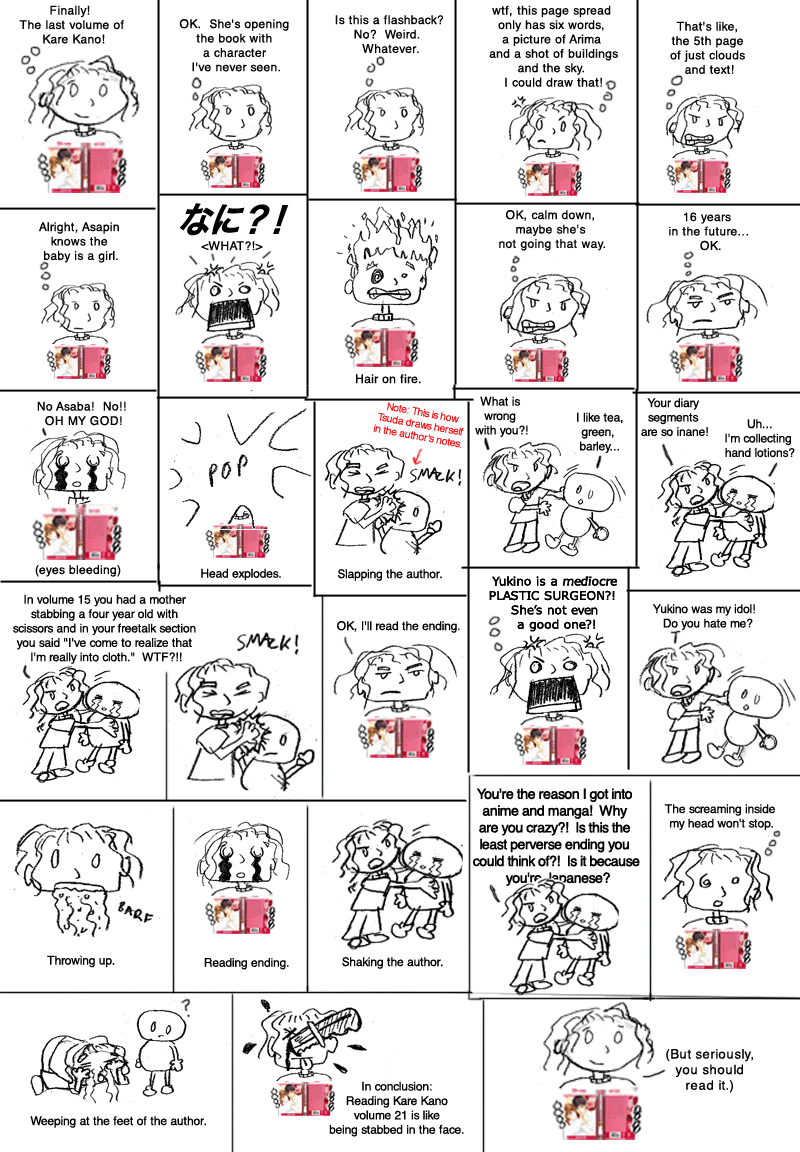
I’m disappointed that I didn’t finish reading this two volume series by Valentine’s Day because this cute story of teen romance would have been the perfect Valentine’s Day manga review. If you’re still in the mood for love, this is a great series to pick up. I still think of Masami Tsuda’s Kare Kano fondly despite the fact that the ending of the series was absolutely loony. Tsuda really has a knack for portraying teenage first love in a very compelling way. Eensy Weensy Monster has the all the cute and funny first relationship elements from Kare Kano without any of the angst and emotional trauma. I think that Kare Kano fans will enjoy this series and it would also be a good way to sample Tsuda’s work if you don’t feel like tackling the twenty one volume series she’s best known for.

Eensy Weensy Monster starts by introducing a shoujo staple character. Nanoha is an average student who is made almost invisible by her two best friends. Nobara is known as the school’s “Lady Oscar,” and her princely demeanor causes her to be the object of plenty of crushes. Renge is the resident genius, the only student able to appear out of uniform at school because she’s at the top of all of her classes. Next to her friends, Nanoha’s everyday talents of being awesome at folding handouts and dividing up food ensure that she fades into insignificance. The three girls share an easy camaraderie, but Nanoha’s peaceful school days are threatened by the resident prince of the school, Hazuki. He’s effortlessly popular and cute, surrounded by groups of girls that dote on him. His presence drives Nanoha insane. While she’s naturally very agreeable, she thinks of herself as having a tiny monster inside that will blurt out hateful thoughts if she isn’t careful.

Nanoha is walking along the hallway at school, awkwardly clutching a present that she’s taking to her teacher. Hazuki is so used to blushing girls approaching him with presents, he assumes it is for him and thanks her for it. This is just the type of incident that triggers Nanoha’s inner monster and she yells “Who said it was yours, you arrogant bastard!” Hazuki is utterly flummoxed by Nanoha’s hatred. Even after Christmas break, he’s being eaten up by wondering why she doesn’t like him. He says “What could you possibly not like about me? You’re pretty strange.” Nanoha’s monster (a cute chibi breaking shackles) is unleashed! She tells him that he makes her sick, and he might be attractive and have good grades but he’s petty and superficial. Hazuki is brought down even more when he goes to his fan club and they inform him that they agree with Nanoha’s assessment. They know he only cares about himself, but they use him as a crush object for fun.

Hazuki decides that he has to change himself and stops indulging in his prince-like behavior. The relationship between Hazuki and Nanoha remains cool for a long time, but then he begins to notice how nice she seems to be to other people. Nanoha feels bad for telling him off, and relations begin to thaw. In the spring, they begin to spend more time together as Hazuki helps Nanoha out with school. All the relationships at school are very light-hearted. The greek chorus of girls that forms Hazuki’s fan club pops up from time to time to offer their comments about Nanoha and Hazuki’s new personality. Nanoha’s Jeckyll and Hyde like transformations are funny whenever she’s speaking her mind, as her shadows suddenly form on her face and the fonts she uses to speak in are transformed to look bold and intimidating.

Nanoha and Hazuki’s relationship develops even more as the second volume starts out in the late spring. Hazuki has realized that he’s in love with her, and starts to act like a total spaz whenever she’s near. Nanoha’s monster assumes that he’s acting this way because he doesn’t want to hang out with her due to her being boring, and she confronts him. He tells her what he’s feeling and now it is her turn to act painfully awkward, mainly by staring at him around corners with saucer-like eyes and sweating a lot. One of the things I like most about Tsuda’s manga is the way she portrays the inner feelings of each part of the couple who is falling in love. She’ll frequently have split pages that show what Nanoha and Hazuki are thinking. Sometimes they’re right in sync, and other times they are in entirely different stages with their emotions.

For most two volume manga series that I read I’m usually left feeling a little bit unsatisfied due to plot elements that aren’t entirely resolved or rushed endings. I didn’t feel that way with Eensy Weensy Monster at all. Tsuda structures the book so the reader gets a sense of time passing from winter to summer break, to the start of a new school year. She noted in one of her author notes that she had each chapter take place in a different month, and I think that the element of time moving forward helped a lot in making the characters and situations not feel static. Tsuda is obviously great at portraying stuck-up characters that are forced to come to their senses, so Hazuki is a familiar character type for her. But even though there were similarities between Kare Kano and Eensy Weensy Monster, I wasn’t bored by the repetition. Eensy Weensy Monster might not be strikingly original, but it is cute, funny and heartwarming. Sometimes that’s all you need to ask for from a good shoujo series.

Categories
Manga Reviews

Viz Signature Quick Takes – House of Five Leaves and Biomega

On the surface House of Five Leaves and Biomega don’t seem to have much in common aside from both of them being published by Viz’s Signature imprint. But both titles rely on distinctive art to create stories that rely more on mood than plot. While House of Five Leaves continues to explore a samurai falling further into a den of thieves in a meandering slice of life style, Biomega’s dystopic world grows even more stylized but still features plenty of decapitations.

House of Five Leaves Volume 2

Hapless samurai grows even more hapless when he’s stricken by illness and starts to lose sensation in his legs. He isn’t adjusting well to living in a brothel with the charismatic House of Five Leaves gang leader Yaichi either. Masa goes to live with Goinkyo in an attempt to recover and begins to learn more about the origins of the group of people he seems to have fallen in with. Very much like Natsume Ono’s series, revelations are made through people talking to each other, sitting in the same room watching the day go by, or sharing a meal. Masa still seems to retain a measure of dangerous naivete as he thinks of his new friends as kind. Goinkyo warns him that his new acquaintances are all criminals and Masa says “those whom you do wish to involve yourself with…those friends and companions with whom you wish to share feelings and experiences…I believe they just are as precious as family.” I’m not sure if the House of Five Leaves feels as deeply towards Masa as he feels towards them.

Even while absolutely debilitated, Masa still attempts to defend Goinkyo when a gang member from his past shows up to his house. But when Masa is feeling better and accidentally bumps into a local tough guy, he starts shaking and runs from battle. Masa’s skill is overpowered by his anxiety, and his weakness makes him an interesting character when thrown into the criminal underworld. Masa encounters a possible mentor, but I think it’ll be a long time before he’s able to summon up the confidence within himself that he admires in Yaichi so much. I think I enjoy this series a little more than Ono’s restaurant centric books like Gente and Ristorante Paradiso, because I enjoy the contrast between Ono’s modern art style and the historic setting. I have more patience for most of the story being expressed through the characters just talking to each other, because the backgrounds and period details like the type of malnutrition that Masa is suffering are a little more interesting to me than her more modern works.

Biomega Volume 5

It wouldn’t be another volume of Biomega without some striking visuals and absolutely insane moments. The visual aspect of this volume that blew me away was the new setting of the cord world. With the organic tendrils and insect-like carapaces covering everything, the background illustrations looked like Nihei’s take on Miyazaki’s ruined world in Nausicaa. The crazy moment came when a disembodied womb gave birth to a tiny doll-like girl named Funipero, who is the heir of evil matriarch Niarudi. So action hero Zoichi is now wandering around yet another alien landscape accompanied by two tiny females his artificial intelligence avatar Fuyu and scarily intelligent Funipero, who seems to be eating a lot and exhibiting strange powers. I always put down Biomega feeling simultaneously bewildered and transported. I might not always understand what’s going on, but it is always interesting to visit the strange world that Nihei creates. There’s probably only one slot in my reading list for “post-apocalyptic insane yet strangely beautiful seinen manga”, but Biomega fills that spot very well.

Review copy provided by the publisher

Categories
Manga Reviews

Gatcha Gacha Volumes 5 and 6

Now that the final volume has come out, I’m catching up with the last half of the series. The more I read of Gatcha Gacha, the more I like it. It combines a certain gleeful trashiness with some affecting emotional moments. It also can occasionally be genuinely weird. I wouldn’t hesitate to recommend this series to someone who feels burnt-out on typical shoujo manga. I can’t imagine myself being so entertained by the worn out storyline of a character coming back from the dead with amnesia in any other series. Yuri and Yabe are dating, and he’s cleaned up his act by transforming into a proper looking Japanese boy. The blond hair is gone, as is the weedy looking goatee. While Yuri might be momentarily blissfully happy with her new love, trouble lurks on the horizon in the person of Kanako, a girl who looks just like Motoko’s deceased crazy sister. Yabe is shaken by his dead girlfriend’s doppelganger. Hirao watches this unfold from the sidelines, and while he’s still nursing feelings for Yuri he tells her that he’ll support her and Yabe however he can.

Kanako is of course Motoko’s sister, but her amnesia has left her unable to remember Yabe. Here is where Tachibana goes for the kill, because seeing Yabe’s conflicted expressions when he looks at her is just gut-wrenching. Kanako was farmed out to some distant relatives who have raised her as a foster daughter. The amnesia has caused her twisted personality to fade, leaving behind a rather sweet girl who still manages to be violent through subconscious reflex actions. Gatcha Gacha being Gatcha Gacha, issues between characters seem to be resolved through gang beat downs that lead to people talking about their feelings instead of non-violent confrontation. Kanako is kidnapped by a bunch of goons, and Motoko and Yabe go to rescue her. Yuri knows that as Yabe leaves, he’s also leaving her. She begs him not to go and he says “I know if I stayed and really learned to love you…I know I could finally be happy. But…I’m sorry. I’m not that good of a man.”

Tachibana does what few manga creators are capable of by making her main female character simultaneously an object of ridicule and sympathy for the reader. Yuri is left alone yet again, crying to the heavens “Will I ever be happy?” She’s absolutely silly and it is hard not to root for her to eventually be happy even though her basic personality is that of a happy cute puppy dog who keeps getting kicked around but still comes back for more.

Volume six starts with a return to the status quo. Kanako has regained her memory and is acting as crazily possessive of her sister and Yabe as ever. She starts to target Yuri but is warned off by Motoko in dramatic fashion. Hirao sees that Yuri may be losing her hair due to stress and he goes to extreme lengths to hide her tiny bald spot, running to a department store to buy a hairstick and devising a new hairstyle for her in an attempt to cover it up so Yuri and other people don’t know about it. He finally tells Yuri his feelings, and she begins to wonder if she can ever be attracted to him. He seems perfect, but she only feels any sort of chemistry with losers and jerks. Is the ultimate bad boy for Yuri actually Motoko? She continues to dress more masculine and rampages around like she always does. Yuri comments to Motoko that she’s physically incapable of being attracted to nice guys and says “What does it say about you that if you were a guy, I’d ask you out in a heartbeat?” Motoko’s face goes absolutely still and then she carries on the conversation with a smile.

The new, forthright Hirao might actually be enough of a loser to inspire feelings of attraction from Yuri when she finally spots him doing something loser-like. Hirao and Yabe begin to act a little more friendly towards each other. I’m not confident that a relationship between Yuri and Hirao will work out, but that’s the way things seem to be headed for now. Even though Gatcha Gacha is very much a shoujo series, Tachibana’s unique and darkly cynical sensibility makes it seem refreshing. With the two main female characters not being afraid to indulge in violence, it is actually fairly entertaining to see just Yuri slap Kanako across the face for being a brat, instead of slinking off to wallow in hurt feelings. When Tachibana’s characters do talk about their feelings, they are amazingly blunt and forthright. There are only two more volumes left for me to read, and I’m a little disappointed that Gatcha Gacha only lasted for eight volumes. I’m looking forward to the end, but I have no idea what to expect. With most shoujo series I pretty much know how the relationships will play out by the end. I’m really not sure what Tachibana is going to do next, and that’s a large part of Gatcha Gacha’s appeal.

Categories
Manga Reviews

Kurozakuro Volume 2


Kurozakuro, Vol. 2 by Yoshinori Natsume

The second volume of Kurozakuro seems a little more conventional than the first. I wasn’t terribly impressed by the first volume, but I did like the way Natsume blended horror with ogre fighting action. For me, the most compelling parts of Kurozakuro came when human turned ogre Sakurai was forced to confront his bestial nature as he attempted to quash his urges to kill and eat the humans around him. He can’t even really stay with his family anymore if his condition starts to progress. The second volume of the series for the most part leaves these moments of internal agony alone and focuses on setting up a more standard shonen adventure quest. Sakurai meets again with ogre hunters Kugai and Asami and makes the decision to help them, claiming that he can keep his urge to eat human flesh under control. Sakurai ends up revealing his new identity to his sister and asks her to intercede with his parents when they discover that he’s missing.

The mystical being Zakuro is dismayed at Sakurai’s unwillingness to embrace the ogre within him, warning Sakurai that he might die. Zakuro seems to be unnaturally attached to Sakurai’s continued existence for some reason. I expect that more about Sakurai and Zakuro will be revealed in future volumes, but after reading the second volume it still felt to me like the story was still being set up. I was disappointed that relentless teen vampire hunter Asami appeared to be left behind, because she was one of the few characters that I found interesting. Sakurai and Kugai join forces to hunt down a nearby super ogre. I think with the second volume Natsume’s blocky art style grew on me a bit. It is a tad simple but the heavy use of blacks and the simplistic, often screaming in horror faces of the characters does give the manga a unique if slightly static feel. There’s still not enough in the series to pique my interest, and I usually give up on manga after trying two volumes and finding that it doesn’t really appeal to me.

Review copy provided by the publisher.