Princess Knight Volume 2

I think reading the first volume of Princess Knight prompted me to enjoy the second volume more, because I was primed to enjoy all the insane plot developments, and I was no longer expecting Princess Sapphire’s gender issues to be dealt with in a serious way. Instead I opened the book expecting to find more fun fairy tale pastiche, and that’s exactly what I got. I grew to have more affection for Prince Franz, because I decided that Tezuka was deliberately portraying him as an idiot. He finds out that Sapphire’s been cross dressing and spurns her, not realizing that she’s his long-lost “flaxen haired maiden.” Captain Blood promptly slaps a wig on her head, causing a comically abrupt change of heart from Prince Franz as he proclaims to the woman he was yelling at seconds before, “I won’t let you go, I’ll carry you back to my castle and mend the wounds in your mischievous, beautiful heart.”

Sapphire continues to have issues holding on to her hearts, as she becomes comically masculine when her female heart is taken from her, then shifts over to being feminine when her female heart is restored and her boy heart is taken instead. Sapphire finds some unexpected allies in her homeland as Prince Plastic becomes extra noble and manly when he consumes her boy heart and decides that he’ll change the laws of their country so Sapphire can assume the throne instead of him. There’s a war between the sexes as Sapphire is barricaded in a tower with the palace women, who use domestic implements to fend off their husbands in their defense of their princess. This is no great blow for women’s liberation, because while they might be fighting for Sapphire’s right to rule, their methods involve going on strike from household duties which are promptly resolved once Sapphire’s situation is resolved.

While her country might be in better shape, Sapphire’s love life is a shambles. Captain Blood still loves her, and fills her in on his past life as an adopted son being raised by Italian nobility before turning to a life of piracy. Franz is blackmailed into agreeing to marry Hecate who is less than thrilled about her prospective bridegroom. Franz and Hecate actually fall into a sort of odd companionship with each other as they deal with their own adventures, which was nice to see. There are plenty of references to fairy tales in this volume, as Sapphire falls into a coma and Tink fights of a briar hedge. The last section of the book is particularly ridiculous, as the Goddess Venus falls in love with Franz and is determined to secure him for herself and Sapphire almost finds herself married to a brave female knight. One of the things I liked about this series overall was the goofiness of the plot combined with the clarity and iconic quality of Tezuka’s art. It seems like there’s no scene he can’t pull off, from a literal battle of the sexes to fending off overly amorous goddesses. Once I found myself accustomed to Princess Knight’s silliness, I ended up finding it extremely charming.
Princess Knight Volume 1

It is the Tezuka Manga Moveable Feast week! Fortunately I have been hoarding the two volumes of Tezuka’s Princess Knight for just such an occasion.

We live in fortunate times, with so many Tezuka manga translated in English, and Vertical has certainly taken on the bulk of the work to produce so many influential titles. I’ve been wanting to read Princess Knight for a long time because I understand that it had a huge influence on the development of shoujo manga. Tezuka titles can sometimes be a bit tricky for me to appreciate. I love the unbridled insanity of Black Jack and appreciate Tezuka’s artistry in general but sometimes the cultural attitudes on display can be a bit off-putting, leading me to appreciate some Tezuka manga more as an important cultural artifact as opposed to a manga that I enjoy purely as a reader.

Princess Knight
is the story of a princess named Sapphire who is born with the unfortunate condition of having both a boy and girl heart. Through a misunderstanding as an infant she was announced as a Prince to her subjects and as a result is a boy in public and a girl in private. Sapphire fences and rides horses and attempts to fend off attempts to penetrate her disguise by the evil Duke Duralumin. Many of the early chapters of the Princess Knight read as a fun fairytale mashup filled with Disney-influenced costume design and woodland creatures. Sapphire goes to a ball as a girl and meets a prince from the neighboring kingdom named Franz Charming. But she finds herself fencing with him as a man the next day, and after Duralumin frames Franz for murder Sapphire decides to help him escape. Like Disney’s Snow White or Cinderella, Sapphire finds animal helpers where ever she goes, if she’s in the woods relaxing or shut up in a dungeon after her true nature is discovered. When her true gender is unmasked, Sapphire goes on an adventure to try to save her kingdom and her mother. She dresses up as a knight in a mask, escapes prison, tries to break into her own palace again, and deals with an evil demoness who wants to claim her heart for a demonic daughter.

Tezuka packs plenty of physical comedy into Sapphire’s adventures, and the pacing of the chapters is almost frenetic. Looking back, I tend to single out a few favorite moments or characters rather than a consistent storyline. I enjoyed Hectate, the daughter of the demoness Madame Hell. Hectate introduces herself to Sapphire by throwing fireballs at her, and when confronted with the prospect of receiving Sapphire’s girl’s heart declares that she doesn’t want to become a feminine princess because “I won’t be able to ride brooms, play tag with bats, or kill toads anymore! How stupefyingly dull!” I don’t tend to enjoy Prince Franz very much, as he seems to be insanely obtuse in not being able to tell that Sapphire is the “flaxen-haired maiden” that he’s fallen for. Sapphire does take up with a pirate captain who recognizes her as a girl and promptly proposes marriage, offering to help her overthrow the evil Duke. I have a feeling Sapphire’s sojourn with pirates won’t last very long though.

It was fun to see elements in Princess Knight that still show up in contemporary shoujo. Cross dressing and phantom disguises are common, and Sapphire bears up bravely under an overwhelming sequences of adventures and problems. I’m suspecting that the series will end with her ditching her extra boy heart and masculine characteristics, which would be a bit of a shame since I tend to prefer her personality when she’s in male mode.

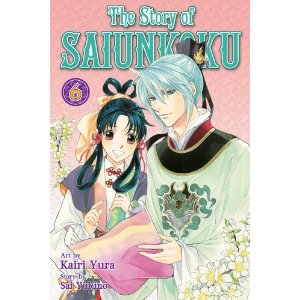
Story of Saiunkoku Volume 6

I’m always happy to see a new volume of this series, which features one of the most sympathetic heroines of shoujo manga. Here we see that while Shurei might pass her civil service exams, her troubles are just beginning. This volume picks up in the middle of a gang fight in a brothel, as Shurei and the young scholar Eigetsu fight the Blue Scarf Gang that has been running around stealing and ransoming examination tokens. Eigetsu turns out to be an unwitting master at drunken boxing, because when he gets splashed by alcohol he turns into the deranged fighter Yogetsu, making him a desirable recruit for anyone in the underworld needing a strong ally.

Ryuki shows his strong promise as a leader when he turns up to extract his future civil servants from gang fighting, striking an amiable deal with the underworld syndicates that control the black market in his city. Now Shurei and Eigetsu are ready to tackle their exams, and they pass while setting records. Eigetsu is the youngest student ever to pass first, Shurei passes in third place, and the eccentric Ryuren Ran passes in second place. Egitsu and Shurei are singled out for the type of harsh hazing that only lifetime bureaucrats would be fiendish enough to survive. While being able to take the exams as a woman was Shurei’s ambition for so long, now she has new tasks to endure if she’s going to fulfill her dream of being a civil servant. One of the things that makes Shurei such a pleasant heroine to root for is that even though she’s suffering, she isn’t held up as a model of saintly behavior. She has a temper and she rants about the horrible treatment she has to endure plenty of times before deciding to stick it out just a bit longer. Ryuki continues to do what he can to protect her, although his role is limited to just watching over Shurei without intervening. Seeing him watch Shurei work out her own problems shows how much he’s evolved as a character since the start of the series, when his previous impulsive tendencies would probably have botched Shurei’s attempts at carving her own path. He’s happy for her success, but ambivalent about her eventual role in government because it will naturally set her at a greater distance from him. Seeing these paradoxical feelings develop as Shurei and Ryuki grow as adults is part of what makes Story of Saiunkoku so entertaining.

A Devil and Her Love Song Volume 1


A Devil and Her Love Song, Vol. 1 by Miyoshi Tomori

If you find yourself fatigued by ordinary shoujo manga, A Devil and Her Love Song is a great series to try read to restore your enthusiasm for the genre. It has an unconventional heroine, two quirky guys, and the promise of an examination of teen social issues with actual psychological depth. The “Devil” referred to in the title is Maria Kawai. She’s introduced to the reader as the object of derision on the subway, as she sits without getting up to offer her seat to the old lady suffering in front of her. When she gets off at her stop, she jostles the sleeping old man sitting next to her and whispers in the old woman’s ear “You must be a lousy pickpocket if you’re targeting a sleeping man, you old crook.” Maria possess incredible powers of intuition. She can instantly see the true feelings and motivations of the people around her. She also has absolutely no filter on her speech, and the habit of bluntly sharing her insights. This ensures that Maria is going to be a target wherever she goes.

Maria starts a new school and soon attracts the attention of an outgoing boy named Yasuke who offers to help her settle in. She comments “I can tell you’re not really a people person, you don’t have to force yourself to talk to me.” Yasuke comments to his friend Shin, “How did she know? I’m upbeat, I’m fun, everybody loves Yasuke!” Shin says that Maria is either being malicious or thoughtful, but in either case he wants nothing to do with her. Maria soon finds herself singled out and bullied, but Shin and Yasuke help her in different ways. With his outgoing facade, Yasuke advises that Maria needs to put “a lovely spin” on what she says so people will get along with her. This results in Maria developing a terrifyingly mannered tendency to tilt her head to the side while saying something horrible to people. Maria begins to start caring about the way she relates to people, seeing “a lovely spin” as a way to view people in the most adorable light possible, while Yasuke attempts to explain that it is a mask he takes off at the end of the day.

Despite Shin’s protests he’s drawn to Maria, intervening in a number of bullying incidents while Maria returns the favor by finding his secret hiding place and dumping water on him when he’s taking a smoke break. Maria is actually able to talk to Shin in a direct way without driving him away, and she actually shares some of her own feelings and experiences instead of commenting on his behavior as though he is the subject of a psychological experiment. Tomori’s character designs are all very attractive, and she does a good job portraying Maria’s cool outer shell when dealing with other people contrasting with the more natural expressions Maria exhibits when she thinks about her own feelings.

I put down A Devil and Her Love Song feeling incredibly intrigued to find out how Maria is going to grow and evolve as a character. She has incredible reserves of inner strength, but I think it will take a long time before she’s able to make true friends or navigate the treacherous hallways of high school without incident. Maria is a refreshing change from the peppy or passive heroines that populate many shoujo series, and I’m excited to see where she’ll wind up.

New Feature at Manga Bookshelf: Bringing the Drama

I talk about the excellent kdrama You’re Beautiful with some of my twitter buddies in a new feature over at Manga Bookshelf. Check it out!