Categories
Manga Reviews

Bakuman Volumes 1 and 2

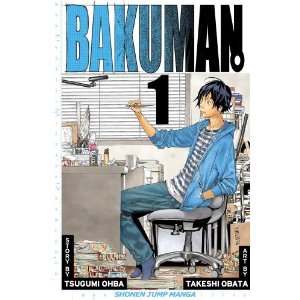
Bakuman Volumes 1 and 2 by Tsugumi Ohba and Takeshi Obata

This is another series I’d steered clear of initially, because even though I enjoyed Death Note despite the narrative shortcomings towards the end of the series, I wasn’t sure how interesting I’d find manga about manga to be. I also read some reviews that charged the series with sexism, so I was avoid the series for that reason as well. I found the first two volumes of Bakuman entertaining, and the sexism in the series seems like an accurate reflection of the attitudes of its protagonists – aspiring manga creators and schoolboys Moritaka Mashiro and Akito Takagi.

Bakuman Volume 1

Mashiro is crushing on the coolest girl in his class, Azuki. He practices his drawing skills by sketching her portrait in his school notebook. When he leaves his notebook at school he rushes back to make sure no one will find out the secret of his drawing habit and his crush. He’s confronted by Akito Takagi, a boy who sits in the back of the classroom and prides himself on his observational powers. Takagi proposes a partnership: he’ll write stories and Mashiro will provide the drawings. They will become mangaka together. Mashiro loves drawing, but is reluctant to become a mangaka because his uncle used to be a professional who failed to build on the success of his initially popular gag series. He died broke and alone.

Takagi ends up forcing Masahiro to draw manga by dragging him to Azuki’s house and confessing their ambitions. Masahiro is so embarrassed, he randomly breaks out with a proposal of marriage, and she accepts on the condition that they marry after they’ve fulfilled their dreams. This ends up being somewhat convenient in a narrative sense, because Azuki ends up being a character that Masahiro can just use as a muse. She isn’t given much of a personality compared to her male counterparts.

I can see why people are criticizing Bakuman for being sexist, but the elements that someone would use to make that critique didn’t really bother me because they seemed to fit with the point of view of young Japanese teenage boys. Takagi makes a long speech about how clever Azuki is because she dedicates herself to being the perfect girl. Her grades aren’t too good. She has a socially acceptable goal of becoming a voice actress. She doesn’t act too stuck up, and she’s mediocre enough not to stand out so she doesn’t inspire jealousy in the other girls. Takagi attributes her behavior to careful calculation. This type of speech seems just like the type of thing a 14 year old boy with ambitions of becoming a writer would say.

Bakuman Volume 2

Seeing how Mashiro and Takagi evolve their ambitions and refine their approach to making manga was fascinating. I always knew manga polls in magazines were significant, but seeing the way the boys discuss the type of story they need to produce in order to get the poll numbers they need made me realize how much the creation of a successful series can be a numbers game. Mashiro and Takagi have a more cerebral, offbeat approach to the stories they create, while their prodigious rival Nizuma seems to be creating the straight-up action series that fans of Naurto would adore.

There were plot elements in Bakuman that seemed to make things just a little too easy. Takagi’s family has held on to his uncle’s studio and gives him access when he announces that he’s going to follow his dream. It turns out that Azuki’s mother was actually the long-lost love of Takagi’s uncle too. Azuki and Takagi agree to wait for each other while pursuing their respective dreams, freeing her up to be an objectified object of affection with the eventual couple only cheering each other on mostly through text messages. The genius fifteen year old manga creator Nizuma and the way he inspires the heros of the story to work harder seems more than a little reminiscent of the relationships between L, Mello, and Near in Death Note.

While all the details about manga creation were interesting, there was a slightly didactic or textbook-like quality to all the exposition. While I enjoyed reading Bakuman, I don’t think it would be the type of series I’d read over and over again. I put these volumes down with a renewed appreciation for Obata’s art. He makes playing Go look dynamic and filled with action, and similarly he makes the process of creating manga look gripping. I put these volumes down with an appreciation for the creative process and the business behind manga. It was interesting to see how Mashiro and Takagi started to revise their work after being taken under the wing of an editor. Seeing how difficult it is to even get a story published in the first place makes me appreciate manga creators even more. Bakuman isn’t a perfect work by any means, but I did feel like I got a lot out of reading it. I’d recommend this title for anyone who is curious about the process of manga creation.

Review copy of volume 2 provided by the publisher.
Categories
Giveaway

Shoujo Mega-Pack giveaway

I thought I’d celebrate moving into my new digs over here at Manga Report and do a manga giveaway. I’m going to give away to one reader:

INVU #5
A Tale of an Unknown Country #1
Nana #21
Butterflies, Flowers #4
Kobato #1

To enter, just leave a comment on this post with the name of your favorite manga heroine. I’ll select a winner at random on Nov 11. You must be 18 to enter.

Categories
Anime

Saturday Morning Cartoon: Princess Jellyfish

Today’s Saturday morning cartoon is the opening sequence of Princess Jellyfish, a new anime that Funimation just started streaming. The characters are shown reenacting scenes from classic movies like Star Wars, Mary Poppins, James Bond, and The Graduate.

Ordinarily I don’t automatically tend to go for stories about female otaku, but Princess Jellyfish is very cute. Tsukumi from the first moment her mother took her to visit an aquarium. She moves to Tokyo to become an illustrator and moves into a shared apartment house owned by a shut-in manga creator who only communicates through papers shoved through her door. “The Sisterhood” that lives in the house are all made up of female otaku. One loves trains, one loves Kimono, there’s a woman obsessed with martial arts and the Chinese classic Romance of the Three Kingdoms. When a beautiful woman helps Tsukumi take home a jellyfish that is being mistreated by an ignorant aquarium owner, Tsukumi discovers that her unwanted new friend is actually a cross dresser.

Here’s the Hulu Channel for the show. Two episodes have been posted so far.

Categories
Manga Reviews

Wicked Lovely: Desert Tales

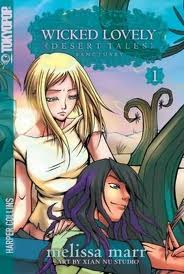
Wicked Lovely: Desert Tales Volume 1 by Melissa Marr and Xian Nu Studio

There have been quite a few manga style adaptions of young adult books. I find the idea of reading original side stories set in an author’s universe more interesting than reading a manga adaptation of what I’ve already read. I’ve read the first three books in Melissa Marr’s Wicked Lovely series and mostly enjoyed them, although the third book teetered on the edge of being a little too emo for my taste. I wrote about Wicked Lovely and Ink Exchange over on the Bureau Chiefs site. Wicked Lovely: Desert Tales features characters from the main books, but the focus is on a new character named Rika.

The Wicked Lovely series is an urban paranormal fantasy series. Keenan, the Summer King of the fairies has been on the hunt for his Summer Queen for centuries. He chooses his queen candidates from mortal girls. There’s a test they have to pass – if they grasp the staff of the Winter Queen and survive the ice, they’re his destined mate. If not, they’re iced over and turn into the Winter Queen, the Summer King’s most hated enemy. Rika is a mortal girl turned fairie by her experience being forced to serve as Winter Queen. She’s taken refuge in the desert, far away from Keenan. Her main distraction is watching a mortal boy – an artist and rock climber named Jayce.

Rika is careful to observe the usual fairy rules about contact with mortals and keeps herself carefully invisible. But the wild desert fey threaten Jayce and she intervenes in order to keep him from being injured. Jayce is mystified at the sudden appearance of a beautiful girl, and they have an awkward first date which consists of them wandering around a nearby town while Rika tries to fight off invisible assailants. Her one local ally is a faerie named Sionnach who seems to be pushing Rika towards the mortal for reasons of his own.

Melissa Marr excels at writing about romance in the initial attraction stage. Jayce and Rika meet, she bandages him up, and as they start talking to each other they share their interests in art and the desert landscape. The character designs fit with the slightly punked out sensibility of the Wicked Lovely books. Rika has pale eyelashes and a choppy bob, providing a contrast to Jayce’s dark skin and dreadlocks. The mischievous desert fey that harass the budding couple are drawn with lines of sand scattered across their skin. I found the story a little more interesting than the art, and there were a couple places in the book where I wished for better transitions between panels or across pages.

I think that fans of the Wicked Lovely series will enjoy this book. I’m not entirely sure how accessible it would be to someone who isn’t already familiar with Melissa Marr’s world. I found reading this manga to be a bit of a relief after Ink Exchange. The love triangle in the main series with Seth, Aislinn, and Keenan has just gotten a little bleak and depressing so I enjoyed being able to visit the Wicked Lovely world with some fresh characters who aren’t bogged down with the continuity in the main series. There are two additional volumes in the Wicked Lovely: Desert Tales manga series, the concluding volume comes out in February.

Categories
Manga News

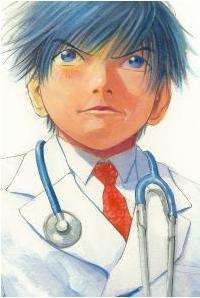
Say Hello to Black Jack

Japanese publishers tend to shy away of digital distribution, so I’m finding the case of Shuto Sato‘s Say Hello to Black Jack really interesting. I was interested to see the notice at Anime News Network that he’s seeking English translators for his online comics site. Sato disclosed financial numbers for what he was making as a mangaka before switching to online distribution. I’ll be curious to read an authorized English translation of Say Hello to Black Jack when it becomes available.

Here’s some links for more information about Sato and Say Hello to Black Jack:

Manga Reality: The Case of Say Hello to Blackjack
Japanese Live Action Drama site
Mangaonweb (Sato’s digital comics site)