Categories
Manga Reviews

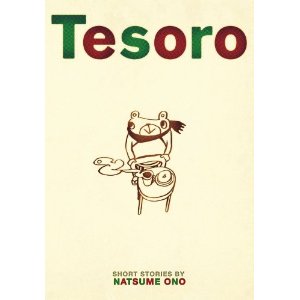
Tesoro by Natsume Ono

For the Manga Moveable Feast, the one title I had sitting on my to-read stack from the Signature line was Natsume Ono’s Tesoro. I enjoyed this volume of short stories and doujinshi, but it might be mainly for Natsume Ono completists. I enjoyed this volume very much, but I tend to be an Ono fan. I think that the only work of hers translated in English that I haven’t read is Not Simple, and the art style in these stories seems to echo the cover of that volume. The facial expressions and thin linework are recognizably Ono’s work, but instead of the more elongated character designs seen in House of Five Leaves and Gente, the proportions of the people in this manga are much more short and childlike. This cartoony style suits the slice of life nature of the stories, as Ono quickly dashes off observations about family relationships and food. This volume will appeal more to fans of Gente and Ristorante Paradiso than House of Five Leaves.

I tended to enjoy the stories in the first half of the volume more than the ones in the back. Standouts to me were the story “Moyashi Couple,” about an aging husband and wife that worry how they are perceived by their neighbors and “Three Short Stories About Bento” in which the traditional Japanese lunch is a main character in the lives of different people. Ono is at her best when capturing quick illuminating moments that portray the relationships between people and their surroundings. Fans of Gente will enjoy the middle part of this volume, with many stories set in Italy. The story I couldn’t really get into was Senza Titolo #4, about a man getting out of prison who needs to deal with the expectations of all the people who are waiting for him. For some reason that story seemed like it was cobbled together from sources instead of having the more authentic feel of the other works in this manga, which feel very observational and true to life. Tesoro is essentially a collection of Natsume Ono B-sides, and if you’re already a fan of her work you will most likely enjoy it in order to get a glimpse of her earlier art and storytelling style.
Categories
Manga Blogging

Manga Moveable Feast: Viz Signature Edition personal archive

The Manga Moveable Feast this month focuses on the Viz Signature Imprint and is hosted at Manga Critic.
I hope to be able to participate with some new reviews, but I thought I’d do a mini-round up of reviews for Viz Signature titles I’ve done in the past and list some of my favorites.

Most of the recent Viz Signature titles were featured on the Sigikki website, which doesn’t seem to be as current as it once was. Still, it was a nice experiment in online comics distribution, even though as more of these volumes are available in print format the free chapters still seem to be disappearing from the site.

Natsume Ono – I’m grateful for the Signature imprint for translating so much of Ono’s work. I enjoy her quirky art style and slice of life stories.

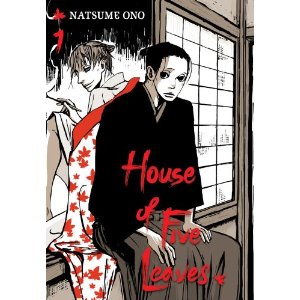
House of Five Leaves is one of my favorite Signature titles, and my favorite Natsume Ono Series. There’s something about this story of a hapless ronin slowly being drawn into a life of crime that I find absolutely gripping. Seeing the way the characters change each other as they go about their daily tasks while dealing with being in a kidnapping and ransom gang gives a bit of a contemporary feel to the historical setting of this series.

House of Five Leaves Volume 1

House of Five Leaves Volumes 4-6

I always enjoy it when manga creators let their personal interests inform their manga, and Ono’s affection for food, Italy, and men wearing glasses is clearly shown in her manga with contemporary settings that revolve around an Italian cafe.

Gente Volume 1
Gente Volume 3
Ristorante Paradiso Volume 1

One of the reasons why I like Ono so much is because she reminds me a bit of Fumi Yoshinaga. Both authors have worked in yaoi, both have an extremely individualistic drawing style, there’s a focus on slice of life stories in their work, and both seem to be serious foodies. I’ve enjoyed the Yoshinaga books put out by Viz Signature.

All My Darling Daughters – A great introduction to Yoshinaga since it is complete in one volume

Ooku focuses on an alternate history Japan with interesting gender dynamics.

Ooku Volume 1

Ooku Volume 2
Ooku Volume 5
Ooku Volume 6

One of the fun things about the Signature imprint is that it does sometimes bring manga to the US that is absolutely crazy. I am referring to Biomega, a title that almost doesn’t need a review, because you just need to ask yourself if you are the type of person who would enjoy a manga that has as a character a talking bear with a machine gun. If you don’t find bears with machine guns enjoyable, I’m not sure if I can be your friend. This reminds me, I need to pick up some of the middle volumes of this series!

Biomega Volume 1
Biomega Volumes 2 and 3

Some of the most personal and deeply affecting titles to come from the Signature line are by Inio Asano. His works focus on that time of life in early adulthood when people aren’t quite sure what they want to become. He blends everyday but surreal images into his manga, giving his stories a dream-like quality that still manages to feel gritty and realistic.

Solanin
What a Wonderful World Volume 1 – I think I only read the first volume of this title. (Unfortunately, this post is making me develop an extensive shopping list.)

Afterschool Charisma I am including in this list of favorites because I love Clone Freud so much. This series from Viz sometimes feels a bit like a high concept B-movie, due to the setting of a high school populated entirely by teenage clones of famous historical figures. Horrifically this series is now up to volume 5, which means that there is even more manga I need to order.

Afterschool Charisma Volume 1
Afterschool Charisma Volume 3

My personal shopping list after compiling this post: What a Wonderful World Volume 2, Biomega Volume 6, Afterschool Charisma Volumes 4 and 5, Ooku Volumes 3 and 4.

Categories
Manga Reviews

Working Kentauros by Est Em

Working Kentauros is available on Jmanga.com

As someone who reads a lot of manga every month, it is easy for me to get a little jaded. I do enjoy the commercial manga that comes out from mainstream publishers, but it is nice to experiment a bit and try something different now and then. Working Kentauros is exactly the type of title I was hoping for when Jmanga launched. I was hoping that the online format would result in some quirky titles being translated, and my wishes were fulfilled to some degree when Jmanga translated a manga that I’d heard about but never hoped to read, Ekiben Hitoritabi. Working Kentauros is about the work lives of centaurs who have entered modern society and it is without a doubt one of the most surprising and well-executed manga that I’ve read recently. I knew I was in for a treat when I saw that the first page featured a businessman in full gallop, clutching a briefcase and stuffing a carrot in his mouth. The next page features a diagram of the contents of a Kentaur’s briefcase, starting with his company cellphone and ending up with a protective charm against traffic accidents. There was more humor and charm packed into the first couple pages of illustrations of Working Kentauros than I see in many full chapters of manga.

So, centaur businessmen is a great gimmick for a manga story, but part of what makes this book so great is the way Est Em integrated what might seem like a goofy concept into her manga. Kentaurs have much longer lifespans than humans, and anti-discrimination laws have only recently been passed that allow them to work in human office environments. The first few chapters deal with the daily life of Kentaro, a Kentaur who has recently been hired by a harness making company. He has to run up flights of stairs to get to work, arriving at the office so sweaty that his senpai has to groom him before they go to a business meeting. Kentaro’s senpai has a certain amount of grudging respect for him. Even when he yells in disbelief “How dare you carry a cordovan leather briefcase!” he says that Kentaro is a good worker. Then he straps boxes to Kentaro to help in an office move, leaving Kentaro to wonder if he’s experiencing workplace bullying. When Kentaro finally is able to ride the larger elevator at his new office building, he finds himself the target of an anonymous molester. Kentaro’s senpai helps him track down the pervert, and it ends up being a horse-crazy lady he has a crush on! Throughout the next few chapters Kentaro and his senpai get to know each other better, and Est Em slips in interesting details about Kentaur society. They add on names based on their work with humans over the years and since they are so long lived, the oldest Kentaurs have names that are so long it is difficult to introduce themselves in one breath. While Kentaro seems like a man who has just graduated college, he’s around fifty years old.

Est Em’s art has simple but mobile line work, and she’s great at portraying Kentaro’s thrilled excitement about an elevator he can fit in as well as his habits of galloping off on sales calls. The character designs are attractive and in proportion, which ends up highlighting some of the difficulties the Kentaurs face when they are navigating through a world that wasn’t originally designed for people with half-horse bodies. The second half of this series focuses on Kentaurs with dreams of other jobs like opening up a noodle stand or becoming a messenger. There’s a chapter that focuses on a successful male model Kentaur who is only able to get work with a stand-in serving as his Photoshopped human legs. As goofy as the concept of Working Kentauros might seem, it is very clear that Est Em has spent plenty of time thinking about her characters and their relationships with each other. There’s a great page towards the end of the book that shows the difference in lifespans of the characters for a Kentaur and human who have gone into business together as partners in a shoe company. A quick succession of images shows the human aging while the Kentaur stays the same age, working at his job the entire time. Working Kentaurous blends plenty of whimsy and humor with the more serious topic of showing people who are just trying to make their way in the world even though they might have hooves instead of feet.

This book was carefully designed too, and sadly one thing that gets lost in the transformation from print to digital are the tiny Kentaur animated flipbook illustrations that are placed at the bottom of each page. This was the first manga by Est Em that I’ve read, but it definitely won’t be the last. If you’re a Jamanga subscriber already, reading this book is a no-brainer. If you haven’t signed up for the site yet, this is a great first title to try.

Access to electronic copy provided by Jmanga.

Categories
Manga Blogging

Aniblog Tourney

Apparently this is the first year a bunch of manga blogs have been in the Aniblog Tourney. Not being a participant before, I wasn’t sure what to expect but apparently there are already scandalous accusations of vote fixing!

Here’s my bracket, and welcome to anyone who is checking out my blog for the first time. If you’re here and you like shoujo manga, you can enter my current giveaway!

Next week I plan to review Blue Exorcist, Est Em’s manga about Centaurs, Story of Saiunkoku, and Ai Ore.

Categories
Manga News

PR: New Shojo Titles from Viz Strobe Edge and Demon Love Spell

It was fun seeing @shojobeat on twitter this afternoon announcing these titles, and here’s the official press release from Viz.

Here’s the cover of Strobe Edge, which has some appealing looking art.
The cover of Demon Love Spell features a hero in the classic Mayu Shinjo mold. I’ve been happy with the recent titles coming out from Shojo Beat. Dawn of the Arcana and A Devil and Her Love Song have been entertaining and quirky enough to seem fresh. I was excited to see another Shinjo series announced. I enjoyed Sensual Phrase, and while I haven’t been getting into Ai Ore as much, I suspect that I’ll like Demon Love Spell quite a lot, if only because the hero looks like Sakuya. I’m shallow that way!

Read on for all the details.

VIZ MEDIA ANNOUNCES NORTH AMERICAN PUBLISHING LICENSES FOR NEW SHOJO MANGA SERIES STROBE EDGE AND DEMON LOVE SPELL

VIZ Media announces its latest manga (graphic novel) licenses with the acquisition of the domestic publishing rights to two new shojo series – STROBE EDGE, by Io Sakisaka, and DEMON LOVE SPELL, by Mayu Shinjo. Both titles are scheduled to begin publication later this year under the company’s Shojo Beat imprint.

Creator Io Sakisaka’s STROBE EDGE (rated ‘T’ for Teens) asks the timeless question, “What is love?” Ninako Kinoshita’s friends tell her it’s one thing, but Ninako wants to discover this mysterious emotion herself. When she meets Ren Ichinose, a handsome, enigmatic guy worshipped by all the girls at her school, she finds her heartbeat quickening with excitement! Is Ninako about to experience the many facets of love?

Celebrated manga creator Mayu Shinjo (AI ORE!, SENSUAL PHRASE) also returns with her new supernatural romance, DEMON LOVE SPELL (rated ‘T+’ for Older Teens). In the series, Miko is a shrine maiden who has never had much success at seeing or banishing spirits. Then she meets Kagura, a sexy demon who feeds off of women’s feelings of passion and love. Kagura’s insatiable appetite has left many girls brokenhearted at school, so Miko casts a spell to seal his powers. Surprisingly the spell works – sort of – but now Kagura is after her!

“STROBE EDGE has been one of the most requested titles that our readers have asked to be licensed, and the romantic coming-of-age story will be a perfect series for young teen readers in particular,” says Leyla Aker, Vice President, Publishing. “Mayu Shinjo’s new series, DEMON LOVE SPELL, will intrigue older teen readers and young adults with its fun mix of comedic supernatural romance and gorgeous artwork. We look forward to launching both series later this year and will be announcing more information on the forthcoming debuts soon!”

For more information on Shojo Beat manga titles, please visit: www.ShojoBeat.com