Sailor Moon Volume 2

Pretty Guardian Sailor Moon Volume 2 by Naoko Takeuchi

A ton happens in this volume! It takes a bit of an adjustment to get into the story pacing of Sailor Moon because everything moves so much more rapidly than most recent shoujo manga I’ve read. Usagi/Sailor Moon and Mamoru/Tuxedo Mask are inexplicably drawn to each other. Usagi knows that she should tell the rest of her team that Tuxedo Mask is aware of her secret identity, but she can’t bring herself to talk about it. The sailor senshi speculate about the crescent-shaped mark on the mysterious Sailor V’s forehead and wonder what her significance is to the lost Moon Kingdom. They fight a typical monster of the week scenario when they go up against an evil video rental shop and Sailor V finally makes an appearance, and Luna introduces her as the heir of the Moon Kingdom, the Princess Serenity. I have to say it was amusing to see Sailor V in her fully awakened state in this series, because it stands in stark contrast to the way she was portrayed in her own series. Here’s she’s calm and cool, immediately assuming the role of mentor to the other sailor senshi.

Usagi has been slowly losing her innate silliness as the series progresses, and with the appearance of Sailor V she willingly assumes the protector role she thinks she should have in her role as Sailor Moon. When she’d act like a wimpy crybaby about going into battle before, she announces “Then it’s our job to protect you!” when Sailor V is determined to investigate a mysterious disturbance on Tokyo Tower. Sailor V’s role as royal decoy doesn’t last long as it is quickly revealed that the real Princess Serenity is Usagi. She and Mamoru are playing out the lives previously lived by a princess of the Moon and a prince of Earth. By the end of this volume the Usagi and the sailor senshi have been to the moon (TO THE MOON!), encountered a hologram of Princess Serinity’s mother in a past life, experienced mystical hair growth, and dealt with the terrible heartbreak that happens when your desired future boyfriend has been turned into a minion of evil (MINION OF EVIL!). It is almost on the verge of being a little exhausting, but I find myself amused by all the little quirky touches in this manga, like the way Sailor Mars is always glaring off into the distance and making pronouncements that she senses evil, right before something evil appears. Sailor Moon continues to be both fun and cute, and the more complex mystical bits about mystical reincarnation and the sadness of decrepit architecture on the moon save it from being too sweet for me to enjoy.

2011 Manga Gift Guide

It is that time again, when the world is awash with consumerism. Surely there are worse things than picking up a few volumes of manga for yourself or loved ones? Here’s what I think should be on your holiday lists depending on the type of person you’re shopping for:

For the old school shoujo fan:

Truly we live in glorious times, when classic and hard to find out of print manga is being released again here in the US. I’m speaking of course of Sailor Moon, because what holiday isn’t made better by magical girls in sailor uniforms taking names and fighting evil while yelling catchphrases like “venus Love-Me Chain!” I’ve reviewed the first volumes of Sailor V and Sailor Moon, and I have the second volumes ready to enjoy over the holiday weekend. Complete at two volumes and never before published in the US, Codename: Sailor V is a must-have for any shoujo fan who hasn’t bought it already, and the nice new editions of Sailor Moon are a treat. Wow, Tuxedo Mask is so dreamy, isn’t he? Great for any manga fan who is in touch with his or her inner 13 year old girl.

Pretty Guardian Sailor Moon and Codename: Sailor V

Princess Knight

I haven’t read Princess Knight yet, but it is on my personal wishlist! Vertical continues to do the world a great service by releasing so many great editions of Tezuka’s manga in English, and this early girls’ manga defined many classic shoujo storylines.

Lovey Hardcover Editions

One nice thing that has happened this year is more manga series are getting the deluxe treatment. I’m not going to turn up my nose at a new paperback manga, but it is nice to see that more publishers are varying the formats we can expect from manga. So I’m going to highlight two very giftworthy series that come in hardback format.

Wandering Son Volume 1

Fantagraphics is one of those companies that does such a stellar job on the book production front that I knew any manga published from them would be a treat. I was happy to see that they brought their best efforts to Wandering Son, a tender and sometimes humorous slice of life story dealing with gender identity issues in modern day Japan.

A Bride’s Story Volumes 1 and 2

The other hardcover series I want to spotlight is A Bride’s Story from Yen Press. Kaoru Mori brings her meticulous attention to detail and through research practices to her story of a young woman married to an even younger boy in Central Asia, cementing ties between two nomadic tribes. I enjoyed the first volume very much, and the second is on my wishlist. Two volumes of this series are out now, and these lavishly illustrated books would make a great gift for any serious manga fan.

Best Manga for Manga Ambassadorship

Drops of God

Drops of God is a bit of an anomaly as it has gotten mainstream press attention due to its effect on wine prices in other countries even before being licensed in the US. This was yet another manga I thought I’d never see translated here, so the fact that I can expect Vertical’s excellent production work makes me even more enthusiastic about this manga. I haven’t read it yet, as it is in a box of comics somewhere between Pennsylvania and Salt Lake City that has yet to be delivered to my house (why is it taking so long, whyyyyyyyyy) but this manga about wine has the best crossover potential of any recent title, and I hope some non-manga readers discover it.

If you are dreaming of an Italian vacation

Gente and Ristorante Paradiso

Natsume Ono’s slice of life stories set around an Italian Cafe allow you to disappear into another world filled with handsome bespectacled older gentlemen and the people who love them. Her manga have a distinct sense of pace and scene, making it easy to vicariously experience the rhythms and foibles of cafe life.

New Collected editions and box sets

Viz always comes out with a crazy box set right before the holidays, and this year we have the Fullmetal Alchemist Box set.

My pain at knowing that X/1999 may never get an actual ending is assuaged by all my memories of the billowing coats and random feathers scattered through every panel of this manga. This was the series that first got me into Clamp, and there’s a new omnibus edition of the first three volumes out.

If you’re curious here’s my manga gift guide from last year.


And here’s the 2011 manga gift guide round-up page.

My personal manga wishlist is Dawn of the Arcana Volume 1, A Bride’s Story Volume 2, and Princess Knight 1 and 2. What’s on your wishlist?

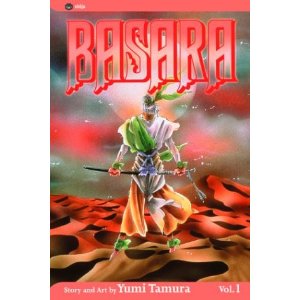
Basara Volumes 1 and 2

When I write manga reviews for this blog, sometimes I feel like I get stuck reading only new volumes. Which is fine, because there’s plenty of exciting new manga coming out these days. But I don’t often take the luxury of time to go back and reread some of my favorite completed series, and there are plenty of manga series that I’ve enjoyed but not necessarily written about all that extensively. So I’ve added a new category of Reread Reviews for series that have come out some time ago but I feel still deserve plenty of attention. I thought I’d start this new feature by working my way through one of my favorite series, Yumi Tamura’s Basara.

Viz started releasing Basara in 2003, and as a result some volumes are out of print or hard to find. But this is one of those series that is well worth collecting, because even though it is long at 27 volumes, this is one of the few series that I think actually deserves all that space. Tamura creates an epic adventure story with star-crossed lovers, cross-dressing, fierce battles, and political revolution in a post apocalyptic Japan. Even though this series is on the long side so much happens in each volume. I never felt like I was reading filler stories or being subjected to recursive battle scenes when reading this manga.

Basara Volume 1 by Yumi Tamura

Like the best adventure stories, Basara starts by introducing the heroine in the context of her home and family and then systematically strips everything away, forcing her to rise to the occasion and assert her true self. Sarasa was born with a twin brother named Tatara, and at their birth a prophet proclaimed “This is a child of destiny…one who will grow to lead the people and be the light in the sky of our nation’s future.” The people in Sarasa’s village are a rebellious group in a post-apocalyptic Japan that has been broken up into areas ruled by petty feudal kings. Everyone assumes that Tatara will be the leader of the next revolution, and Sarasa is shunted aside since she’s a girl. She’s introduced to the reader first as a young spirited tomboy who is acutely aware of the differences between the way she and her brother are treated. She’s heedless of her own safety, heading out to the desert when everyone celebrates her brother’s birthday and ignores her. She makes the mistake of crossing a column of troops headed by the cruel Red King and her life is saved only when a desert nomad named Ageha insinuates himself into the situation, losing an eye in the process. When Sarasa gets back to her village she finds out that the Red King’s army has struck there, killing her childhood friend who identified himself as Tatara in order to save the real “Boy of Destiny.”

The Red Army returns to the village again, and this time Sarasa’s brother is killed. She’s paralyzed with fear but remembers that her brother asked her to protect the villagers if he was gone. She cuts her hair, yells that her sister is dead and orders the villagers to follow her in order to save their own lives. While Sarasa’s ingenuity allows her to rescue her village’s sacred sword from the Red Army, her next attempt at battle fails and she’s cut off from her people. Determined to rally more people to her brother’s cause, Sarasa strikes out towards another rebel village. The Red King is shown throughout the volume with his face slightly obscured. He’s covered by a helmet or his face is partially shadowed or cut off by the borders of a panel. He’s a pragmatic ruler determined to hold on to his territory despite the manipulations of his family. Sarasa meets an arrogant and rich young man named Shuri when she’s visiting a hot springs, and they feel an instant attraction to each other. When Sarasa sees Shuri for the first time, it is also the first time the reader has seen the entire face of the Red King.

Basara Volume 2 by Yumi Tamura

The second volume of Basara shows Sarasa preparing herself to be a rebel leader and not having much time for the young man she keeps running into as she follows the path of the Red King on her way to Sakurajima to locate allies. She visits the city where the Red King lives and is struck by the riches there in contrast to the way her people live. She falls in with a group of traveling show people, who are anchored by a glamorous woman with a bejeweled eyepatch who happens to be Ageha in disguise. Ageha exhibits a sort of watchful antagonism to Sarasa. He’s suspicious that Tatara really is the boy of destiny who will bring revolution to the land, but he’s occasionally helpful. Sarasa as Tatara disguises herself as a dancing girl and slips out of the city into even greater danger in the form of a decrepit tunnel that leads to Kyushu. In the tunnel Sarasa faces a classic hero’s test where she can only call upon herself to get out of a dangerous situation, and she succeeds in reaching the other side, but not before she manages to finally bond with her late brother’s horse Yato. She also has a fateful encounter with a prisoner trapped in the tunnel who gives her valuable information about the rebel village she’s questing for.

Sarasa begins to understand the political nature of rebel leadership when she meets a young boy claiming to be Tatara who is rallying people to rebel against their local lord. It turns out he’s being blackmailed to identify potential rabble rousers in his region. Sarasa is shrewd, keeping quiet about who she is until she has a full grasp of the situation. The boy Hayato ends up attaching himself to Tatara as his new right hand man. In just a couple volumes Tamura has introduced characters on both sides of the Red King/Tatara war and managed to make each side sympathetic for different reasons. Shuri is shown growing up as a young boy with a sociopath for a father who brands his own son with a slave’s mark. Shuri is about to dispatch his cousin Shido to go after Tatara, but Shido is leaving his fiancee behind when he goes on his mission. Shuri and Shido see Ageha (the former slave of Shido’s family) tortured in an attempt to give up Tatara’s location.

Tamura’s art style might take a bit of getting used to. Her men have a tendency towards triangle face, with eyes that sometimes look like horizontal slits. But she varies her character designs quite a bit, making it easy for the reader to keep track of the cast of Basara even though it seems to expand with every volume. Sarasa has covered a lot of ground in the first two volumes of Basara in both her physical and internal journey. Tamura is moving all the pieces together to tell an epic story, and I’m entertained all over again when I’m rereading this series.

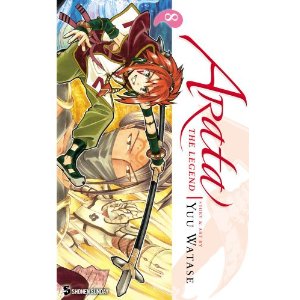
Arata Volumes 7 and 8

It took seven volumes, but I am finally starting to warm up to Arata. I always thought it was well-executed because Yuu Watase is such a pro, but I wasn’t feeling as much of a connection to this series just because I tend to prefer her shoujo work. But these two volumes were packed with adventure and I found myself enjoying Arata’s quest more because the emotional stakes for Arata were raised in a variety of ways.

Arata Volume 7

I skipped volume 6, but the recently introduced complication that seems like a slightly recycled plot from Fushigi Yugi is that Arata’s school enemy in Japan, Kadowaki has now journeyed into Amawakumi and has become a Sho himself in opposition to Arata. The volume opens with Arata traveling to Lord Yorunami’s land, where Kotoha promptly gets kidnapped and placed into a watery death trap. Arata’s struggle with Yorunami ends up being more of an internal and emotional struggle than a violent fight, and when Arata helps Yorunami with his mother issues the Sho promptly surrenders because he is newly at peace. While Arata is able to fight one battle without using violence, he gets some disturbing news from the Original Arata who has taken his place in Japan. He finds out that Kadowaki has jumped into his adoped world, and the Sho Harunawa has killed Arata’s friend Suguru. Harunawa has vowed that for every Sho that submits to Arata, he will find a way to kill someone precious to Arata on the other side. Original Arata vows to protect Arata’s family so Arata can continue his mission. Arata picks up a new companion, the pretty but harsh warrior Mikusa, who has a secret that is tied to his prettiness.

Arata’s commitment to achieving his quest through non-violence is a nice contrast to all the fighting shonen manga out there. His strength comes mostly from resoluteness of character. Even though he does fight with other Sho to make them submit, the battles are won due to Arata’s internal strength as opposed to an outward show of power.

Arata Volume 8

Arata and his companions travel to Lord Kugura’s area of the country where they make some disheartening discoveries. The water is stagnant, land barren, and the regular people are starving. Girls are taken to the palace as “tribute,” but they are actually hostages. Mikusa challenges Arata’s approach to his quest, calling him naive, saying “Evil must be destroyed. If you are not the one capable of destroying it, then you are the one who will be killed.” Arata loses a strong ally when Kanate finds out that the gang that he used to belong to is in the hills. His reunion doesn’t go as planned, and when he has the opportunity to become powerful himself by inheriting the weapon of a Sho, he takes it. Kanate’s response to power shows the true destructive power of a Sho, which stands in contrast to Arata’s measured actions. Arata still maintains his friendship with Kanate after he disappears, saying “I still believe in him!”

Lord Kugura’s predilection for young women of course results in some cross-dressing hijinks, as Arata and his group decide they have to pretend to be female in order to enter the palace. The tone of this episode was definitely on the lighter side, which balanced out the earlier adventures that had more emotional heft. Overall, I’m finding myself enjoying Arata much more than I was in the earlier volumes. I’m finding the way Arata is literally carrying the souls and powers of his former enemies along with him, asking them for help when he has to fight an interesting contrast to the more typical shonen hero. It almost seems like Watase is writing an anti-shonen shonen adventure, with non-violence and the bonds friendship emphasized over physical fighting. I’m more intrigued with this series than I was when I first started reading it, so I’m looking forward to the next volume.

Review copies provided by the publisher.

Natsume Ono Manga Moveable Feast

This week’s Manga Moveable Feast focuses on Natsume Ono.

I’m not totally sure if I’m going to be able to participate in the MMF, because I’m not going to be able to get my hands on her new book Tesoro, and I’ve already read and reviewed a good chunk of Ono’s manga that has come out in the US. So I thought I’d post a round-up of the titles I have reviewed, and hopefully I’ll be able to carve some time out this week to reread House of Five Leaves (my favorite Ono series) and post some additional thoughts.

House of Five Leaves Vol 1
House of Five Leaves Vol 2
House of Five Leaves Volume 3

Ristorante Paradisio Vol 1

Gente Vol 1
Gente Vol 3