Categories
Manga Reviews

Gatcha Gacha Volumes 7 and 8

I’ve procrastinated writing about the last couple volumes of Gatcha Gacha because I didn’t really want this series to end. In a world filled with cookie cutter shoujo, this series is genuinely weird, somewhat endearing, and occasionally disturbing. I’m assuming that based on the long stretches of time between the series debut and the translation of the final volume that this series didn’t do so well in the sales arena, so kudos for Tokyopop for finishing it. While I’m unhappy about so many series being unfinished with Tokyopop shutting down, I’m trying to comfort myself with the idea that at least Gatcha Gacha was finished. There are plenty of spoilers ahead, so be warned.

Gatcha Gacha Volume 7 by Yutaka Tachibana

The seventh volume was the first one where I felt like Tachibana was stalling for time before the end of the series. Instead of focusing on the relationships between the main characters, we get an extended flashback of what happened between Motoko and a girl from her past named Sae. Motoko gets involved in Sae’s life, and while Sae thinks that she’s using Motoko, it is clear that everyone’s favorite tough girl has her own motivations for intervening. The next story arc in this Motokocentric volume touches on the possibility that she has a different family background than everybody previously assumed. It is interesting to see the agony Yuri goes through when confronted with the idea that Motoko might be disappearing from her life. Motoko ends up solving the issue with her customary directness, and it reminded me how much I enjoy reading a manga that features a character that just says whatever she wants without fear. In another series, the situation probably wouldn’t have been taken care of in half a volume, because everyone would sill be sneaking around without saying anything.

Gatcha Gacha Volume 8 by Yutaka Tachibana

The final volume confirms that the great love affair in this manga wasn’t between Yuri and Yabe or Yuri and Hirao, but Yuri and Motoko. Someone with a better background in gender studies than I would probably have a field day with Gatcha Gacha. It certainly shows a quirky yet positive proto-lesbian relationship between Yuri and Motoko, but it also uses gay characters and situations as fodder for soap opera sleaze of the highest order, as the cute girl who has been stalking Hirao is revealed to be a guy with an overprotective brother/gang leader who makes his displeasure known when the male objects of his cross dressing brothers affection reject his advances. The image of Yuri being menaced by a gang member in full gimp costume is one of the most incongruous things I’ve seen in mainstream shoujo, and one of the reasons why I love Gatcha Gacha is that it can be both surprising and weird.

The ending is one of those open-ended conclusions that often seem to plague manga. The characters are all a little different thanks to knowing each other, but all of the ongoing relationship issues are hinted at instead of given a clear resolution. Hirao is still enamored of Yuri, but even as she tries to give their relationship a chance and acts jealous if other girls give him attention, she’s probably slotted him into a non-romantic category in her mind. His emotional sensitivity and generosity has her thinking of him as princess she wants to protect. In contrast, when Yuri needs someone to rescue her, the person she calls for is Motoko. Motoko sweeps in, ready to fight for Yuri. When I first put the volume down I felt a little cheated because the end of the manga didn’t totally feel like a static conclusion. After reflecting a bit, I realized that even though there might not be major changes, the personalities of all of the characters have shifted a little bit just from their interaction over time. Motoko really views friendship with Yuri as something precious. Yuri is able to stand up for herself a little bit. Hirao is still going after Yuri, but he’s aware that it may already be too late. One of the funniest bits in this volume came with the omake at the back where the characters react to the lack of an ending, and Hirao is complaining that everything’s come back to where it started, only to be answered with the comment that “the girls have all grown into strong, sensitive men.” Gatcha Gacha has been one of the quirkiest shoujo manga that I’ve read, and I’ll horde these precious volumes until I die since they’ll be going out of print. I’m already looking forward to rereading the series next year.

Thanks so much to Sean Gaffney for sending me his extra copy of Volume 8!
Categories
Giveaway

Tokyopop Trio Giveaway

I generally donate any review copies I decide not to keep to local libraries, but I figure as a last hurrah I will do a giveaway of spare copies of Tokyopop series:

Butterfly #1
Clean Freak: Fully Equipped #1
Pavane for a Dead Girl #1

Post a comment here listing the Tokyopop series you’ll miss most, and I’ll randomly select a winner next Tuesday.

Thanks for commenting, this giveaway is closed

Categories
Manga Blogging

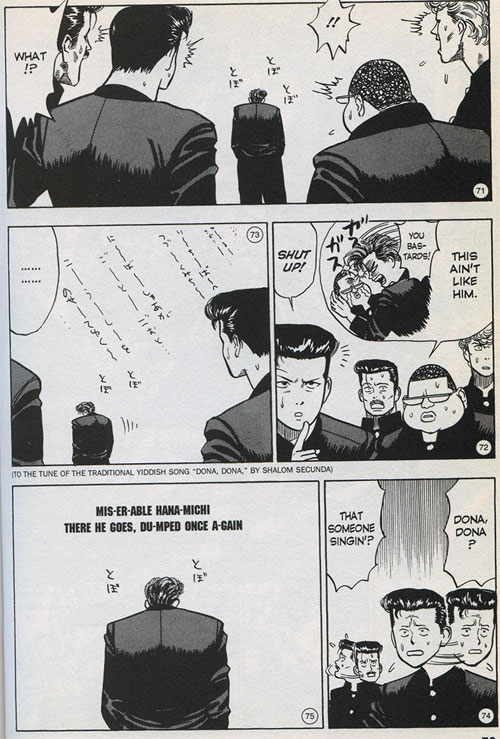
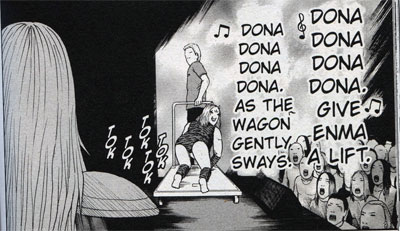
Dona Dona in manga and anime

One thing that I’ve always found a little odd the few times I’ve run across it is the occasional reference in manga and anime to the Jewish folk song “Dona Dona.” It generally is used as a shorthand way of referencing certain doom or despair for a particular character. I guess it is because this song that I’ve generally understood as a Holocaust metaphor (based on what I was told in Sunday School) is inexplicably popular in Japanese Elementary schools?

Here are a few references I’ve found, but I’m sure that there are plenty out there that I’ve forgotten or haven’t encountered yet. If you have any more please send them in and I’ll add them to the page. Thanks to ace Dona Dona spotter David Wolkin!

One of the longest and most overt references ever takes place in in Revolutionary Girl Utena, there’s a version of the song used when Nanami transforms into a cow (song kicks in at the end of the clip):

Here’s a panel from Detroit Metal City Volume 7:

And Slam Dunk Volume 1:

Do you have any Dona Dona references to share? Please let me know!

Categories
Manga Reviews

Yaoi Quick Takes from Blumanga – Cute Devil and Blood Honey

Cute Devil by Hiro Madarame

Tohru is the strong silent type. He wears glasses and serves in the student council. One day a boy with an angelic face named Fuuta asks if he’ll be his friend. Due to Fuuta’s striking looks, he’s treated like a princess by everyone at school. Fuuta pleads with Tohru with limpid watery eyes, and the two start hanging out together. While Fuuta might look like an angel, he’s actually a sexually rapacious demon and he’s picked Tohru to be his lover. I didn’t care for the story very much, because there wasn’t very time spent on character development. Also, I don’t find the fairly typical in yaoi dynamic of one character forcing himself on the other very entertaining. The chapters in the manga are all fairly similar, as Fuuta and Tohru play out the same dynamic in their relationship over and over again. That being said, Fuuta’s rapid personality shifts were funny and Madarame has some very attractive character designs.

Blood Honey by Sakyou Yozakura

Yuki is a vampire with a very sensible job of working at a blood bank. His favorite blood donor is Mayuzumi, a teacher who seems to enjoy donating blood more frequently than the average person. It turns out Mayuzumi is so hot blooded, he needs to get rid of excess blood so he doesn’t lose his temper. When Yuki is propositioned by his boss, Mayuzumi comes to his rescue and offers to give blood to Yuki for the rest of his life. Blood Honey switches the point of view for various chapters. Yuki’s featured at the start of the volume, Mayuzumi deals with temptation and his feelings for Yuki in the next, and the third story focuses on Yuki’s vampire nephew Kiri. Kiri’s a notorious playboy who keeps trying to insert himself into Mayuzumi and Yuki’s life, so they send him off to live in a temple along with a slightly corrupt priest. Yozakura’s art is simple and a bit on the cartoony side, as Mayuzumi’s temper seems to always show him overreacting to everything. I liked the linked short story format of this volume.
Review copies provided by the publisher

Categories
Manga News

Tokyopop Memories

Like most other manga fans, I was surprised to read about Tokyopop shutting down. Soliloquy in Blue has a post listing what might be the final volumes of many Tokyopop series. Here are some of the things I’ll miss about Tokyopop:

Josei

Perhaps contributing to low sales, Tokyopop was one of the few companies to publish longer josei series earlier than almost anyone else. Some of the classic josei series they published include:

Happy Mania
Tramps Like Us (Kimi Wa Petto) – One of my favorite Josei series of all time
Paradise Kiss
Suppli

Clamp

Now that Dark Horse seems to have taken over printing many of Clamp’s historic series with new translations, hopefully this means that many of these series won’t go out of print. I’m not counting on anything though, especially with the recent Dark Horse staff layoffs. Tokyopop published Cardcaptor Sakura, Tokyo Babylon, Wish, and more.

Manhwa

This is simultaneously good and bad because the glut of manhwa that Tokyopop pushed out during the boom years probably contributed a lot to financial problems later on. But I’ll always be fond of Queen’s Knight, which was the first Manhwa title I really enjoyed.

Sailor Moon
It seems weirdly cyclical that Tokyopop is shutting down just when the flagship title that touched off the manga craze in the US is going to be published by a different publisher. I previously about how stumbling across the Tokyopop editions of Sailor Moon got me interested in manga again after a long absence.

Some of my favorite completed Tokyopop series include:
Marmalade Boy
Mars
Kare Kano
Karakuri Odette
Gatcha Gacha
Planetes
Fruits Basket

Current series I’ll miss:

Skyblue Shore
Shinobi Life
Stellar Six
Alice in the Country of Hearts
Silver Diamond
VB Rose
Demon Sacred

I thought that recently Tokyopop had been picking up much more interesting shoujo titles, and I’d increased the number of series from them I was actively following. I’m sorry I won’t be able to see the conclusions of many of these series.